MAF Test: Use the 180 Formula to Track Monthly Running Pace

The MAF test tracks your running pace or cycling power at a consistent heart-rate target estimated with Phil Maffetone’s 180 Formula. Repeat a manageable course under comparable conditions and record your splits. Trends can indicate changes in submaximal performance, but the formula is a training heuristic—not a laboratory measurement of aerobic threshold or Zone 2.
TL;DR:
- Estimate a MAF heart-rate target with 180 minus age and one health/training-history adjustment: −10, −5, 0, or +5 bpm. These are Maffetone’s method rules, not universal clinical prescriptions.
- Warm up very easily for about 15 minutes, then use the same manageable distance or cycling setup and comparable heart rate each month.
- Faster pace or higher power at a comparable heart rate can indicate better submaximal performance. It does not establish your aerobic threshold, Fatmax, or VO₂max.
- Compare several tests and note weather, fatigue, illness, hydration, cardiac drift, and sensor accuracy before interpreting a change.
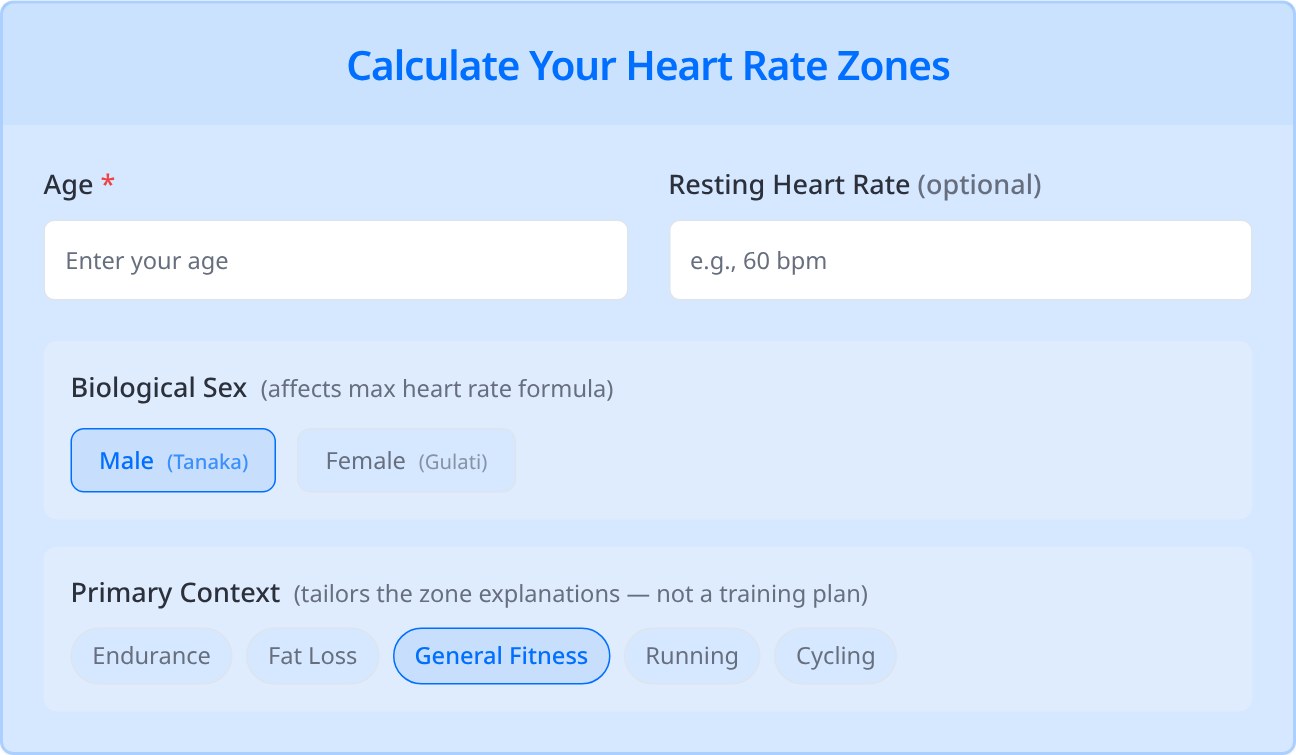
Estimate your heart rate zones for context; the calculator does not calculate a MAF target or measure aerobic threshold.
Table of Contents
- What does the MAF test actually measure?
- How do you calculate your MAF heart rate?
- How do you run the MAF test step by step?
- How do you interpret your MAF test results?
- What can throw off your MAF test results?
- What does a simple monthly testing plan look like?
- How do our calculators help with MAF testing?
- FAQ
- Sources
What does the MAF test actually measure?
The maximum aerobic function (MAF) test records how fast you run, or how much cycling power you produce, while holding a consistent heart-rate target. Under comparable conditions, faster pace or higher power can indicate improving submaximal performance.
Phil Maffetone developed the MAF test as part of his training method. A slower test is a reason to check conditions, recovery, and your log—not a diagnosis or a reliable early detector of overtraining.
The 2020 review by Maffetone and Laursen discusses possible relationships with aerobic threshold and maximum fat oxidation, but explicitly says these relationships must be verified scientifically. It is a description of the method, not independent validation of an individual’s target.
- What it measures: pace, speed, or power at the recorded heart rate during that session.
- What it can suggest: a longer-term change in submaximal performance when testing conditions are comparable.
- What it cannot prove: changes in mitochondrial function, fat oxidation, or VO₂max from one test.
- What needs separate assessment: aerobic threshold, VT1, LT1, Fatmax, and maximum fat oxidation are not measured by the 180 Formula. The same review in Frontiers in Physiology explains the proposed physiological background and limitations.
Treat the result as one useful signal among several, not a verdict on your fitness.
How do you calculate your MAF heart rate?
The MAF 180 Formula starts with 180 − age, then applies one category adjustment. It estimates a practical training target, not maximum heart rate or a validated measurement of aerobic threshold, maximum fat oxidation, lactate threshold, or Zone 2 boundaries.
The following categories come from Maffetone’s method, reproduced in Table 1 of the published MAF review:
- Subtract 10 bpm: major illness or recovery from it (including an operation or hospital stay), rehabilitation, prescribed regular medication, or chronic overtraining.
- Subtract 5 bpm: injury; regression or no improvement in training or competition; more than two colds, flu, or other infections a year; seasonal allergies or asthma; excess body fat (described as “overfat” in the method); acute overtraining; inconsistent training; or just beginning or returning to exercise.
- No adjustment: consistent training at least four times weekly for up to two years without the issues above.
- Add 5 bpm: more than two years of training without the issues above, progress in MAF tests, and improved competitive performance.
Select one category rather than stacking adjustments. These categories are Maffetone’s heuristic, not clinically validated universal heart-rate prescriptions. Do not diagnose overtraining or a medical condition from a slower test.
Worked example: at age 40, 180 − 40 = 140 bpm. Applying the −5 category gives 135 bpm. Maffetone’s published table places this at the top of a 10-bpm training range: 125–135 bpm. That range belongs to his method; it is not a measured Zone 2 boundary.
Do not apply a generic adult target blindly to children or older adults. Seek age-appropriate exercise guidance rather than inventing an age exception or treating the formula as individualized medical advice.
Safety: if you take heart-rate-altering medication or have a relevant medical condition, ask a qualified healthcare professional about suitable exercise intensity. Subtracting 10 bpm does not compensate reliably for medication effects or establish a safe target. Do not change prescribed medication to complete a test. Stop exercising for concerning symptoms such as chest pain, faintness, or unusual breathlessness.
For a different purpose, our max heart rate formula comparison explains population-based HRmax estimates. The Heart Rate Zone Calculator estimates five training zones; it does not calculate the MAF 180 Formula. The zones for a 34-year-old are an age-based example, not proof that a MAF target equals Zone 2.
How do you run the MAF test step by step?
Follow the same protocol each time so you compare like with like. A 3- to 5-mile run is a common example, not a required distance. Choose a shorter manageable distance or a fixed-duration cycling test if more appropriate; do not extend the session beyond your current ability for the sake of the test.
- Estimate your MAF heart rate using the guidance above and choose a target appropriate to your circumstances.
- Warm up very easily for about 15 minutes. Stay below your selected target and build effort gradually.
- Hold a comparable heart rate. Settle gradually near your target, ease off if it rises, and avoid surging to chase every sensor fluctuation. Slow to a walk when necessary. Record actual average heart rate and any time above target; cardiac drift can require slowing later in the test.
- Cover a fixed manageable distance or time. Use the same route or cycling setup. Treadmills and stationary bikes can support comparisons when machine, settings, calibration, and cooling are consistent. Do not compare different sports as if they were the same test.
- Record every split. Note the time for each mile or kilometer, or average cycling power for each equal-duration block.
- Log the result afterward, including total time and distance, every split, average pace or power, actual average heart rate, and the device used.
Choose a flat, uncomplicated course such as a track or flat loop. For indoor testing, use the same machine, incline or resistance, calibration, and cooling setup. Pace or power may change because of environmental conditions, equipment, or fatigue as well as fitness.
Your log is what turns a single workout into useful data. Capture these items every time:
- Date and time of day
- Weather: temperature, humidity, and wind
- Course or equipment: route, track, treadmill, or bike setup
- Shoes and equipment settings
- Heart rate device: chest strap or wrist sensor
- Target and actual average heart rate; every split, total time, and average pace or power
- Notes: sleep, stress, illness, hydration, recent hard workouts, and how you felt
Keep the same device if you can. A switch from a wrist sensor to a chest strap can shift your readings, which makes one month’s result hard to compare with the next.
How do you interpret your MAF test results?
Compare pace or power across tests only when actual heart rate and testing conditions are reasonably similar. A faster result can indicate better submaximal performance, but it does not isolate the physiological cause.
The following invented example shows a runner testing at a comparable 140 bpm over five miles. It illustrates arithmetic and trend tracking—not a typical or guaranteed rate of improvement. Every mile split is shown.
| Month | Mile 1 | Mile 2 | Mile 3 | Mile 4 | Mile 5 | Total time | Average per mile |
|---|---|---|---|---|---|---|---|
| January | 10:40 | 10:50 | 10:55 | 10:55 | 11:00 | 54:20 | 10:52 |
| February | 10:20 | 10:25 | 10:30 | 10:40 | 10:45 | 52:40 | 10:32 |
| March | 10:00 | 10:05 | 10:15 | 10:25 | 10:30 | 51:15 | 10:15 |
| April | 09:50 | 09:55 | 10:00 | 10:05 | 10:10 | 50:00 | 10:00 |
Arithmetic: January totals 54:20 (3,260 seconds); 3,260 ÷ 5 = 652 seconds = 10:52 per mile. February totals 52:40; 3,160 ÷ 5 = 632 seconds = 10:32. March totals 51:15; 3,075 ÷ 5 = 615 seconds = 10:15. April totals 50:00; 3,000 ÷ 5 = 600 seconds = 10:00. Equal-distance splits are averaged by dividing total time by five.
This example gets faster each month at the same recorded heart rate. Real results may fluctuate or remain unchanged. Neither faster splits nor less slowing across a test prove a change in mitochondrial function, fat oxidation, or VO₂max.
- Faster pace or higher power: check that conditions and actual heart rate were comparable before treating it as progress.
- Flat results: review several tests and your training log, not just one month.
- Slower results: first check heat, wind, terrain, hydration, fatigue, illness, sleep, and measurement accuracy. A slower test is not a diagnosis of overtraining.
If you suspect a temporary cause, retest only after you feel recovered and can reproduce similar conditions. Do not repeatedly test through illness or concerning symptoms. Persistent unexplained decline or symptoms warrant appropriate professional guidance. Think in trends, not single data points.
What can throw off your MAF test results?
Many things besides fitness can change your pace at a fixed heart rate. Note them before interpreting a test.
Environment. Temperature, humidity, wind, terrain, and altitude can change pace or power at a given heart rate. Heat and duration can also produce cardiac drift: heart rate rises at an unchanged workload, so holding a target may require slowing. Keep conditions as comparable as practical and record differences.
Your body on test day. Fatigue, recent illness, sleep, stress, hydration, caffeine, meals, and recent hard training can affect a comparison. Use a similar routine and test only when adequately recovered.
Equipment and accuracy. Sensor fit, a weak battery, or signal errors can distort heart rate. Different routes, treadmills, bike calibration, and cooling setups can change pace or power readings.
- Did I feel well and adequately recovered?
- Were the weather, terrain, wind, and equipment comparable?
- Did I use the same device, worn the same way?
- Were actual heart rate and splits recorded, including drift or sensor problems?
- Was recent training, sleep, and hydration similar?
Similar conditions make comparisons more useful, but they do not eliminate measurement error or normal day-to-day variation. If conditions differ substantially, label the result accordingly rather than treating it as a clean fitness comparison.
Pro Tip: Check fit, battery, and signal quality before testing. A second device or manual pulse count can help flag a gross sensor error, but neither guarantees accuracy during exercise. Moisten chest-strap electrodes if recommended by the manufacturer.
What does a simple monthly testing plan look like?
A repeatable plan is more useful than one unusually good test. Monthly testing is a practical recommendation, not a requirement or a promise of monthly improvement.
- Choose a consistent monthly time when you can test adequately recovered.
- Use the same route or machine and record conditions.
- Repeat the protocol: the same warm-up, target, and manageable distance or duration.
- Log every result: actual heart rate, all splits, total time, average pace or power, equipment, weather, and recovery notes.
- Review several tests: look for trends while checking whether conditions and heart rate stayed comparable.
If a test goes badly and conditions or recovery were different, wait until you feel well and can test under comparable conditions. Review training and recovery alongside several results rather than diagnosing a problem from a second slow session.
Review your target if your age, health, medication, or training category changes. Do not compare results at a changed target as though the test intensity were unchanged; note the change and establish a new baseline where appropriate.
Pro Tip: Keep one spreadsheet or notebook so results and their conditions remain visible together.

How do our calculators help with MAF testing?
SnapHRZones provides estimated heart rate zones for training context. These tools do not calculate your MAF target, measure aerobic threshold, or validate whether your MAF heart rate equals Zone 2.
- Zone estimates: the Heart Rate Zone Calculator estimates five zones from age and sex, with optional resting heart rate for heart-rate-reserve calculations.
- Zone 2 context: our Zone 2 heart rate page explains the estimated range; it is not interchangeable with a MAF target.
- Age-based examples: the estimated ranges for a 32-year-old or a 52-year-old illustrate the percentage-based approach, not individually measured thresholds.
Use a well-fitted heart rate monitor and a repeatable protocol to record your chosen MAF target. Set a MAF alert from the 180 Formula guidance above, not from the calculator’s Zone 2 result.
FAQ
What does MAF stand for in running?
MAF stands for maximum aerobic function, the name of Phil Maffetone’s training and testing method. The name does not mean its formula measures the highest heart rate at which aerobic metabolism occurs.
What is the MAF formula?
The MAF 180 Formula starts with 180 minus age, then applies one category adjustment: −10, −5, 0, or +5 bpm based on Maffetone’s health and training-history rules. It is a practical training heuristic, not a validated measurement of aerobic threshold, Fatmax, lactate threshold, or Zone 2.
Is 140 bpm too high for Zone 2?
You cannot establish that from heart rate alone. It depends on the individual and the zone definition or measurement method. Age-based HRmax estimates, heart-rate reserve, and laboratory threshold methods can give different ranges. A MAF target of 140 bpm is not automatically Zone 2. Our Zone 2 page provides estimated ranges, not a measurement of your individual threshold.
How often should I repeat the MAF test?
About once a month is Maffetone’s practical recommendation. Keep the route or equipment, warm-up, target, and conditions comparable, and record actual heart rate and all splits. Interpret several tests rather than expecting improvement every month. Delay testing when ill or not adequately recovered.
Sources
- What is the MAF Test? — Phil Maffetone
- Maximum Aerobic Function: Clinical Relevance, Physiological Underpinnings, and Practical Application — Maffetone and Laursen (2020)
Recommended
Find your personal heart rate zones
Enter your age to get all five training zones in seconds.
Open the heart rate zone calculator