Full-Body Strength Workouts for Runners and Triathletes
Quick answer: Cover a squat or step-up, hip hinge, push, pull, calf exercise and core exercise in one session. Start with manageable sets and controlled repetitions, leave repetitions in reserve and progress gradually around key endurance sessions. The example program is a starting option, not a universal prescription. Judge lifting intensity by load, technique and effort—not by trying to reach an endurance heart rate zone.

Full-body strength training can complement running, cycling, and swimming without requiring a separate workout for every muscle group. Start with one or two sessions per week and learn a small set of repeatable movements. Below is a practical sets-and-repetitions program, guidance on choosing a manageable load, and example weeks that protect your most important endurance sessions.
TL;DR
- Full-body strength work can support endurance performance: a 2018 meta-analysis found moderate improvements in runners, cyclists and swimmers when strength training was added to endurance training.
- Build each session around hip-dominant, knee-dominant, push, pull and core movements, with extra attention to glutes, hamstrings, calves and core.
- Begin with one or two sessions per week, separated by at least one day without lifting. Avoid unfamiliar or fatiguing leg work immediately before a key endurance session; placement depends on your schedule and recovery.
- Warm up before you lift and cool down after. Progress gradually and let recovery guide you.
- Use heart rate to help manage aerobic sessions, not to select lifting loads. During strength work, monitor technique, load, and how many controlled repetitions remain possible.
Table of Contents
- Why full-body workouts suit endurance athletes
- Choosing exercises by movement pattern
- A repeatable full-body strength program
- A sample full-body circuit
- How hard should you work?
- How often, and where it fits in your week
- Using heart rate to protect your key sessions
- Warm-up, cool-down and staying healthy
- FAQ
- Sources
Why full-body workouts suit endurance athletes
Most runners and triathletes have limited time. A full-body session covers every major muscle group in 20 to 45 minutes, so you do not need a separate leg day, back day and arm day competing with your swim, bike and run.
The research gives reasons to bother. The 2018 meta-analysis above attributed the gains to better energy cost of locomotion, maximal power and maximal force. A 2022 narrative review reports that lower-limb resistance exercise improves running economy and performance, and suggests it may help reduce the risk of running-related injuries, provided all major lower-limb muscle groups are targeted. USA Triathlon notes that resistance training improves oxygen efficiency in running and biking and supports durability.
These are findings from reviews of varied studies, not guarantees. Individual results depend on your training history, load and consistency.

Choosing exercises by movement pattern
A simple template beats a random list. Triathlete’s DIY guidance starts with soft-tissue work and mobility, then moves to core and primary strength categories: hip-dominant, knee-dominant, push and pull. Pick one or two exercises per category.
| Pattern | Example exercises |
|---|---|
| Knee-dominant | Squats, lunges, step-ups |
| Hip-dominant | Glute bridges, single-leg Romanian deadlifts |
| Lower leg | Calf raises |
| Push | Push-ups, overhead press |
| Pull | Rows, band pull-aparts |
| Core | Planks, supermans, X-chops |
World Athletics lists lunges, squats, glute bridges, hamstring leans, single-leg Romanian deadlifts, calf raises, planks and supermans for beginning runners, and advises prioritizing glutes, hamstrings, calves and core.
Triathletes should add shoulder work. USA Triathlon suggests in-season resistance training target the rotator cuff, posterior chain (glutes, hamstrings, lumbar extensors), lateral hip, quadriceps and calf complex.
A repeatable full-body strength program
This is an editorial example for generally healthy adults, not an individualized prescription or a verbatim program from a cited source. Complete the sets for each exercise before moving on. Allow about 35 to 50 minutes including warm-up and the listed rests; one set per exercise takes less time.
| Movement | Exercise | Working sets and repetitions | Rest between sets |
|---|---|---|---|
| Knee-dominant | Goblet squat or supported sit-to-stand | 2 × 8–10 | 2 minutes |
| Hip hinge | Dumbbell Romanian deadlift; glute bridge while learning | 2 × 8–10 | 2 minutes |
| Push | Incline push-up or dumbbell floor press | 2 × 8–12 | 90 seconds |
| Pull | Supported dumbbell row or securely anchored band row | 2 × 8–12 per side | 90 seconds |
| Lower leg | Supported calf raise | 2 × 10–15 | 60–90 seconds |
| Trunk control | Dead bug | 2 × 6–8 controlled repetitions per side | 60 seconds |
Use a comfortable, controlled range of motion. Rest longer if technique requires it. Repeat the program for a second weekly session or substitute a low step-up for the squat. Do not automatically add the timed circuit on top.
Progress without overwhelming endurance training
- First two weeks: New lifters can begin with one working set per exercise and one weekly session. Add a second session only if soreness and fatigue are manageable.
- Build consistency: Move toward two sets before adding more exercises.
- Add repetitions first: Keep the load unchanged until you reach the top of the range on every set with good technique and two or three repetitions in reserve on two consecutive sessions.
- Then add load: Use the smallest practical increase and return to the lower repetition range. Keep the old load if technique worsens.
- Experienced lifters: A familiar squat or hinge may instead use 3 sets of 5–6 repetitions with 2–3 minutes of rest. Keep accessories as listed. This is an alternative, not extra work.
- Fatigued weeks: Reduce two sets to one, remove the second weekly session or skip lifting. Do not increase endurance volume and lifting load simultaneously.
Record load, repetitions and repetitions in reserve. If soreness changes your running stride or swimming technique, reduce the next session. Stop for sharp pain; persistent pain or unusual symptoms warrant professional assessment.
A sample full-body circuit
This circuit comes from a 30-minute routine published by Triathlete. Do three rounds of six exercises:
- Lunge to clean and press
- X-chop
- Step-ups
- Supine knee drive
- Elbow-hand walk-ups
- Three-way jumps
Treat this timed circuit as an optional conditioning format, not the default strength program below. Long work intervals and short rests can make breathing the limiting factor before the target muscles receive an appropriate strength stimulus. Clean-and-press movements and jumps also require technique and landing control; beginners can choose the simpler exercises in the sets-and-repetitions program instead.
No gym? Use a backpack or a single dumbbell for the clean and press and step-ups on a sturdy stair. If you are new to jumping, start with small, controlled hops or skip the jumps for a few weeks.
A runner’s alternative circuit
Runner’s World suggests circuit training with 45 seconds per exercise and 15 to 20 seconds of rest, for 2 to 3 sets. You could use squats, reverse lunges, glute bridges, planks, calf raises and push-ups. That is our example selection, built from the movements above.
How hard should you work?
Choose a load that lets you complete the prescribed repetitions with controlled technique and about two or three repetitions in reserve: you could do another two or three good repetitions if necessary. During the first few sessions, leave more room while learning the movements. Stop a set when technique deteriorates rather than chasing exhaustion.
Adjust strength training to your experience and current endurance demands rather than following a universal seasonal percentage chart. A recovery week should reduce total training stress, not automatically introduce heavier lifting. Ironman is an additional coaching resource, but the starter program here does not require testing a one-repetition maximum. More experienced lifters can use heavier loads with fewer repetitions when technique and recovery support them.

The retained illustration shows seasonal load examples, not this article’s prescription. Its heavier off-season or de-load percentages should not be read as advice to increase lifting load during a recovery week. Use experience, technique and total workload to guide adjustments.
The 2022 review identifies isometric training as a possible option during periods of high overall training load, not a proven recovery shortcut. If you are struggling to recover, first reduce strength volume or skip a session; replacing every exercise with a hold does not necessarily reduce fatigue.
How often, and where it fits in your week
The published suggestions point to a similar range:
- Runner’s World: 2 to 3 sessions per week on non-running days.
- Mark Allen: a foundational triathlon strength program twice weekly year-round, about 45 minutes, with at least one day between sessions.
- USA Triathlon: 1 to 2 sessions of 20 to 30 minutes per week in season.
Start at the low end. One or two sessions is enough to learn the movements without wrecking your run training.
Placement around swim, bike and run
Ironman advises treating strength as a support session: slot it on easy or non-key days, and avoid fatiguing lifting immediately before a key long run, ride or brick workout. USA Triathlon adds that it takes intentional planning so it helps rather than hinders your primary training.
A sample week for a runner might look like this:
| Day | Session |
|---|---|
| Mon | Easy run |
| Tue | Intervals or tempo |
| Wed | Full-body strength |
| Thu | Easy run |
| Fri | Rest or easy cross-training |
| Sat | Long run |
| Sun | Full-body strength (light) or rest |
This is an illustration, not a prescription. Move things around so the day before a key workout is easy.
Examples with two strength sessions
No single placement suits everyone. Some athletes lift after a key endurance workout to preserve easy days; others tolerate separate easy-day lifting better. Complete the priority session first and separate sessions by several hours when practical. Do not force a second lift into a week that already exceeds your recovery capacity.
| Day | Runner example | Triathlete example |
|---|---|---|
| Monday | Rest or easy run | Easy technique swim or rest |
| Tuesday | Key run; strength later if recovered | Key bike; strength later if recovered |
| Wednesday | Easy run | Easy run and optional easy swim |
| Thursday | Easy run; second strength session | Run workout; shorter strength later if tolerated |
| Friday | Rest or short easy run | Rest or easy swim |
| Saturday | Long run | Long ride with optional planned brick |
| Sunday | Rest or easy recovery activity | Long easy run only if recovered; otherwise shorten or rest |
These are scheduling examples, not complete race plans. Beginners can use Tuesday only. If Thursday lifting compromises Saturday, reduce or remove it. Avoid new exercises and reduce strength volume during race week or a substantial endurance build.
Using heart rate to protect your key sessions
Strength work does not need heart rate targets the way a steady run does, but your easy days do. If a lifting session leaves you so tired that your easy run drifts into moderate effort, the easy day has stopped being easy. Our guide to heart rate zones for strength training explains what your pulse does during lifting and circuits. For the runs around them, see heart rate zones for running. If you add hard intervals, our page on interval training heart rate covers work and recovery targets.
Heart rate reflects cardiovascular demand, not how heavy a load is relative to your strength. Heavy sets with long rests may produce a lower average pulse than light circuits with short rests. Breathing, static contractions and wrist movement complicate interpretation. Do not shorten rests or add repetitions just to reach an endurance zone. Use load, technique and repetitions in reserve to judge strength intensity.
SnapHRZones offers a free heart rate zone calculator with gender-specific formulas and an optional resting heart rate input, so your zones can be more personal than a single age-based number. Treat any estimate as a starting point and adjust to how you feel.
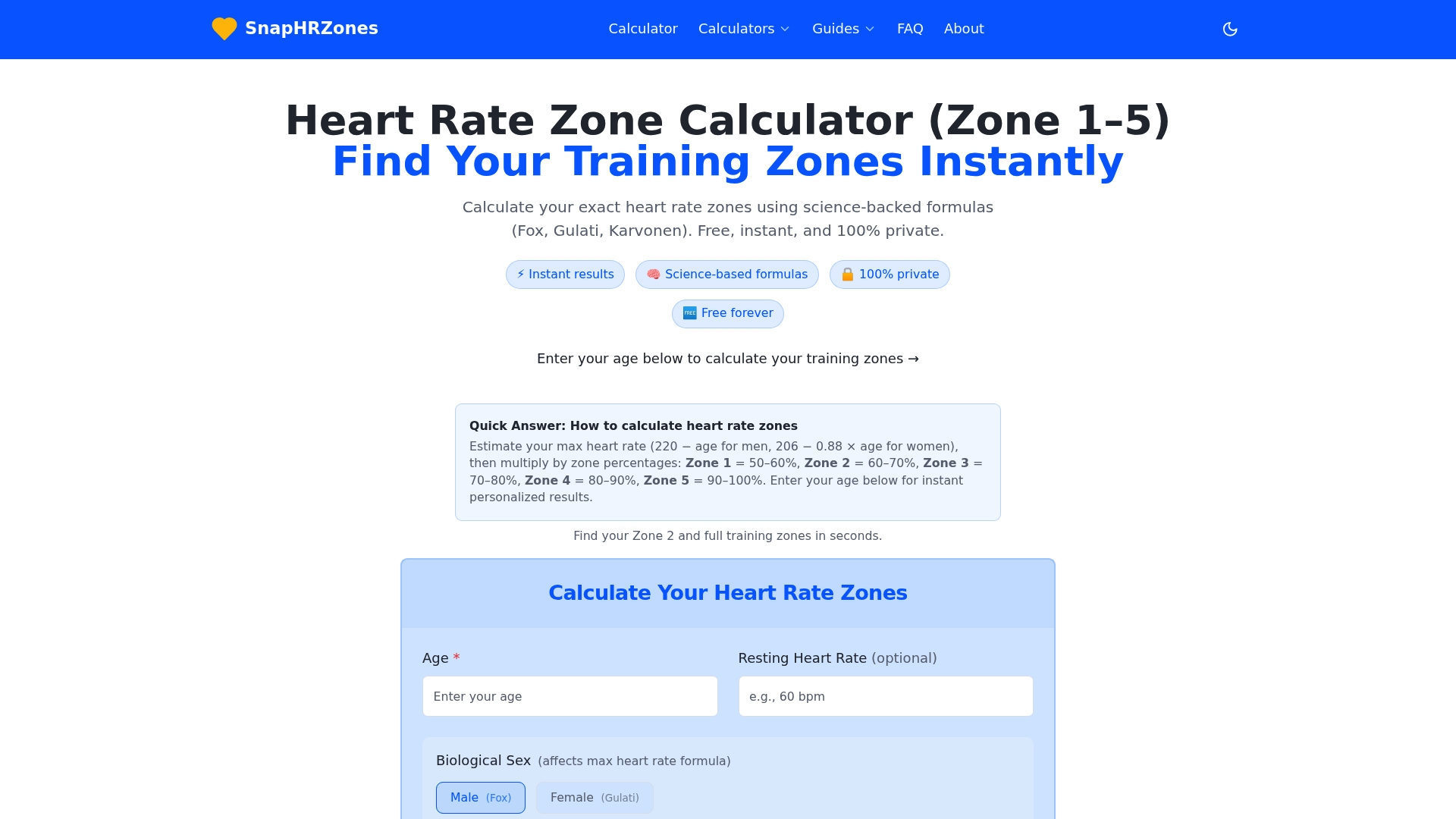
If you want a Zone 2 range for your easy days, try the Zone 2 heart rate calculator.
Warm-up, cool-down and staying healthy
Begin with about five minutes of easy movement, then rehearse the planned exercises with bodyweight or light resistance. Before a loaded squat or hinge, add one or two lighter practice sets. An easy cool-down is optional for comfort; it does not guarantee prevention of soreness or injury.
Progress one variable at a time: add a set, a few reps or a little load, not all at once. If a joint hurts (as opposed to muscle fatigue), stop and see a physician or physical therapist, particularly if you have a past injury or a medical condition.
FAQ
Do runners and triathletes really need strength training?
Evidence suggests it helps. A 2018 meta-analysis found moderate performance improvements in runners, cyclists and swimmers, and USA Triathlon calls it non-negotiable for triathletes. Results vary by athlete, so start small and track how you respond.
How many full-body workouts a week should I do?
Published recommendations range from one or two sessions in season to two or three for runners on non-running days. Keep at least one day between sessions and start at the low end.
Can I do a full-body workout at home?
Yes. Squats, lunges, step-ups, glute bridges, planks, push-ups and supermans need little or no equipment. Add a backpack or dumbbell for resistance once the movements feel easy.
Should I lift before a long run or ride?
Avoid unfamiliar or fatiguing leg lifting immediately before a long run, ride or brick. Place it where it least disrupts priority sessions, and reduce or omit it when recovery is limited.
Sources
- Strength Training for Middle- and Long-Distance Performance (IJSPP, 2018)
- Resistance Exercise for Improving Running Economy and Performance (PMC, 2022)
- Strength Training for Triathletes: Why It’s Non-Negotiable (USA Triathlon)
- Strength & conditioning for beginners (World Athletics)
- A 30-Minute Full-Body Strength Routine for Triathletes (Triathlete)
- Ask a Trainer: DIY Strength Training Program (Triathlete)
- Full-Body Circuit Workout (Runner’s World)
- Mark Allen’s 12 Best Strength Exercises (ACTIVE.com)
- Strength Training for Triathletes: 2 Simple Circuits (Ironman)
Recommended
Find your personal heart rate zones
Enter your age to get all five training zones in seconds.
Open the heart rate zone calculator