High Heart Rate on Slow Runs? 4 Checks Before You Change Pace

A high heart rate during an easy run is usually explained by cardiac drift, heat, dehydration, poor sleep or stress, an outdated max heart rate estimate, or a sensor glitch, and most of these causes are reversible once you spot them. The exception is a short list of red flags, including chest pain, fainting, or severe shortness of breath, which call for emergency or prompt medical attention rather than a pace adjustment. The sections below walk through quick checks and fixes you can use on your next run.
TL;DR:
- Age-based maximum heart rate formulas are population estimates; their typical error is several beats per minute, and an individual can be off by more. Compare your zones with how the effort feels and the talk test.
- Over a long, steady run, cardiovascular drift can raise heart rate gradually, more so in heat; how much varies between people and conditions. Hydration and walk breaks may reduce it.
- For a suspicious wrist reading, compare it with a chest strap or a manual pulse count; a large, repeated mismatch suggests a sensor problem.
- Chest pain, fainting or severe breathlessness are emergencies: stop and call your local emergency number. A heart rate that stays unexpectedly high at easy effort, or prolonged irregular palpitations, warrants a medical check.
Table of Contents
- Establishing Your Baseline: Resting Heart Rate, Max Heart Rate, and Zone Accuracy
- Common Temporary and Physiological Causes
- Cardiovascular Drift: Why Your Heart Rate Climbs Even at the Same Pace
- Wearables and Measurement Errors: Is the Number Even Real?
- Immediate Field Fixes: Pacing, Hydration, Cooling, and the Talk Test
- When to Seek Medical Help and What Tests to Expect
- How to Validate or Recalibrate Your Zones
- Hydration Status and Electrolyte Balance Go Beyond Just Drinking Water
- Altitude and Elevation Changes Can Push Your Heart Rate Up at the Same Effort
- Body Composition and Weight Can Influence Heart Rate at Low Intensities
- Recent Meals and Blood Sugar Swings Affect Heart Rate Too
- Anxiety and Excitement Raise Heart Rate Before You’ve Taken a Step
- Treadmill, Bike, and Outdoor Running Don’t Always Produce the Same Heart Rate
- Recalculate Your Zones in Minutes With SnapHRZones
- FAQ
- Sources
Establishing Your Baseline: Resting Heart Rate, Max Heart Rate, and Zone Accuracy
Before you can call a number “too high,” you need a baseline that actually reflects your physiology. Resting heart rate (RHR) is the easiest place to start: measure it first thing in the morning, before you sit up or check your phone, ideally with a chest strap or a validated app over a few consecutive days. A single reading can be thrown off by how well you slept or whether you were startled awake, so an average over several mornings gives a steadier number.
Maximum heart rate is trickier, and this is where a lot of runners get misled. A common age-based formula was built from population averages, and individual max heart rates can land well above or below what the equation predicts, which means every zone calculated from it shifts too. A runner whose real max heart rate is higher than the formula suggests may see “easy” efforts register as uncomfortably high on a watch, when the effort itself is perfectly reasonable.
A few practical checks help close that gap:
- Compare your watch’s HR reading against the talk test: if you can speak in full sentences, the effort is genuinely easy regardless of what the number says.
- Cross-reference perceived exertion (RPE) with your heart rate reading over several runs.
- Max heart rate formulas give population-based estimates, not your exact value. An actual maximum heart rate measurement may require professionally supervised exercise testing; unsupervised all-out efforts are not recommended. For everyday easy running, estimated zones combined with the talk test and perceived effort are enough.
- Log the same route, time of day, and rough weather conditions across multiple runs to see whether the high reading is consistent or situational.
Common Temporary and Physiological Causes
Most elevated heart rates during slow running trace back to a handful of everyday factors, and working through them in order usually turns up the culprit quickly.
Heat and humidity are among the most common. When your body needs to dump heat, blood flow shifts toward the skin for cooling, which leaves less blood returning to the heart per beat and pushes heart rate up to compensate. Dehydration compounds this: losing fluid reduces blood volume, which lowers stroke volume (the amount of blood pumped per heartbeat) and forces your heart to beat faster to maintain the same output.
Lifestyle factors matter just as much. Poor sleep, psychological stress, and stimulants like caffeine or nicotine all increase sympathetic nervous system activity, the “fight or flight” signaling that raises heart rate independent of how hard you’re actually working. Alcohol and certain over-the-counter cold or asthma medications are also common, often overlooked, triggers for a higher-than-usual heart rate during exercise, according to Harvard Health.
A few other physiological factors are worth ruling out, especially if the high readings persist across multiple runs:
- Anemia or low iron reduces the blood’s oxygen-carrying capacity, so the heart compensates by beating faster, often alongside fatigue or unusual paleness.
- An overactive thyroid raises baseline metabolic demand, which can elevate resting and exercise heart rate together with unexplained weight change or persistent restlessness.
- A recent viral illness, including COVID-19, can leave lingering autonomic effects that mimic POTS (postural orthostatic tachycardia syndrome) symptoms, where heart rate spikes disproportionately to effort.
- New or returning runners frequently misjudge what “easy” should feel like relative to their current aerobic base, so the pace itself may be harder than it seems even though it feels slow.
Pro Tip: Alcohol, nicotine, and some over-the-counter cold or asthma medications are common, often-overlooked, non-exercise triggers for an elevated running heart rate.
Sinus tachycardia, the technical term for a normal exercise-driven rise in heart rate, is the most likely explanation for many of these cases and is usually not a sign of heart disease on its own, according to UH Hospitals. It can also be driven by an underlying condition such as anemia or an overactive thyroid, which is why persistent, unexplained high readings deserve a check.
Cardiovascular Drift: Why Your Heart Rate Climbs Even at the Same Pace
Cardiovascular drift describes the gradual upward creep in heart rate that happens even when your pace and effort stay constant. The mechanism is straightforward: as a run continues, fluid shifts and blood flow redirected toward the skin for cooling both reduce stroke volume, and your heart beats faster to keep cardiac output steady.

Drift can start appearing during sustained effort. In one heat-stress study of simulated moderate occupational work (not running) in a hot room, heart rate rose by roughly 17%, about 18 beats per minute, between 15 and 105 minutes, while stroke volume fell by a comparable margin. That is one small study under specific conditions, not a typical figure for every run. Cardiovascular drift is a recognized, normal response to prolonged exercise; its size varies with duration, heat, humidity, hydration and fitness.
A few things worth knowing about drift:
- It happens even at a truly easy, unchanged pace, so a rising number alone does not mean you are working harder.
- Staying hydrated and pacing conservatively from the start can blunt the size of the drift, though they do not always eliminate it entirely.
- Breaking a long effort into structured work-to-rest intervals also appears to reduce cumulative cardiovascular strain in heat.
If your heart rate climbs steadily over the back half of a run while your pace and breathing feel unchanged, drift is a far more likely explanation than something being wrong.
Wearables and Measurement Errors: Is the Number Even Real?
Before chasing a physiological explanation, it’s worth asking whether the reading itself is accurate. Optical wrist sensors, the kind built into most running watches, are notoriously prone to noise, especially in the first few minutes of a run, when the strap is loose, when skin is cold, or over tattooed skin. A common failure mode called cadence lock also occurs, where the sensor mistakenly tracks your arm swing or footstrike rhythm instead of your actual pulse.
Chest straps and validated phone ECG apps are considerably more reliable for short comparisons, since they read electrical signals directly rather than inferring pulse from light absorption through skin.
A simple field check:
- Stop briefly and take your pulse manually at the wrist or neck, then calculate your heart rate.
- Compare that number against what your watch displayed at the same moment.
- Manual counts are themselves imprecise, especially right after you stop, because heart rate starts dropping within seconds. A small difference proves nothing; a large mismatch that repeats, or a reading that jumps to match your cadence, points to the sensor. A chest strap is the better comparison.
Pro Tip: If a high reading appears only at the start of a run and then settles, it’s more likely a sensor warm-up glitch than a real physiological spike.
Immediate Field Fixes: Pacing, Hydration, Cooling, and the Talk Test
When your heart rate looks too high mid-run, a few simple adjustments usually bring it back in line, and they double as a way to tell whether the rise is transient or worth paying closer attention to.
- Slow down further than your usual easy pace feels like it should require, and don’t hesitate to add short walk breaks, especially early in a run.
- Switch your primary gauge from the number on your wrist to the talk test or a simple RPE scale for the rest of that session.
- Hydrate before and during the run, and on hot or humid days, seek shade, wear a hat, or use a wet sponge or bandana to cool your neck and wrists.
- Reschedule hard or long efforts to cooler parts of the day when possible, and treat a hot, humid run as an automatic pace adjustment rather than a target to hit.
- Skip caffeine and high-stimulant pre-workout supplements before easy runs, since both increase heart rate independent of effort.
- Prioritize sleep and build in recovery days, since accumulated fatigue and stress both raise baseline heart rate.
- If the elevated reading shows up across several controlled runs despite these adjustments, start logging symptoms, timing, and conditions, and consider bringing that log to a primary care visit.
Pro Tip: Treat RPE and the talk test as your primary intensity gauge on any day your heart rate looks unusually high. Let the number catch up to how you actually feel rather than the other way around.
When to Seek Medical Help and What Tests to Expect
Most exercise-related heart rate elevation is sinus tachycardia, a normal and benign response to physical demand, heat, or stress. That said, certain symptoms shift the situation from “adjust your run” to “get checked promptly.”
Stop exercising and call your local emergency number (for example 911 in the US and Canada, 999 in the UK, 112 across Europe, 000 in Australia) for:
- Chest pain or pressure during or after exercise.
- Fainting or a near-fainting sensation.
- Sudden, severe shortness of breath out of proportion to effort.
- Palpitations that feel irregular and persist, especially alongside any of the symptoms above.
Arrange a prompt (non-emergency) medical check if your heart rate stays unexpectedly high at easy effort across several runs after ruling out heat, sleep, stimulants and sensor error, if it jumps suddenly and stays high rather than climbing gradually, or if you notice new palpitations, unusual breathlessness or dizziness.
According to the American Heart Association, palpitations lasting minutes to hours or occurring with new symptoms like chest pain or dizziness are considered a serious medical problem that warrants prompt evaluation, even though outpatient rhythm monitoring sometimes finds no electrical abnormality at all.
A reasonable first-line medical workup typically includes an ECG to check heart rhythm, a complete blood count to screen for anemia, a TSH test for thyroid function, and basic electrolyte panels. Persistent palpitations sometimes warrant an ambulatory rhythm monitor worn over several days. Causes behind pathological tachycardia can include anemia, dehydration, thyroid disease, and certain medications, according to the American Heart Association, and anyone with known cardiac disease or significant risk factors should loop in a cardiologist earlier rather than later.
How to Validate or Recalibrate Your Zones
If your heart rate consistently reads high on easy runs even after ruling out heat, dehydration, and sensor issues, your zones themselves may be the problem rather than your body.
- Log your morning resting heart rate for several consecutive days and use that real number in a personalized calculator rather than defaulting to an age-only formula.
- Cross-check your zone placement against the talk test and RPE over a few sessions. If you need a measured maximum heart rate, ask about professionally supervised exercise testing rather than doing an unsupervised all-out effort.
- Field HR measurement methods, including wearable sensors and standard max-HR equations, carry known margins of error, with max-HR equations showing a standard error of roughly 3 to 12 beats per minute according to ACSM. A standard error describes typical scatter, so an individual estimate can be off by more, which is enough to shift your zones.
A calculator that factors in resting heart rate and sex, rather than age alone, produces more personalized Zone 2 and Zone 3 estimates, which matters most for runners whose easy pace keeps reading as uncomfortably hard.
Hydration Status and Electrolyte Balance Go Beyond Just Drinking Water
Dehydration is only part of the story. Losing fluid through sweat also strips out electrolytes, primarily sodium, potassium, and magnesium, which play a direct role in how efficiently your heart muscle contracts and how nerve signals regulate rhythm. When sodium losses run high, especially on long or hot runs, the resulting imbalance can contribute to a disproportionate heart rate response even when you’ve been drinking water steadily.
On long or hot runs, fluid loss can reduce blood volume. With less blood returning to the heart, each beat pumps a little less, so heart rate tends to rise to keep up, and core temperature can climb alongside it. Simply drinking plain water without replacing electrolytes can, in some cases, dilute remaining sodium levels further rather than correcting the underlying issue.
For longer runs, especially in heat, consider your fluid and electrolyte needs. An electrolyte drink or tablet may suit some runners, but individual needs vary. Shorter, cooler runs rarely require anything beyond normal fluid intake. If you notice cramping, unusual fatigue, or a racing heart rate on runs where you believed you were well hydrated, electrolyte balance is worth considering alongside total fluid intake.
Altitude and Elevation Changes Can Push Your Heart Rate Up at the Same Effort
Running at altitude, or even gaining meaningful elevation mid-run, reduces the amount of oxygen available per breath. Your body responds by increasing heart rate to circulate the available oxygen more quickly, which means the same easy pace that felt comfortable at sea level can produce a noticeably higher heart rate once you’re climbing or running somewhere higher than you’re used to.
This effect tends to be more pronounced in the first few days after arriving somewhere new in elevation, before partial acclimatization sets in. Even modest hill sections within a normally flat route can cause a temporary spike that settles once you’re back on level ground, which is a different pattern from a sustained, run-long elevation in heart rate.
If you travel to a higher-altitude destination for a race or training block, expect your heart rate to run higher than usual for the same perceived effort during the first several days, and consider leaning on RPE and the talk test rather than your usual heart rate targets until your body adjusts.
Body Composition and Weight Can Influence Heart Rate at Low Intensities
Carrying additional body weight, particularly from fat mass rather than lean muscle, generally requires more cardiovascular work to move the body at any given pace, since the heart and circulatory system are supporting a larger total mass. This can mean a higher heart rate at the same pace compared to someone lighter, even when both runners are working at a similar relative effort.
This isn’t a simple cause for concern on its own. Relative effort, how hard a given pace feels for your current fitness and body composition, is what actually matters for training purposes, not an absolute heart rate number compared against someone else’s. A heavier runner’s “easy” heart rate may sit higher in absolute terms while still representing genuinely easy, aerobic effort within their own zones.
Changes in body composition over time, whether through added training volume or intentional weight changes, often shift what a given pace costs in heart rate terms, which is one more reason periodic zone recalibration is useful rather than relying on numbers set months or years ago.
Recent Meals and Blood Sugar Swings Affect Heart Rate Too
Digestion itself places a modest demand on the cardiovascular system, since blood flow is temporarily directed toward the digestive tract after eating. Running soon after a large meal can nudge heart rate upward simply because your heart is managing two competing demands at once.
Blood sugar swings play a role as well. A rapid rise in blood sugar after a high-sugar meal followed by a subsequent drop can trigger a release of adrenaline as your body works to stabilize glucose levels, and adrenaline directly raises heart rate. Running on very low blood sugar, such as after skipping a meal, can produce a similar stimulant-like effect, since your body perceives low glucose as a stressor.
Spacing a run after a balanced meal, with a mix of carbohydrates and protein, may help limit these swings compared to running immediately after eating or on an empty stomach for longer efforts. If you’ve noticed your heart rate runs unusually high on days following a particular meal pattern, that timing is worth tracking alongside your usual training log.
Anxiety and Excitement Raise Heart Rate Before You’ve Taken a Step
Psychological state has a direct, measurable effect on heart rate independent of physical effort. Anxiety, pre-race nerves, or even simple excitement about a run activate the same sympathetic nervous system response that physical exertion does, which means your heart rate can already be elevated before you start moving.
This is particularly common on race mornings or at the start of a new training block, when anticipation alone produces a resting heart rate noticeably above your normal baseline. The effect typically fades once the run settles into a rhythm, though in some runners it contributes to a heart rate that reads high for the entire easy effort, especially if the underlying stress doesn’t fully resolve.
Recognizing this pattern matters because it’s easy to mistake an anxiety-driven elevated reading for a sign that your pace is too hard or that something is physiologically wrong. If your heart rate runs high specifically before and during stressful or high-stakes runs, but normal on relaxed, routine efforts at the same pace, psychological state is the more likely explanation than a physical one.
Treadmill, Bike, and Outdoor Running Don’t Always Produce the Same Heart Rate
Heart rate responses can differ meaningfully across cardio equipment and environments, even at a similar perceived effort. Treadmill and outdoor heart rate at the same pace can differ in either direction. On a flat treadmill there is no air resistance or variable terrain, which can lower the energy cost slightly, while warm, poorly ventilated rooms, treadmill calibration and changes in running mechanics can push heart rate up. There is no fixed adjustment; compare by effort and heart rate on your own runs.
Stationary bikes and ellipticals often produce a different heart rate than running at a comparable RPE, by an amount that varies from person to person. This is why cross-training heart rate numbers rarely translate directly to running zones; the same bpm figure can represent meaningfully different relative efforts across equipment types.
If you train across multiple modalities, it’s more useful to calibrate perceived effort and talk-test comfort separately for each one rather than assuming your running zones apply directly to a bike or treadmill session.
Recalculate Your Zones in Minutes With SnapHRZones
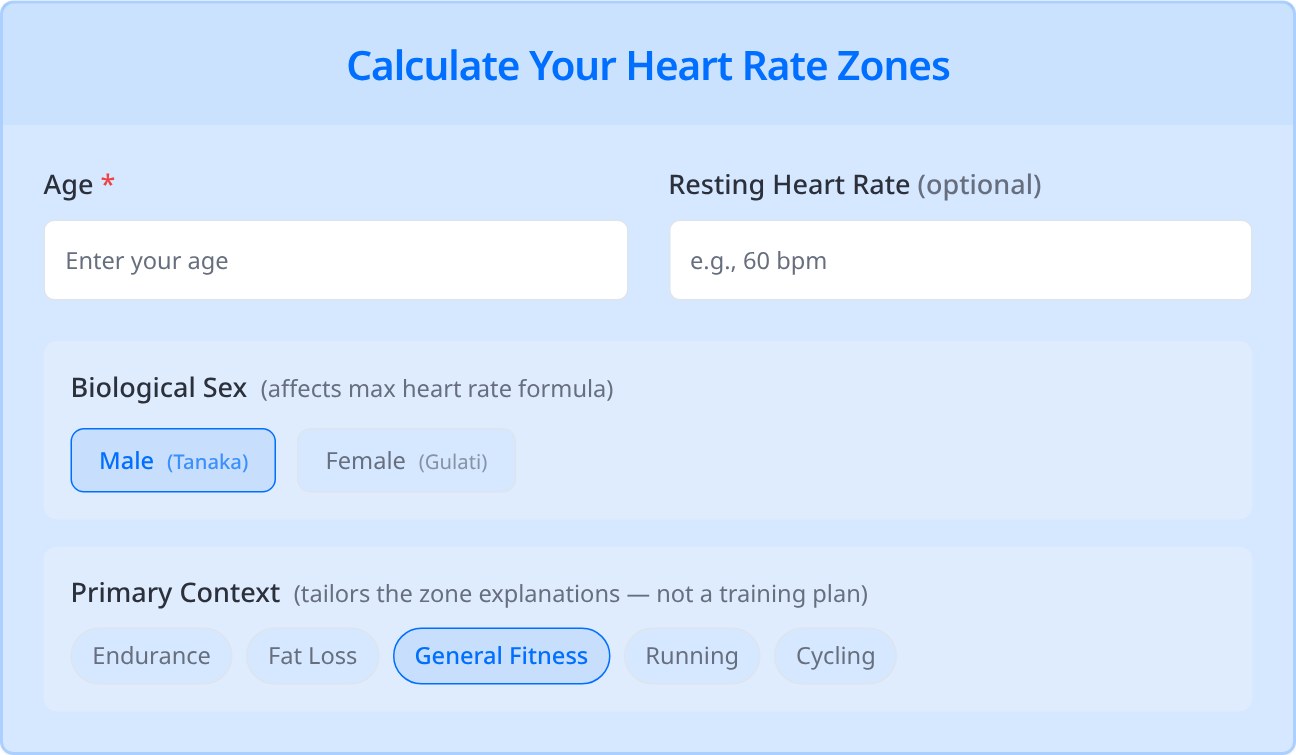
Working through heat, drift, hydration, and sensor checks only gets you so far if the zones you’re comparing against were never personalized in the first place. Our Heart Rate Zone Calculator estimates your training zones from your age and sex (Tanaka for men, Gulati for women), with optional resting heart rate input. The results are estimates, not measured thresholds.
- Enter your age, sex, and resting heart rate for a more personalized zone estimate than age alone.
- Use the resulting Zone 2 range as your target, then confirm it feels right with the talk test over your next few easy runs.
- Revisit the numbers periodically as your fitness, body composition, or training load shifts.
| What you get | Why it helps |
|---|---|
| Gender-specific HRmax formula | Offers an alternative to age-only equations |
| Optional resting HR input | Adds resting heart rate to the calculation |
| Instant results | Provides your calculation when you need it |
If you’ve already pinned down your Zone 2 range and want the full picture, our Zone 2 heart rate guide walks through how to apply it to your training.
This article is general information, not a substitute for advice from a qualified doctor. Consult a qualified healthcare professional about your own circumstances before acting on anything here.
FAQ
Is a Heart Rate of 170 Bad While Running?
A particular heart rate during running is not inherently bad. It depends on your age, fitness level, and personalized max heart rate, since the same number can represent an easy effort for one runner and a near-maximal one for another. Cross-check it against the talk test and how you feel. A high number on an easy run is usually a sensor glitch, heat, fatigue or a harder pace than intended; a reading that stays unexpectedly high at easy effort, or comes with symptoms, deserves a medical check rather than an assumption that your max is simply high.
Is a 210 Heart Rate Bad When Running?
210 bpm is above the estimated maximum for most adults, so on an easy or moderate run it is most often a sensor error (for example cadence lock on a wrist sensor). Check with a chest strap. If a chest strap or ECG confirms it, or it comes with palpitations, dizziness or breathlessness, stop and get medical assessment; a sudden jump to a very high rate that stays there can be an arrhythmia rather than normal exercise. Chest pain or fainting is an emergency: call your local emergency number.
Is a 190 Heart Rate Bad When Jogging?
A high heart rate while jogging suggests either a genuinely harder effort than intended, significant heat or dehydration strain, or a max heart rate estimate that doesn’t match your real physiology. It can also be a sensor error. Use the talk test to check whether the effort actually feels that hard, verify with a chest strap, and do not assume a very high easy-run reading is fine just because some people have a high maximum. If it persists at easy effort or comes with symptoms, get it checked.
Is 200 bpm While Running Too High?
For most adults 200 bpm is at or above estimated maximum, so it is not an expected reading on an easy run. Stop and walk, then check the sensor against a chest strap and consider heat or dehydration. If the reading is confirmed, recurs at easy effort, or starts suddenly and stays high, get medical assessment. Chest pain, fainting or severe shortness of breath is an emergency: call your local emergency number.
Sources
- Uhhospitals
- Health
- Effect of Work-to-Rest Cycles on Cardiovascular Strain and Maximal Oxygen Uptake during Heat Stress
- How serious are heart palpitations? Causes, symptoms and when to worry | American Heart Association
Recommended
Find your personal heart rate zones
Enter your age to get all five training zones in seconds.
Open the heart rate zone calculator