Zone 5 Training: VO2max Intervals, Workouts & Heart Rate
Quick answer: In a common five-zone model, Zone 5 is roughly 90–100% of maximum heart rate and represents very high-intensity work. It often overlaps with VO2max-focused interval training, but Zone 5 heart rate and VO2max are not the same measurement. Longer intervals of about 2–5 minutes are commonly used because oxygen uptake needs time to rise, while pace, power and perceived effort can be more useful than heart rate early in each interval.

Zone 5 is the very-high-intensity top of a common five-zone heart-rate chart, and it is often where VO2max-focused intervals end up. But a Zone 5 heart rate and VO2max are not the same thing, and because heart rate rises with a delay, it is an imperfect guide during short hard efforts. This guide explains the difference and how hard interval sessions are commonly structured.
TL;DR:
- In a common five-zone model, Zone 5 is roughly 90–100% of maximum heart rate — a convention, not a universal definition.
- Zone 5 is a heart-rate label; VO2max is maximal oxygen uptake. They often overlap during hard intervals but are not interchangeable.
- A 2026 meta-analysis found that work intervals of 2 minutes or longer produced more time near VO2max than shorter intervals.
- Heart rate responds with a delay during rapid changes in intensity, so pace, power and perceived effort are useful alongside it.
- Most endurance training should not be Zone 5; hard sessions need recovery around them.
- Stop and seek medical advice if you develop chest pain, fainting, unusual shortness of breath or concerning palpitations.
Table of Contents
- What is Zone 5?
- Zone 5 vs VO2max: not the same measurement
- What the research says about interval length
- Why heart rate is imperfect for short hard intervals
- How often to train in Zone 5
- Example VO2max-style sessions
- Recovery around hard sessions
- Safety
- Estimate your Zone 5 range
- FAQ
- Sources
What is Zone 5?
In a common five-zone heart-rate model, Zone 5 is roughly 90 to 100% of maximum heart rate, a range Harvard Health describes as very high intensity. Other zone systems draw the boundaries differently, so treat the percentage as a convention rather than a fixed physiological line. For how the full five-zone model fits together, see Heart Rate Zones Explained.
Zone 5 is also very different from moderate tempo work. If you want the contrast with sustained, moderately hard efforts, see Zone 3 training; Zone 3 is steady tempo, while Zone 5 is short, very hard intervals with recovery between them.
Zone 5 vs VO2max: not the same measurement
Several different ideas often get blurred together:
- Zone 5 is a heart-rate-zone label in one common five-zone model.
- VO2max is maximal oxygen uptake — the highest rate at which your body can take up and use oxygen.
- Time near VO2max (often measured as time above 90% of VO2max) is a laboratory measure of oxygen uptake during a session.
- Maximal effort is how hard you are trying, which is not the same as how much oxygen you are using.
Because heart rate rises with a delay, you can already be doing a VO2max-focused interval before your heart rate reaches Zone 5. And being above 90% of maximum heart rate does not prove you are above 90% of VO2max. An all-out sprint is also not automatically a better VO2max interval: a very short sprint can end before oxygen uptake has had time to rise, while a well-paced interval of a few minutes gives it time to climb and stay high.
What the research says about interval length
A 2026 systematic review and meta-analysis of 86 studies and 239 HIIT protocols found that work intervals of 2 minutes or longer produced more time at or near VO2max than shorter protocols. Variable-intensity work intervals produced more time near VO2max than even-paced ones, while the recovery mode itself did not show a clear effect.
An important limitation: the review states that the dose-response relationship between time near VO2max and long-term training adaptation still requires further investigation. Time spent near VO2max is commonly used as a marker of the acute physiological stimulus of HIIT, but more time in that range does not automatically guarantee greater long-term improvement. Some interval studies use accumulated time near VO2max as a session metric, but there is no universal minimum number of minutes that guarantees improvement.
A study published in 2025 illustrates why heart rate and oxygen uptake are not interchangeable. In 12 highly trained middle-distance runners, 4 × 3-minute intervals produced more time above 90% VO2max than 24 × 30-second intervals, but the opposite pattern appeared for time above 90% of maximum heart rate. It is a single small study in trained athletes, so it should not be generalized to all exercisers — but it shows that the two measures can tell different stories.

Why heart rate is imperfect for short hard intervals
Heart rate responds with a delay during rapid changes in intensity. Early in a hard interval, your heart rate may still be climbing even though the effort is already high, and wrist-based sensors can also lag or misread during sudden changes.
- Use heart rate as one signal, not the only one.
- Cross-check with pace or power when you have them; they respond immediately to changes in effort.
- Pair any number with perceived exertion: hard intervals should feel very demanding but controlled enough to repeat.
How often to train in Zone 5
Many endurance programs use one or occasionally two high-intensity sessions in a week, depending on training history, total volume, recovery and sport. Beginners generally need less high-intensity work than well-trained athletes — see heart rate training for beginners.
- Most endurance training should not be Zone 5; a large share of easy training is common in endurance programs, as described in the 80/20 training method and the Zone 2 heart rate guide.
- Consider total weekly load, not just the hard session itself.
- Individual tolerance varies; if hard sessions are leaving you persistently tired, do fewer of them.
- Some athletes build up the number of repetitions gradually over a few weeks, or emphasize hard intervals in the weeks before a goal event — these are practical examples, not evidence-based requirements.
Example VO2max-style sessions
These are examples, not prescriptions. Each starts with a gradual warm-up and ends with an easy cool-down.
- Running: 4 × 3 minutes hard, controlled effort, with about 3 minutes easy recovery.
- Cycling: 3 × 4–5 minutes hard with generous easy spinning between intervals.
- Rowing: 3–4 longer high-intensity intervals with easy rowing between reps.
- Newer athletes: fewer repetitions and longer recovery until pacing feels consistent.
The correct pace or power depends on training history and testing. The goal is a repeatable hard effort, not an all-out sprint from the first second.
Recovery around hard sessions
Hard interval sessions are usually separated by easy training or recovery so fatigue does not compromise the next quality session.
- Sleep and adequate food intake support recovery from demanding training.
- Easy aerobic work or rest on the days around a hard session helps keep the next quality session effective.
- If a strength session falls soon after hard intervals, some athletes keep it lighter.
Safety
Zone 5 work is very demanding. Stop exercising and seek medical advice if you develop chest pain, fainting, unusual shortness of breath, or concerning palpitations. People with known cardiovascular disease or significant risk factors should discuss vigorous exercise with a healthcare professional.
For context, an American College of Sports Medicine commentary discusses research on high-intensity activity in people with elevated coronary artery calcium. It is commentary on specific research, not blanket clearance for everyone.
This article is for informational purposes only and does not provide medical advice. Always consult a healthcare professional before starting a new exercise program.
Estimate your Zone 5 range
The SnapHRZones Heart Rate Zone Calculator gives you an estimated Zone 5 bpm range alongside the other four zones. You can also calculate heart rate zones step by step.
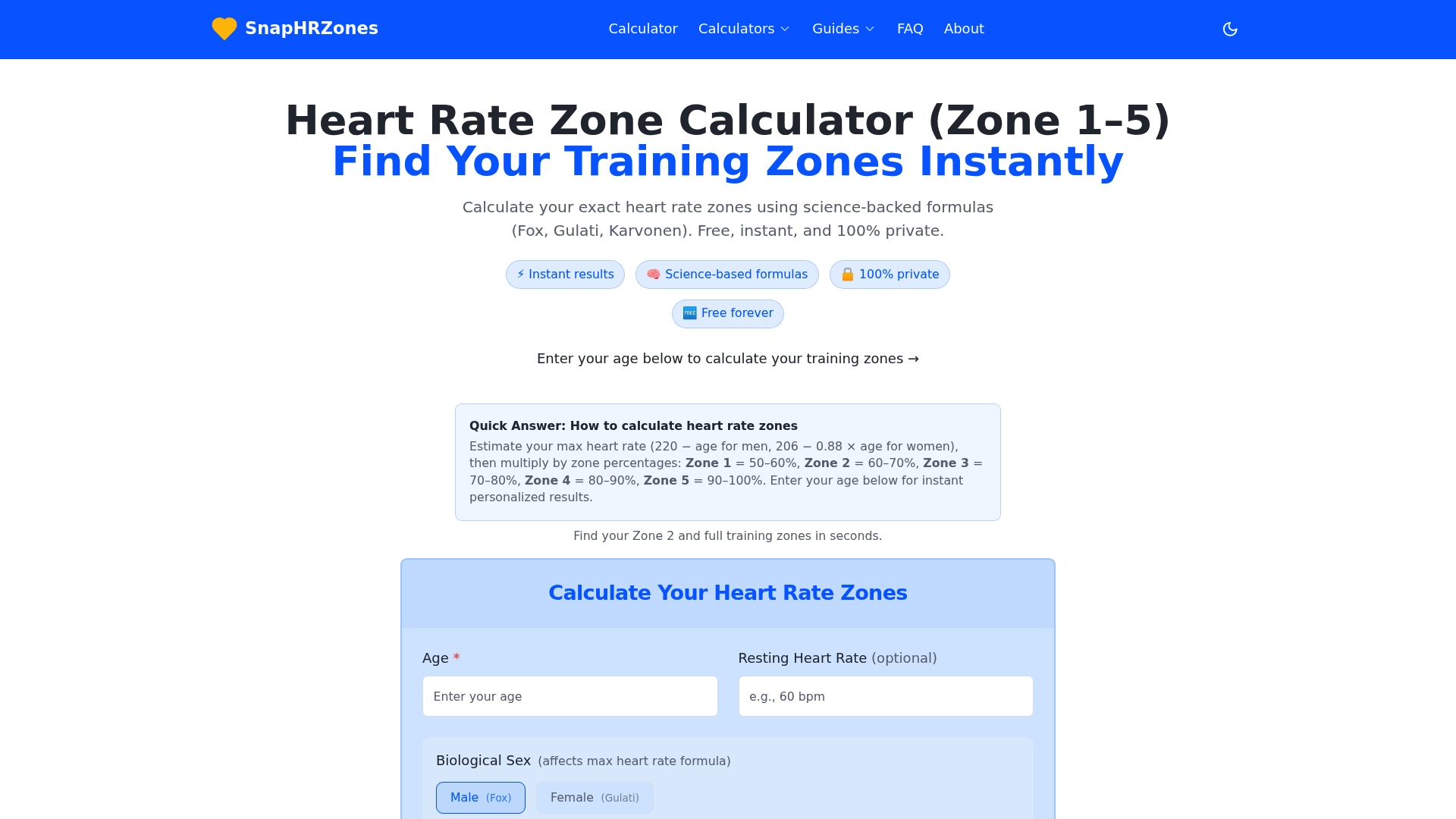
- Age-based formulas estimate maximum heart rate; they are starting points, not measurements.
- Adding your resting heart rate uses the Karvonen method (heart-rate reserve), which is more individually tailored.
- A measured maximum heart rate can differ substantially from formula estimates, so check estimated zones against pace, power and perceived effort.
Cyclists building interval sets around group rides can also find structured sessions and local routes through Coffeeride Club, which organizes rides by pace and discipline.
FAQ
How long are Zone 5 intervals?
VO2max-focused intervals are often around 2–5 minutes, although interval design varies by sport, fitness and goal. A 2026 review found longer intervals of at least 2 minutes tended to produce more time near VO2max than very short intervals.
Is Zone 5 the same as VO2max?
No. Zone 5 describes a high heart-rate range in a five-zone model, while VO2max is maximal oxygen uptake. They often overlap during hard endurance intervals but are not interchangeable.
Should I use heart rate to pace Zone 5 intervals?
Use heart rate as one signal, but not the only one. Heart rate responds with a delay during short hard efforts, so pace, power and perceived effort can help.
How often should I train in Zone 5?
There is no universal number. Many endurance programs use one or occasionally two high-intensity sessions in a week, depending on training history, total volume and recovery; beginners generally need less.
Is Zone 5 dangerous?
Zone 5 work is very demanding. Stop exercising and seek medical advice if you develop chest pain, fainting, unusual shortness of breath, or concerning palpitations. People with known cardiovascular disease or significant risk factors should discuss vigorous exercise with a healthcare professional.
Sources
- Schoenmakers et al. (2026). Time spent at or near VO₂max during high-intensity interval training — a systematic review and meta-analysis
- Fleckenstein et al. (published 2025). Intensified short VO2max running intervals are inferior to traditional long intervals for time spent above 90% VO2max. Frontiers in Sports and Active Living.
- Harvard Health. Understanding exercise heart rate zones
- American College of Sports Medicine (commentary). High intensity physical activity in individuals with elevated levels of coronary artery calcium appears to be safe
Find your personal heart rate zones
Enter your age to get all five training zones in seconds.
Open the heart rate zone calculator