HRV vs Heart Rate: Pick One and Build a Baseline in 2–4 Weeks
Quick answer: HRV and resting heart rate measure different things. HRV often reacts earlier to short-term stress, poor sleep or illness, while resting heart rate is simpler and works well for broad fitness trends. Neither should be judged from a single reading: compare multi-day trends with your own baseline rather than universal HRV cutoffs, and let HRV inform — not dictate — training decisions alongside how you actually feel.

If you can only track one metric consistently, pick the one you'll actually measure every day — a steady routine matters more than which number you choose.
TL;DR:
- HRV tends to react earlier to short-term stress than resting heart rate, especially when measured overnight, while resting heart rate offers a quick overall fitness trend.
- HRV trends can be one input when deciding whether to adjust training, alongside sleep, fatigue, symptoms, soreness and perceived recovery — not an automatic hard/easy switch.
- Resting heart rate for most adults falls roughly between 60 and 100 beats per minute, with well-trained endurance athletes often lower; HRV has no fixed ideal and varies widely between people, devices and age.
- Single unusual readings of HRV or heart rate are less meaningful than multi-day trends and should be interpreted in the context of other factors like sleep, illness, or fatigue.
- Consistent measurement timing and a repeatable tracking routine improve reliability, and combining both metrics with how you actually feel gives the clearest picture.
Table of Contents
- HRV vs resting heart rate: a direct comparison
- When to use HRV versus resting heart rate for recovery decisions
- How HRV and resting heart rate are actually measured
- What's a normal HRV or heart rate, and when should you worry?
- A practical daily tracking plan for HRV and resting heart rate
- Why consistency matters more than any single reading
- Turning your readings into a training plan
- FAQ
- Sources
HRV vs resting heart rate: a direct comparison
HRV and resting heart rate (RHR) answer different questions, even though both come from the same heartbeat data. HRV describes the variation in time between heartbeats. It is a physiological signal that can reflect changes in autonomic regulation, but it is not a direct measurement of recovery or nervous-system health. RHR simply counts how many times your heart beats per minute at rest, and it can shift with fitness, fatigue, illness, heat, hydration, stress, stimulants and sleep.
| What it compares | HRV | Resting heart rate |
|---|---|---|
| What it measures | Beat-to-beat timing variation | Beats per minute at rest |
| How to read changes | Interpret relative to your baseline; higher is not automatically better | Interpret relative to your baseline; a sustained rise above it is worth noting |
| Sensitivity to short-term stress | High, often shifts within a day | Moderate, usually lags behind |
| Ideal measurement timing | Overnight or first thing upon waking | Seated or supine, right after waking |
| Best use case | Short-term trend input, one signal among several | Long-term fitness trend, quick checks |
A few practical takeaways follow from this:
- Look at HRV trends as one input when weighing how hard to train on a given day.
- Check RHR when you want a fast, low-effort read on overall cardiovascular trend.
- Both numbers depend heavily on protocol: a rushed daytime reading won't match an overnight one.
- A single odd reading of either metric rarely means anything; a multi-day shift does.
Measurement timing changes the numbers themselves, not just their accuracy. Overnight HRV averages smooth out the noise from meals, conversation, or a stressful commute, while a daytime spot check can swing for reasons that have nothing to do with recovery.
When to use HRV versus resting heart rate for recovery decisions
The two metrics fit different decisions, and knowing which one to reach for saves time and prevents overreacting to normal noise.
- Use HRV trends as one input for same-day training decisions. A clear drop from your own baseline can be a sign that your body is still processing stress, whether from training, poor sleep, or life in general — weigh it alongside sleep, soreness, fatigue and how you feel before changing the plan.
- Use HRV when something feels off, but you can't name it. It can sometimes shift before subjective fatigue does, giving you an early hint worth paying attention to.
- Use RHR for a quick morning gut check when you don't have HRV data handy or your device didn't capture an overnight reading.
- Use RHR to track monthly or seasonal fitness trends. A gradually falling resting rate over weeks of consistent training often goes hand in hand with improving cardiovascular fitness.
- Combine both for the clearest picture: let HRV trends inform, not dictate, day-to-day adjustments, and let RHR show whether your broader training pattern is moving in the right direction over time.
How HRV and resting heart rate are actually measured
HRV is most commonly reported as RMSSD, the root mean square of successive differences between heartbeats, measured in milliseconds. It captures short-term, beat-to-beat variability and is the metric most consumer devices and researchers rely on because it's less sensitive to breathing rate artifacts than some other HRV measures.
A workable daily protocol looks like this:
- Record HRV overnight through a wearable, or first thing upon waking while still lying down.
- Measure RHR seated or supine for three to five minutes after waking, before coffee, checking your phone, or standing up.
- Keep the position, time of day, and device consistent; changing any of these shifts the numbers independently of your actual state.
- Note anything unusual — illness, alcohol, late-night training — that might explain an outlier reading.
A resting heart rate for most adults falls roughly between 60 and 100 beats per minute, though highly trained endurance athletes often sit lower at rest. (Mayo Clinic) Wearable HRV readings tend to run less precise than clinical electrocardiograms, and irregular breathing or movement during sleep can introduce artifacts worth watching for if your numbers look erratic.
What's a normal HRV or heart rate, and when should you worry?
Resting heart rate has a well-established range: roughly 60 to 100 beats per minute covers most healthy adults, with fit endurance athletes commonly running lower, according to Mayo Clinic. HRV doesn't have an equivalent universal number. It varies substantially with age, individual physiology, measurement method, device, time of day, breathing, training status and recent stress or recovery — so there is no single HRV value that counts as "low" or "healthy" for everyone.
Large population data illustrate this. The Lifelines Cohort Study derived age- and sex-specific RMSSD reference curves from tens of thousands of short ECG recordings, and HRV declines fairly steadily with age. Those curves are descriptive group data, not personal thresholds or diagnostic boundaries. A 25-year-old and a 55-year-old shouldn't be judged against the same number, and comparing your reading to your own history is usually more informative than chasing a published benchmark.
HRV and resting heart rate trends are not diagnostic tools, but certain signs do warrant medical advice regardless of what your baseline looks like:
- Chest pain, fainting, or unusual shortness of breath.
- Persistent palpitations, or an irregular rhythm your device flags repeatedly rather than as a one-off.
- A resting heart rate sustained above 100 beats per minute without an obvious cause.
- Persistent, symptomatic slow heart rate (bradycardia), especially with dizziness or fainting.
- Unexplained, sustained changes in your heart rate or HRV pattern that you can't tie to normal factors like illness, caffeine, or poor sleep.
A practical daily tracking plan for HRV and resting heart rate
A sustainable routine beats a perfect one. Here's a simple approach that works whether you're training for a race or just want better recovery awareness:
- Pick your measurement window and stick to it. Overnight HRV through a wearable, or a first-thing seated RHR check, both work as long as the timing stays consistent.
- Build a baseline over roughly two to four weeks before reacting to any single day's number. Treat it as a practical starting period, not a scientific requirement — early readings are just noise until you have a personal reference point.
- Watch for meaningful deviation from your own pattern, not daily wiggle. A clearly unusual drop relative to your recent range is a reasonable cue to consider an easier day; a small dip might just mean shifting, not skipping, a session. There is no universal percentage or millisecond rule that fits everyone.
- Cross-check with how you feel. A low HRV reading paired with poor sleep or heavy leg fatigue is a stronger signal than either one alone.
Pro Tip: Log a quick 1-to-5 fatigue or sleep-quality score alongside your HRV reading. The combination catches real stress far more reliably than the number by itself.
Use your HRV or resting heart rate trend, together with how you feel, to decide how hard you want to train that day. If you choose an easier Zone 2 session, the SnapHRZones heart rate zone calculator can show you the heart rate range for it. The calculator works out zones; it does not interpret HRV or readiness.

Why consistency matters more than any single reading
The biggest mistake people make with HRV and heart rate tracking is treating either number like a verdict instead of a data point. A single low reading after a bad night's sleep tells you almost nothing on its own; a week-long downward trend tells you a lot. Devices also have real limits — respiration, movement, and sensor placement all introduce noise — so pairing the numbers with how you actually feel produces better decisions than the metric alone ever will. Choose one protocol you can repeat for months, not the one that looks most sophisticated on paper.
Turning your readings into a training plan
Knowing your HRV trend or resting heart rate only helps if it changes what you actually do in a workout. You make that decision yourself, based on your trend and how you feel. Once you have decided on an easy or a harder session, the SnapHRZones heart rate zone calculator gives you the heart rate range for each zone. It does not read HRV or tell you which session to do.
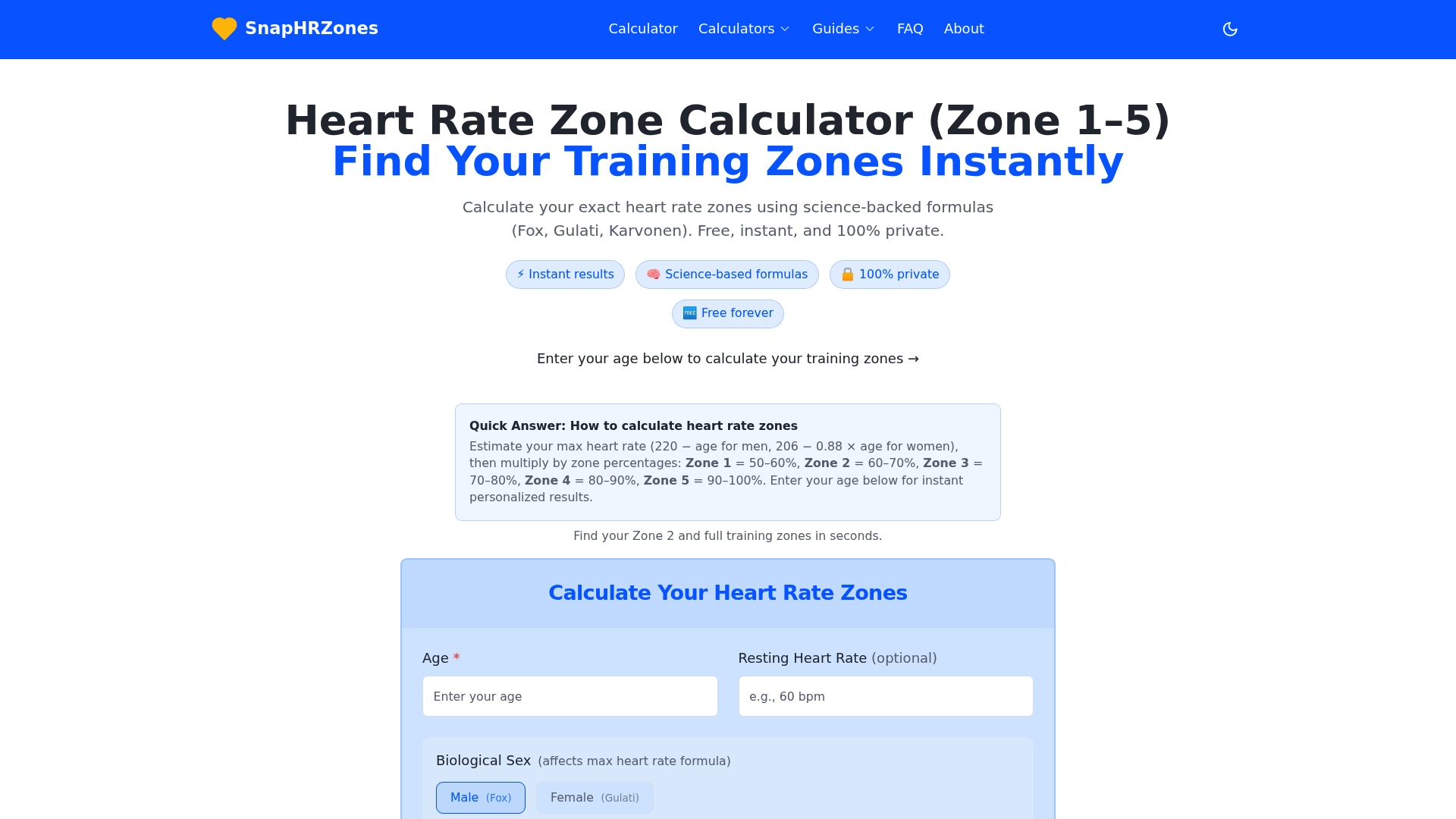
- Works from your max heart rate and, optionally, your resting heart rate for a more personalized zone breakdown.
- Free to use, with no sign-up required.
- Not a medical tool: persistent or concerning readings deserve a conversation with a clinician, not just a calculator.
Try the calculator to find the heart rate ranges for the session you have chosen.
This article is general information, not a substitute for advice from a qualified doctor. Consult a qualified healthcare professional about your own circumstances before acting on anything here.
FAQ
What is a good HRV for age?
There's no single "good" HRV number for any age because typical values vary by measurement method, device, and individual physiology. Population data from the Lifelines Cohort Study show HRV generally declines with age, but those are descriptive group figures, not personal targets. The most useful benchmark is your own baseline over several weeks rather than an age-based chart.
Is an HRV of 37 ms considered low?
It depends on your age, measurement device, and personal baseline rather than a fixed cutoff. A reading of 37 ms may be perfectly typical for one person and unusual for another. What matters is whether it sits within your own normal range, measured the same way at the same time of day.
Is an HRV of over 100 considered good?
Not automatically. Higher HRV relative to your own baseline often goes hand in hand with being well recovered, but an absolute number above 100 ms is not a universal marker of good health — values depend on age, device, and measurement method. Your trend over time is more informative than any single threshold.
What is an unsafe HRV?
HRV itself doesn't have an established "unsafe" threshold the way heart rate does, and HRV trends are not a diagnostic tool. What warrants medical advice is a persistent, unexplained change from your personal pattern, especially alongside symptoms, or heart rate red flags like chest pain, fainting, unusual shortness of breath, persistent palpitations, or a resting rate sustained above 100 beats per minute.
Sources
Find your personal heart rate zones
Enter your age to get all five training zones in seconds.
Open the heart rate zone calculator