Aerobic Threshold Heart Rate for Athletes: Find It, No Lab Needed

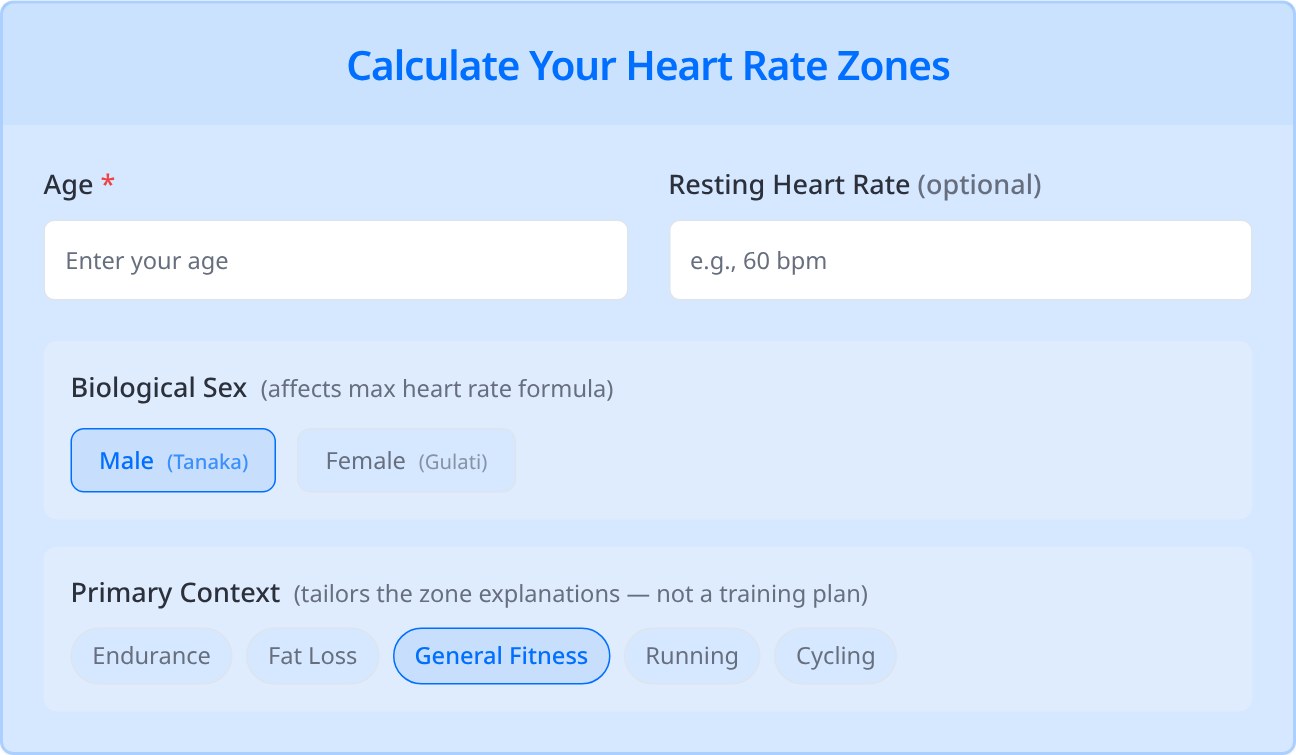
Your aerobic threshold heart rate is the heart rate at the intensity where breathing and blood lactate first begin to rise above easy-effort levels; in many five-zone models it sits near the top of Zone 2. It can only be measured in a lab (VT1 from breathing gases, LT1 from blood lactate). Without a lab, the talk test and a steady effort session give a practical estimate, not a measurement. Our Heart Rate Zone Calculator estimates your zones from age, sex and optional resting heart rate, which you can compare with how those efforts feel.
TL;DR:
- Lab VT1, lab LT1, a talk-test estimate and a steady-state heart rate are different measurements, not interchangeable numbers.
- A 30 to 45 minute steady session at comfortable-speech effort is a practical effort check; its average heart rate is a reference point, not your measured aerobic threshold.
- The point where comfortable speech gets harder roughly tracks the first ventilatory threshold; RPE around 12 to 13 on the 6 to 20 scale is a rough average, not an exact marker.
- Some coaches set Zone 2’s lower boundary 10 to 15 beats below an estimated AeT; this is an optional heuristic, not a validated rule. Weigh field estimates and calculated zones together.
- Lab testing is most useful for competitive athletes refining high volume training, people with cardiac needs, or when field estimates repeatedly conflict.
- People taking beta blockers should use perceived effort rather than heart rate targets, since medication suppresses heart rate; consult a clinician before starting new training.
Table of Contents
- What aerobic threshold is and why it matters
- How AeT maps to Zone 2, %HRR, and %HRmax
- Laboratory methods: CPET, ventilatory thresholds, and lactate testing
- Field methods you can use today
- Step-by-step field test protocol
- Convert your AeT into training zones and Zone 2 workouts
- Sensors, data quality, and measurement tips
- What the research says, and where it stops
- Put your number to work with our calculator
- FAQ
- Sources
What aerobic threshold is and why it matters
Aerobic threshold (AeT) is a training term for the first of two major turning points in exercise physiology. In the lab it is identified either as the first ventilatory threshold (VT1), from breathing gases, or the first lactate threshold (LT1), from blood lactate. VT1 and LT1 often occur at similar intensities but are measured differently, defined differently between labs, and do not always coincide. Below it, your body produces energy aerobically and clears the byproducts about as fast as it makes them. Above it, breathing starts to climb in a way you can feel.
Here is what happens around that point:
- Breathing changes. Ventilation stops rising in a smooth line with effort and begins to climb faster, which is why conversation starts to feel slightly harder.
- Lactate begins to rise above resting levels. Your muscles still clear it, so the effort stays sustainable for a long time.
- Fuel use shifts. The balance between fat and carbohydrate moves toward carbohydrate as intensity rises past this point.
Exercise physiologists describe intensity domains: moderate intensity sits below the first threshold, heavy intensity lies between the first and second thresholds, and severe intensity lies above the second. Sustainable duration falls as you move up the domains, but how long any one person can hold each depends on fitness, the exact intensity within the domain and the conditions, so there is no universal number of minutes.
That second threshold (VT2/LT2) is a different training target, and closer to what our LTHR field test estimates. AeT is where you build durable endurance with steady, repeatable sessions. The second threshold is where hard, time-limited efforts begin. Mixing them up is a common reason easy days turn into moderate-intensity ruts.
How AeT maps to Zone 2, %HRR, and %HRmax
In many five-zone models, AeT is placed around the top of Zone 2, but percentage-based zone edges do not measure your threshold. Harvard Health describes Zone 2 as roughly 60% to 70% of maximum intensity, and notes that heart rate and perceived effort can be used together to meet weekly activity targets. Treat those percentages as a starting range, not a verdict. A well-trained athlete may hold a conversation at a higher percentage of max than a beginner can.
Percent of heart rate reserve (%HRR) is often a better fit than percent of max heart rate. Reserve is your max heart rate minus your resting heart rate, so it accounts for how fit you are at rest. When oxygen uptake is not measured, %HRR works as a practical stand-in for percent of oxygen uptake reserve (%V.O2R), which is how clinical exercise guidelines such as ACSM’s frame intensity.
A few ways to apply this:
- Use %HRmax for a rough first estimate, knowing it can miss by a meaningful margin.
- Use %HRR when you know your resting and max heart rate, since it tracks effort more closely.
- Cross-check with perceived effort every time, because fitness shifts where the percentages land.
Perceived effort gives you a useful second signal. In a retrospective analysis of 863 lab exercise tests, ventilatory threshold corresponded to a mean rating of perceived exertion of about 12 to 13 on the 6 to 20 scale (12.5 ± 0.9). The same study found large individual variation in where VT fell as a percentage of oxygen uptake reserve (averaging roughly 43% to 75% depending on fitness), so no single %HRR or %HRmax value pins down AeT.
On average, ventilatory threshold corresponded to an RPE of about 12 to 13, the “somewhat hard” region of the 6 to 20 scale, where you can still talk but would rather not sing. Individuals vary, so treat it as a guide rather than an exact marker.
If your watch says Zone 2 but the effort feels like a 15, trust the effort and investigate the heart rate. If you want to see where the standard percentages land for you, our Zone 2 calculator page estimates the range from your own numbers.
Laboratory methods: CPET, ventilatory thresholds, and lactate testing
Cardiopulmonary exercise testing (CPET) is the reference method for finding thresholds. You exercise on a treadmill or bike with increasing intensity while a mask measures the oxygen you consume and the carbon dioxide you exhale. Analysts then identify VT1 and VT2 from the breathing pattern and read off the exact heart rate and oxygen uptake at each point. One review calls CPET the most important tool for determining ventilatory thresholds, and notes that percent-based heart rate or VO2 prescriptions can misclassify intensity, especially in cardiac patients and people on beta-blockers.
Lactate testing takes a different route. A technician takes small blood samples at each stage of a graded test and plots lactate against workload. Some practitioners mark AeT in training terminology using a lactate value, though labs and coaches draw this line in different places, so results from one lab do not transfer cleanly to another.
What each method gives you:
- CPET: heart rate and oxygen uptake at VT1 and VT2, as identified by the analyst, plus a map of your whole intensity range.
- Lactate testing: a direct look at how your blood chemistry responds to rising workload.
- Both: a snapshot of one day’s fitness under one protocol.
Lab testing is worth the cost and effort in a few situations: competitive athletes fine-tuning high-volume training, people with a cardiac or clinical need for individualized intensity, and anyone whose field estimates keep contradicting each other. Access is the main limit. Not everyone lives near a lab, and protocols differ between facilities, so compare results only within the same setup.
Field methods you can use today
You do not need a lab to get a usable estimate. Three field tools do most of the work, and they are strongest when you combine them.
- The talk test. Exercise at a steady effort and recite a familiar passage out loud. The point where speech stops feeling comfortable is a rough indicator of the intensity near VT1. Studies link the loss of comfortable speech to ventilatory threshold, which makes it a practical proxy, but it does not give the precision of lab testing. A validation study also found that talk test stages correlated strongly with heart rate, perceived effort, and ventilatory threshold across treadmill and bike testing.
- The steady-state drift check. Pick a sustainable pace and hold it for 30 to 45 minutes. Compare your average heart rate in the first half with the second half. A noticeable rise may suggest the effort was harder than intended, so the next attempt could begin slightly easier. Drift also happens below threshold, especially in heat or when dehydrated, so treat this as a rough coaching cue, not a threshold measurement.
- The effort check. Note your perceived exertion every 10 minutes. A steady 11 to 13 is broadly consistent with effort around the aerobic threshold for many people, while a number creeping toward 15 suggests you are working harder than intended.
Heart rate variability (HRV) offers a fourth approach. Some apps estimate thresholds from the pattern of beat-to-beat intervals during an incremental test. A systematic review with meta-analyses (50 studies, 1,160 participants) found good average agreement with lab thresholds, but results varied with the HRV method, device and test protocol, so treat an HRV-derived number as one data point, not the answer.
Pro Tip: Run the talk test and the drift check on separate days, then compare the heart rates. If they are close, you have a more consistent working estimate, though still not a lab value.
Step-by-step field test protocol
This is a practical effort assessment, not a validated measurement of your aerobic threshold. It gives you a heart rate reference for a comfortable, steady effort that you can compare with your calculated zones. Choose a flat route or a treadmill, wear a chest strap if you have one, and test when you are rested.
- Warm up for 10 to 15 minutes. Start very easy and build to a pace that feels steady and conversational. This pace should feel like something you could hold much longer.
- Start the test segment. Once your pace feels settled, begin recording and hold it as steady as you can for 30 to 45 minutes. Keep effort constant rather than speed constant if the terrain changes.
- Check in at the 10-minute mark and every 10 minutes after. Say a few sentences aloud and write down whether speech felt comfortable, slightly strained, or labored. Log your perceived exertion at the same time.
- Finish and cool down. Walk or jog easily for 5 to 10 minutes.
- Note your steady-effort heart rate. The average heart rate from the middle 10 to 20 minutes is a reference for that effort on that day, not your aerobic threshold. If your notes show speech turning from comfortable to strained at a particular point, record the heart rate at that moment too; it is a rough talk-test estimate of the intensity near VT1.
- Check for drift. If your heart rate in the final portion rose noticeably above the middle section, the effort may have been harder than intended, or heat and hydration may have played a part. Repeat slightly easier on another day.
- Repeat the test if useful. Day-to-day variation from sleep, heat, stress, and caffeine can shift your heart rate. Test twice and use the average, or the lower value if the two differ widely.
Pro Tip: Keep conditions boring. Same route, same time of day, same breakfast, and the same shoes make the second test comparable to the first.
The result is a beats-per-minute reference. Treat it as a working estimate, not a measured threshold.

The "heart-rate average 10–20 min" bar is the window of the steady segment you average. That average is a reference value from this one session, not a measured aerobic threshold, VT1 or LT1.
Convert your AeT into training zones and Zone 2 workouts
If you have a lab-measured VT1 or LT1, many coaches use it as the top of Zone 2. With only a field estimate, treat it as approximate. Some coaches set the lower boundary roughly 10 to 15 beats below the estimate; that is an optional coaching heuristic, not a validated universal rule, and a %HRR band is another option. Our Heart Rate Zone Calculator estimates zones from your age, sex and optional resting heart rate, so you can compare a field estimate with the formula-based range. If they disagree, weigh both alongside the talk test and perceived effort rather than treating either as definitive; a lab test can settle repeated disagreement.
Three session types cover most of what an aerobic base block needs:
- Long steady session (60 to 120 minutes). Stay between the bottom and top of your Zone 2 band, with perceived effort around 11 to 13. This is the foundation workout.
- Aerobic intervals (for example, 4 x 10 minutes). Work at a comfortable, steady effort just below where speech starts to get harder, with easy movement between efforts. The structure breaks up the time without pushing you above threshold.
- Recovery session (30 to 45 minutes). Stay in the lower half of Zone 2 or below it, at an effort that feels almost too easy.
A sample week for someone building an aerobic base might include regular Zone 2 sessions, a longer weekend session, and rest or recovery days. If you also do harder training, many coaches keep most weekly volume at easy, conversational effort so the hard days stay productive. Treat these durations as starting points and adjust to your current fitness, schedule, and how recovery feels.
For sport-specific tips, our guide to a Zone 2 treadmill workout covers incline and pacing, and our Garmin heart rate zones walkthrough shows how to enter these ranges on a watch.
Sensors, data quality, and measurement tips
A test is only as good as the heart rate data behind it. Chest straps and ECG-based devices are generally more accurate than wrist optical sensors, especially when effort changes quickly or your wrists flex a lot. Device and software choices also affect HRV-derived estimates, so keep the same setup from one test to the next.
To keep your numbers comparable:
- Test at the same time of day, with similar hydration, caffeine, and sleep.
- Avoid testing in unusual heat, after illness, or after a hard training block.
- Wet the strap electrodes and fit the strap snugly before you start.
- Record the conditions in a short note so you can explain an odd result later.
Heart-rate-based training is unreliable for people on beta-blockers, because these drugs suppress heart rate. The American Heart Association advises using perceived exertion instead of heart rate targets in these cases. If you take beta-blockers or other heart-rate-altering medication, lean on the talk test and your effort rating, and ask your clinician before starting a new training plan.
What the research says, and where it stops
The evidence supports field methods as useful proxies, with real limits.
- HRV-derived thresholds agreed well with ventilatory and lactate thresholds on average in the meta-analysis, but the match depends on the variables, software, devices and protocols used. A good result in one app does not guarantee the same result in another.
- The talk test has reasonable validation behind it: losing comfortable speech is associated with ventilatory threshold in many samples, though studies use specific protocols and participant groups, so individual results can still differ.
- Fitness level shifts the mapping. The relationship between threshold and %HRR or %V.O2R is not the same for everyone, which is why a fixed percentage can overshoot for one person and undershoot for another.
For these reasons, we describe field tests as estimates. If a result affects a medical decision or an elite training plan, a lab test is the safer reference.
Put your number to work with our calculator
Our Heart Rate Zone Calculator estimates all five heart rate zones from your age and sex, using the selected max heart rate model (Tanaka for men, Gulati for women), with optional resting heart rate. It does not convert a talk-test or steady-state heart rate into laboratory-measured physiological zones, but it lets you compare your field estimate with the formula-based Zone 2 and see how far apart they sit.
- Open the Heart Rate Zone Calculator to estimate your zones from age, sex and optional resting heart rate.
- Visit What Is My Heart Rate Zone 2? for a guided Zone 2 range.
- Read the heart rate drift guide to understand why steady-state heart rate climbs.
Do the effort check, compare it with your calculated zones, and start your first Zone 2 session this week.
FAQ
Is aerobic threshold the same as VT1 or LT1?
Not exactly. Aerobic threshold is a training term. VT1 is measured from breathing gases and LT1 from blood lactate during a graded lab test; they often fall at similar intensities but use different methods and definitions. A talk-test or steady-state heart rate is a field estimate of the same region, not the same measurement.
Can the talk test find my aerobic threshold?
It can help estimate the intensity near the first ventilatory threshold: the point where comfortable speech starts to get harder is a practical marker. It does not provide the precision of lab testing, and results vary between people, days and conditions.
Is aerobic threshold the top of Zone 2?
In many five-zone models it is placed around there, and many coaches use a lab-measured VT1 or LT1 as the top of Zone 2. Cleveland Clinic describes Zone 2 as 60% to 70% of maximum heart rate. Percentage-based zones like these are estimates and do not measure your threshold, so compare them with the talk test and perceived effort.
What is a good aerobic heart rate by age?
There is no single correct number, because aerobic threshold heart rate varies with fitness and between individuals of the same age. Age-based Zone 2 ranges, such as our age 52 and age 62 pages, are formula-based starting estimates; refine them with the talk test and perceived effort.
How often should I retest my aerobic threshold?
There is no research-established schedule. Many coaches recheck every couple of months during a base-building block, and sooner after illness, a long break, or a big change in training. As fitness improves, you may notice the same pace producing a lower heart rate, or a higher heart rate at the same comfortable effort. Keep conditions consistent so changes reflect fitness and not the day.
What is the difference between aerobic and anaerobic threshold?
Aerobic threshold marks the first rise in breathing and lactate, and it anchors long, sustainable endurance work. The second threshold (VT2/LT2, often called anaerobic threshold) sits higher; efforts near it are hard and much less sustainable, and how long they can be held varies with fitness and the exact intensity. Both are distinct from the talk-test and steady-state field estimates described above.
Sources
- Agreement Between Heart Rate Variability-Derived vs. Ventilatory and Lactate Thresholds: A Systematic Review with Meta-Analyses (Sports Medicine – Open, 2024)
- Ventilatory Threshold Related to V.O2reserve, Heart Rate Reserve and Rating of Perceived Exertion in a Large Varied Sample - PMC
- Understanding exercise heart rate zones - Harvard Health
- Comparison of cardiorespiratory responses between treadmill and bicycle ergometer exercise
Recommended
Find your personal heart rate zones
Enter your age to get all five training zones in seconds.
Open the heart rate zone calculator