60–70% Max Heart Rate: A Zone 2 Guide for Runners
Quick answer: In many five-zone heart-rate systems, Zone 2 is estimated at about 60–70% of maximum heart rate. That is a useful starting point, not a universal physiological boundary: your actual aerobic thresholds can vary with fitness, physiology and the method used to define training zones. Use an age-based or Karvonen calculation as an estimate, then cross-check the effort with the talk test and RPE.

Heart rate zones, often numbered Zone 1 through Zone 5, are ranges that describe how hard you’re working during exercise. In many 5-zone models, Zone 2 is the easy aerobic range, and 60 to 70% of your maximum heart rate is a common practical estimate for it. That range is only an estimate: zone systems define Zone 2 differently, your maximum heart rate is usually predicted rather than measured, and your physiological thresholds won’t sit at the same percentage as everyone else’s. Age-based formulas, the Karvonen method, the talk test and perceived exertion (RPE) are different tools, and they won’t always give the same answer. A simple check is how the effort feels: you should be able to speak in full sentences, and the effort should feel easy to moderate.
TL;DR:
- 60 to 70% of max HR is a common starting estimate for Zone 2 in some 5-zone models, not a universal physiological definition.
- Age-based formulas such as 220 minus age only estimate max HR, so check the result with the talk test or perceived exertion (RPE).
- Physiological thresholds such as VT1 vary between people and don’t map to one fixed percentage of max HR.
- Heat, dehydration, poor sleep, caffeine, stress, illness and some medications can change your heart rate at a given effort.
- Lab or field threshold testing gives a more individualized picture, but most recreational runners don’t need it to train sensibly.
Table of Contents
- What does 60–70% of max heart rate mean?
- Why VT1 and fixed percentages are different
- 220 minus age vs Karvonen
- Why Zone 2 percentages vary
- How to check a calculated zone in real training
- Which method should you use?
- Get your personalized Zone 2 range in minutes
- FAQ
- Sources
What does 60–70% of max heart rate mean?
“60–70% of max HR” means a heart rate between 0.60 and 0.70 times your maximum heart rate. In many 5-zone systems that range is labeled Zone 2, the easy aerobic zone. Here is how a typical 5-zone model describes each zone:
- Zone 1 (very light): active recovery, easy spinning or walking, helps clear fatigue without adding stress.
- Zone 2 (light to moderate): steady, conversational aerobic work, commonly used to build an aerobic base for endurance training.
- Zone 3 (moderate to hard): tempo work that feels comfortably hard and takes more recovery than easy running.
- Zone 4 (hard): threshold work near your lactate or ventilatory threshold, improves your ability to sustain faster paces.
- Zone 5 (very hard): short, near-maximal efforts used in high-intensity interval training.
Why VT1 and fixed percentages are different
In threshold-based models, Zone 2 is usually defined as the intensity at or below your first lactate or ventilatory threshold (LT1 or VT1). That is a measured physiological boundary, and it doesn’t sit at the same percentage of max HR for every person. A 2025 laboratory study of 50 cyclists found substantial individual variability in common Zone 2 markers: VT1 lined up well with the intensity of maximal fat oxidation, while fixed percentages of max HR and fixed blood lactate values showed wide individual differences. The authors note that fixed percentages are practical and simple but may not reflect each person’s metabolic response.
Zone definitions also differ between systems. 60 to 70% of max HR is a common practical estimate for Zone 2 in some 5-zone models, while other models use different ranges (the same study cites about 72 to 82% of max HR as one typical definition). Treat any percentage as a starting point, and use the talk test and perceived exertion (RPE) as practical cross-checks. Two people with the same age can also have quite different thresholds, so the same percentage can mean a different physiological effort for each of them.
Public health guidance uses a different framework. It describes general activity levels, not individualized training zones: moderate effort is commonly described as activity where you can talk but not sing, and adults are advised to get at least 150 minutes of moderate or 75 minutes of vigorous activity each week.
220 minus age vs Karvonen
You don’t need a lab to get a usable starting point. These approaches range from a rough estimate to a more individualized one. For a step-by-step walkthrough, see how to calculate your heart rate zones.
- Estimate your max heart rate. The best-known formula, cited by Harvard Health’s guide to exercise heart rate zones, is 220 minus your age. It’s a rough population estimate, and an individual’s true max HR can be well above or below it. A 40-year-old would estimate a max HR of 180 beats per minute, with moderate activity landing at 50 to 70% (90 to 126 bpm) and vigorous activity at 70 to 85% (126 to 153 bpm).
- Use the Karvonen method. This uses your heart rate reserve (max HR minus resting HR), so your resting heart rate is part of the calculation. That makes it more individualized than a simple percentage of max HR, but it still depends on the max HR you put in. See Karvonen method explained for details. The formula is: Target HR = ((HRmax minus HRrest) times %Intensity) plus HRrest. For a 40-year-old with a resting HR of 60 and a Zone 2 target of 65%, the math looks like (180 minus 60) times 0.65, plus 60, which equals 138 bpm. Note that percentages of heart rate reserve and percentages of max HR aren’t interchangeable, so the same “65%” gives different numbers in the two methods.
- Check it in the field. During a steady run or ride, see whether you can speak in full sentences without strain. If you can, you’re probably in an easy aerobic range. On a 0–10 scale, that usually feels like roughly 3 to 4 out of 10.
| Method | Formula | Best suited for |
|---|---|---|
| Age-predicted max HR | 220 minus age | A quick, rough starting estimate |
| Karvonen (heart rate reserve) | ((HRmax minus HRrest) x %Intensity) + HRrest | A more individualized estimate that includes resting HR |
| Talk test / RPE | Subjective: can you converse comfortably? | Confirming zones in real conditions |
| Lab threshold testing | Measured lactate or ventilatory thresholds | Athletes and coaches who want threshold-based zones |
If you’re new to structured training, start with the age-based formula or the Karvonen method and adjust based on how sessions feel. Threshold testing measures your own physiological boundaries rather than predicting them from age, so it can be useful for athletes with specific performance goals. Most recreational runners don’t need it to train sensibly.
Why Zone 2 percentages vary
The 60 to 70% range is a useful starting point, not a universal rule. Where your own thresholds fall can depend on factors such as training status and fitness. Treating a fixed percentage as exact can mean your easy days end up too easy or too hard.
- Ventilatory thresholds vary meaningfully between individuals, which means the same percentage of max heart rate can represent different training stimuli for different people.
- Heart rate lags behind changes in effort, especially during intervals, so readings are more meaningful once you’ve settled into steady effort for several minutes.
In a 2026 study on reference values for heart rate and speed zones in 1,411 endurance-trained runners, the first ventilatory threshold (VT1) occurred on average at 85.1 ± 4.6% of peak heart rate and the second ventilatory threshold (VT2) at 93.5 ± 2.5%. In this cohort, less-trained men showed higher relative threshold values than elite men, while women showed higher and more stable relative values across performance levels. These are findings from one study population, not universal training zones. They do show that a measured threshold such as VT1 can sit well above a fixed 60 to 70% estimate, which is why percentage-based Zone 2 and threshold-based Zone 2 shouldn’t be treated as the same thing. For runners with specific race goals, threshold testing can make zones more individualized than age-based estimates.
How to check a calculated zone in real training
Heart rate isn’t static from day to day, and several everyday factors can push your numbers higher or lower than expected.
- Heat and humidity raise heart rate at a given effort, so adjust your pace rather than chasing a fixed number on hot days.
- Dehydration, poor sleep, and caffeine can all nudge your heart rate up independent of actual effort.
- Stress and recovery from illness can also shift your heart rate. If you’re unwell, rest, and ease back in gradually.
Medications matter too. Beta-blockers and similar heart-rate-altering drugs can blunt your normal heart rate response, making age-based formulas unreliable. If you take these medications or have a heart condition, check with your clinician before relying on heart rate targets. This article is general information, not medical advice.
On the device side, give your monitor a few minutes to settle before trusting the number, check chest strap or wrist placement if readings look erratic, and remember that heart rate lags behind effort during short intervals, so don’t chase a number that hasn’t caught up yet.
For session length, frequency and weekly structure, see our complete Zone 2 training guide. This article focuses on what the numbers mean.
Which method should you use?

The SnapHRZones approach is built around a simple idea: a formula gets you close, but your body tells you the rest. Combining a quick calculation with the talk test and RPE catches the individual variability that any fixed percentage misses.
That’s why SnapHRZones calculators present zones as estimates, and the guides pair them with simple checks you can do on any run or ride. In practice: use 220 minus age (or another age formula) for a quick estimate, use Karvonen if you know your resting heart rate, use the talk test and RPE to check the result, and consider threshold testing only if you want zones based on your own measured thresholds.
Get your personalized Zone 2 range in minutes
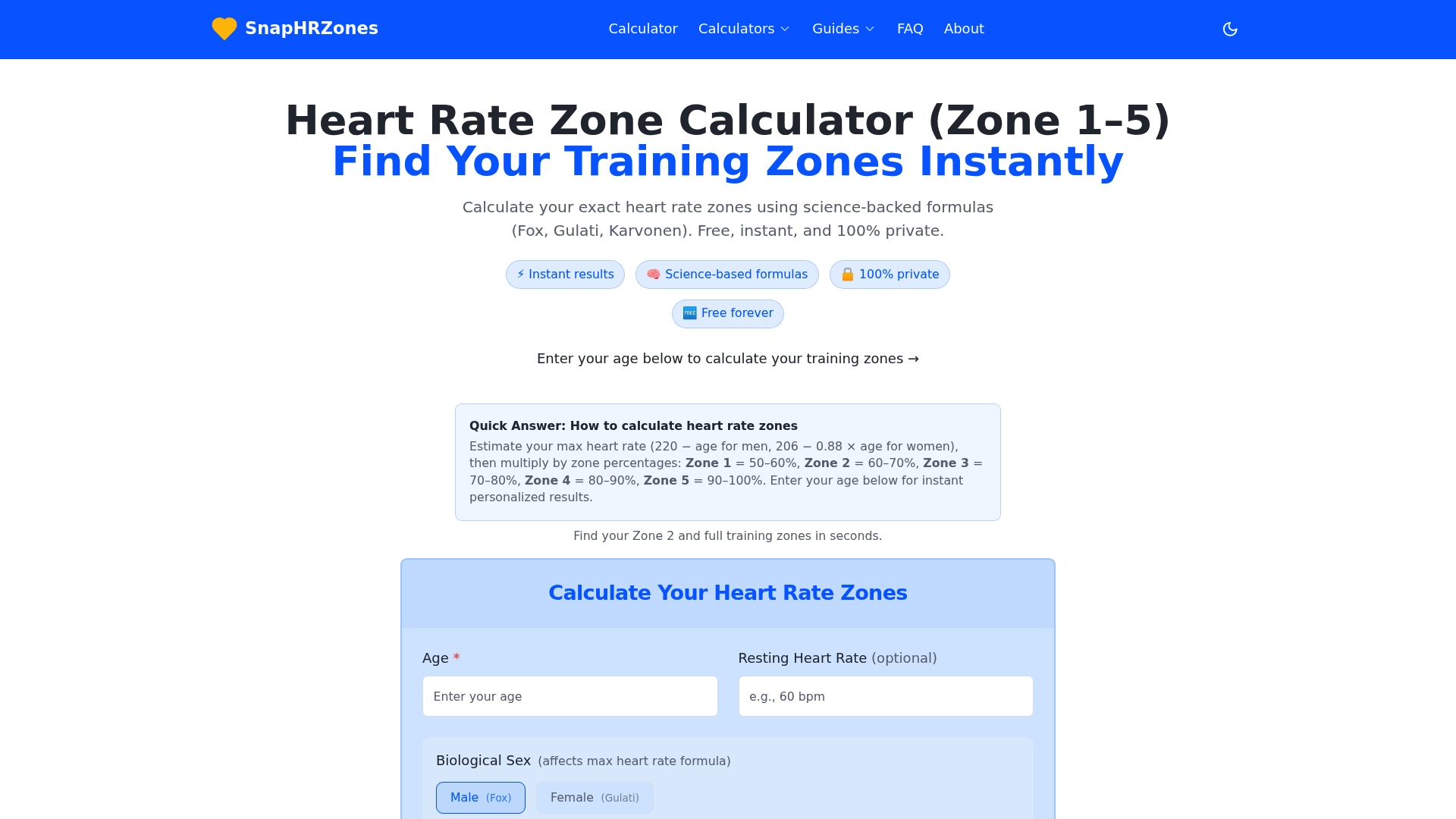
Enter your age, and optionally your resting heart rate, into our heart rate zone calculator to get an estimated Zone 2 range based on the methods above. Then check it with the talk test or RPE during your next easy session. Formula results are a starting point, not a lab measurement. If you’re mainly training for fat loss, our guides on the fat-burning zone and Zone 2 for fat loss explain what heart rate can and can’t tell you. If you take beta-blockers or manage a heart condition, check with your clinician before training by heart rate targets.
FAQ
Is Zone 2 always 60–70% of max heart rate?
No. 60 to 70% of max HR is a common estimate for Zone 2 in some 5-zone systems, but other systems use different ranges, and threshold-based models define Zone 2 by your first ventilatory or lactate threshold instead of a fixed percentage.
Is Karvonen more individualized than 220 minus age?
Yes, in one respect: Karvonen includes your resting heart rate through your heart rate reserve, while 220 minus age only estimates max HR from your age. Karvonen still depends on the max HR you enter, so if that number is an age-based estimate, the result is still an estimate.
Is 60–70% max HR the same as VT1?
No. VT1 is a measured physiological threshold that varies between people. In the 2026 study of 1,411 endurance-trained runners cited above, VT1 occurred on average at about 85% of peak heart rate, well above a fixed 60 to 70% estimate.
Why do different heart-rate-zone calculators give different results?
Calculators can use different max HR formulas, percentage-of-max or heart-rate-reserve methods, and different zone boundaries. Each choice changes the numbers, so two calculators can both be “right” within their own model and still give different ranges.
Can I use the talk test instead of a heart-rate percentage?
Yes, the talk test is a practical way to judge easy aerobic effort: if you can speak in full sentences without strain, you’re probably in an easy range. Many people use both, a calculated range as a starting point and the talk test or RPE to check it.
Do medications affect my heart rate training zones?
Yes, medications such as beta-blockers can blunt your heart rate response to exercise, making standard formulas unreliable. If you take these medications, talk with your clinician before using heart-rate-based targets, and use perceived exertion as a guide.
Sources
Find your personal heart rate zones
Enter your age to get all five training zones in seconds.
Open the heart rate zone calculator