How Much Deep Sleep Do You Need? Age, Recovery and Wearables
Quick answer: There is no universal nightly deep-sleep requirement or validated minute target for each age. Deep sleep generally becomes less abundant with aging, but individual patterns vary. Prioritize enough total sleep and daytime functioning. Watches and rings estimate sleep stages indirectly, so a low deep-sleep score alone cannot establish poor recovery or a sleep disorder.

There is no universal nightly deep-sleep requirement or established minute target for each age group. A broad educational estimate is that adults spend about 10% to 20% of sleep in this stage, as described in Sleep Foundation’s deep sleep guide. That estimate is not a diagnostic reference interval or a target for your watch. Sleep-stage proportions vary between people, across nights and with age; total sleep and daytime functioning provide more useful context.
This matters to runners and triathletes because hard training only turns into fitness when you recover from it. Here is what deep sleep is, how much is typical, what changes it, and what you can do about it.
TL;DR
- The 10% to 20% figure is a broad educational estimate of adult N3 sleep, not an individual requirement, validated age-specific range or prescribed minute target.
- Deep sleep generally becomes less abundant from childhood into adulthood, and older adults often have less than younger adults. A low tracker estimate alone cannot establish a problem or rule one out.
- Total sleep is the target you can act on: the AASM and SRS recommend adults sleep 7 or more hours regularly.
- Wearables estimate sleep stages indirectly; both single nights and longer-term trends can be affected by device bias.
- Persistent trouble falling or staying asleep is a reason to see a health care provider, not to chase a number.
Table of Contents
- What deep sleep is
- How much deep sleep adults typically get
- How deep sleep changes with age
- What deep sleep does
- What happens when sleep falls short
- How to support deep sleep
- How accurate is your watch or ring?
- Using sleep and heart rate together
- Calculate your zones
- FAQ
- Sources
What deep sleep is
Sleep moves through stages in cycles. The stage called N3 is deep sleep, also known as slow-wave sleep, named for a pattern of slow waves seen in brain activity. The NHLBI explanation of sleep phases places it among the non-REM stages, with REM sleep as a separate phase.
Deep sleep is generally concentrated earlier in the sleep episode, while REM periods tend to lengthen later, as described by the NHLBI sleep-stages overview. It is not confined to a fixed window before midnight. A late bedtime alone does not establish that deep sleep has been lost; if wake-up time remains fixed, it leaves less opportunity for sleep overall. Sleep timing reflects both circadian rhythms and sleep pressure accumulated during wakefulness, as investigated in research on circadian phase and sleep-dependent regulation.
Two terms are often mixed up:
- Deep sleep is the N3 stage, a physiological state measured with brain activity.
- Good sleep is the broader outcome: enough hours, few awakenings, and feeling rested.
You can have a decent night without ever seeing a big deep sleep number on your watch.
How much deep sleep adults typically get
Descriptions of typical sleep-stage distributions are not clinical requirements. The table below illustrates the arithmetic of a broad 10% to 20% estimate; its minute values are not nightly goals or a diagnostic reference interval.
| Total sleep | Deep sleep at 10% | Deep sleep at 20% |
|---|---|---|
| 7 hours (420 min) | 42 min | 84 min |
| 8 hours (480 min) | 48 min | 96 min |
| 9 hours (540 min) | 54 min | 108 min |
This broad estimate is reported in the Sleep Foundation guide, a secondary educational source, and the table is arithmetic rather than an age-specific recommendation. The NHLBI does not prescribe this percentage range. Individual variation and aging mean that these values cannot establish whether someone’s sleep is healthy.
Total sleep has firmer guidance behind it. The existing link labeled AASM and SRS consensus statement leads to the AASM position statement “Sleep is essential to health,” which summarizes the separate joint recommendation. The original 2015 AASM/SRS recommendation addresses adults aged 18 to 60 and recommends 7 or more hours regularly. It does not set a deep-sleep percentage or minute requirement.
The original recommendation is available in the 2015 AASM/SRS adult sleep-duration consensus. Seven hours is a general minimum recommendation, not a guarantee that it meets every person’s needs.

The illustration shows only the arithmetic of the secondary 10% to 20% estimate. Its ranges are not age-specific requirements, medical targets or a way to judge a wearable score.
A worked example
Say you sleep 7.5 hours (450 minutes) and your tracker reports 55 minutes of deep sleep: that is about 12%. A report of 38 minutes is about 8%. Neither establishes that your true deep sleep is adequate or deficient. Nights vary, and device errors can affect both individual readings and longer-term averages; interpret them alongside sleep quality and daytime symptoms rather than a target percentage.
How deep sleep changes with age
Deep sleep is not fixed across a lifetime. The NHLBI notes that it is most abundant in early childhood, drops sharply after puberty, and continues to decline with age. Harvard’s sleep medicine division adds that older adults generally have relatively short periods of deep sleep, with sleep that is lighter and more fragmented.
Less deep sleep with aging does not mean sleep becomes unimportant or that eight hours is a universal upper limit. Persistent insomnia, gasping or substantial daytime sleepiness should not be dismissed as normal aging.
What this means for you:
- In your 20s and 30s: Population averages tend to show more slow-wave sleep in younger adulthood, but individuals vary. Comparing a tracker score with a teenager’s is not a clinical assessment.
- In your 40s and 50s: Slow-wave sleep generally decreases across adulthood, but there is no identical decline for every person or a validated target for each decade. Persistent symptoms deserve attention regardless of age.
- In your 60s and beyond: Older adults often have less slow-wave sleep and more fragmented nights, but these population trends should not be used to dismiss insomnia, gasping, heavy daytime sleepiness or other persistent symptoms. Discuss those with a clinician.
A lifespan meta-analysis of objectively recorded sleep found age-related differences in slow-wave sleep, not a fixed decline for every person. In its adult analyses, only sleep efficiency continued to decline significantly after age 60. Population-level differences do not establish a required deep-sleep percentage for each decade.
Age also shapes your training. Heart rate ranges shift over the years, so a session that feels easy at 25 may need adjusting at 55. If you want to see the numbers, the calculator and the age-specific pages, such as Zone 2 at age 43 or Zone 2 at age 58, show how ranges differ.
What deep sleep does
Sleep science is still filling in the details, and it is worth being careful here. A review of sleep and nutrition interactions in athletes describes sleep as restorative for the immune and endocrine systems, helpful for recovery of the nervous system, and involved in learning, memory and synaptic plasticity. It also notes that slow-wave sleep early in the night promotes prolactin release.
You may also see claims that deep sleep “cleans the brain.” Researchers have proposed that deep sleep supports the glymphatic system, which helps clear metabolic byproducts built up while awake. A review in the sleep research literature calls this an attractive theory that still needs more experimental evidence. Treat it as a hypothesis in progress, not a settled fact.
Why runners and triathletes care
Training stress is the stimulus, and recovery is when you adapt. The research does not give a deep sleep number that guarantees better race results, and nobody can promise that. What it does show is that sleep supports the systems you lean on when you train. If you stack hard sessions, short nights and late workouts, you give those systems less room to work.
A practical way to use this: pair your hardest sessions with your best sleep opportunities. Easy aerobic days, like Zone 2 treadmill workouts, make a sensible choice when a rough night has left you tired. Higher-intensity work, such as Zone 5 intervals, fits better when you have slept well.
What happens when sleep falls short
Research is clearer about total sleep than about deep sleep alone. The same athlete-focused review reports that acute sleep deprivation and sleep disturbance, including short sleep or reduced sleep efficiency, impair adaptive immunity. They are associated with weaker responses to vaccinations and greater vulnerability to infectious diseases.
That is an association, not a guarantee that one bad night will make you sick. For an athlete, the takeaway is modest and practical: protect your sleep in the weeks when training load is high and stress is up.
Signs that your sleep is not meeting your needs are mostly about daytime function:
- Feeling unrefreshed after a full night in bed
- Heavy fatigue during sessions that normally feel routine
- Trouble concentrating
- A resting heart rate or perceived effort that drifts upward with no clear cause
None of these proves a deep sleep deficit. They are reasons to look at your habits first and, if they persist, to talk with a health care provider.
How to support deep sleep
No trick has been shown to reliably raise your deep sleep on demand. What is well supported is the foundation of healthy sleep. MedlinePlus lists these habits:
- Keep a consistent bedtime and wake-up time.
- Make your bedroom cool, dark and quiet.
- Avoid caffeine in the afternoon and evening.
- Avoid alcoholic drinks before bed.
- Skip naps after 3 p.m.
- Remove distractions such as TVs, computers and phones.
For athletes, a few adjustments follow from these:
- Time your caffeine. Pre-workout and afternoon coffee count. If you train late, check how it sits with your bedtime.
- Watch late intense sessions. Some people find evening hard efforts leave them wired. If that is you, move the hard work earlier, and keep late sessions easy.
- Be consistent on weekends. A long race-day or long-run schedule can wreck a routine. Aim to return to your usual hours the next day.
- Treat alcohol as a sleep cost. It is on the MedlinePlus list for a reason.
If you have persistent trouble falling or staying asleep, or suspect sleep apnea, the guidance from MedlinePlus is to see a health care provider for an evaluation. Loud snoring, gasping at night or heavy daytime sleepiness are good reasons to book that visit rather than tweak your routine.
How accurate is your watch or ring?
Consumer watches and rings estimate sleep stages indirectly from movement, heart rate and related signals, rather than directly measuring the brain-wave patterns used in laboratory polysomnography. Their results are not equivalent to a clinical sleep study. Studies comparing seven consumer devices with polysomnography and five commercial sleep trackers with laboratory measurements found inconsistent staging and device-specific bias in the tested devices. These studies do not validate every current device or long-term trend; averaging more nights does not automatically remove systematic error.
The seven-device study tested 34 healthy young adults over three laboratory nights. The five-device study tested 53 young adults for one laboratory night. These designs reveal errors in the tested devices, not accuracy for every age, sleep disorder, device generation or software update. A Garmin, Apple Watch or Fitbit score should not be assumed equivalent to a clinical sleep study.
So use your device this way:
- Use trends cautiously. Several nights provide context, but longer-term averages can still be biased and are not confirmation of true deep-sleep duration.
- Keep duration in context. Total sleep estimates may be more useful than stage splits, but they too can be inaccurate.
- Do not chase a target. Worrying about a deep sleep score can itself make sleep worse.
- Pair it with how you feel. Persistent symptoms, sleep quality and daytime function matter more clinically than reaching a wearable-generated score.
If your numbers look consistently odd and you feel poorly, that is a question for a clinician, who can order a proper sleep study if needed.
Using sleep and heart rate together
Sleep is one part of recovery, not a complete readiness test. Consider total sleep, daytime alertness, soreness, recent training and how a familiar easy effort feels. Resting heart rate and HRV can add context when measured consistently against your own baseline, but neither identifies a deep-sleep deficit or diagnoses stress. After a poor night, consider shortening or easing the session; rest may be more appropriate if you are unusually sleepy, unwell or exhausted. Do not change training solely because your watch reports fewer deep-sleep minutes.
Calculate your zones
If you train by heart rate, our Heart Rate Zone Calculator gives you personalized zones in a few seconds, with optional resting heart rate input for a more tailored result. For easy aerobic days, What Is My Heart Rate Zone 2? walks you through your range.
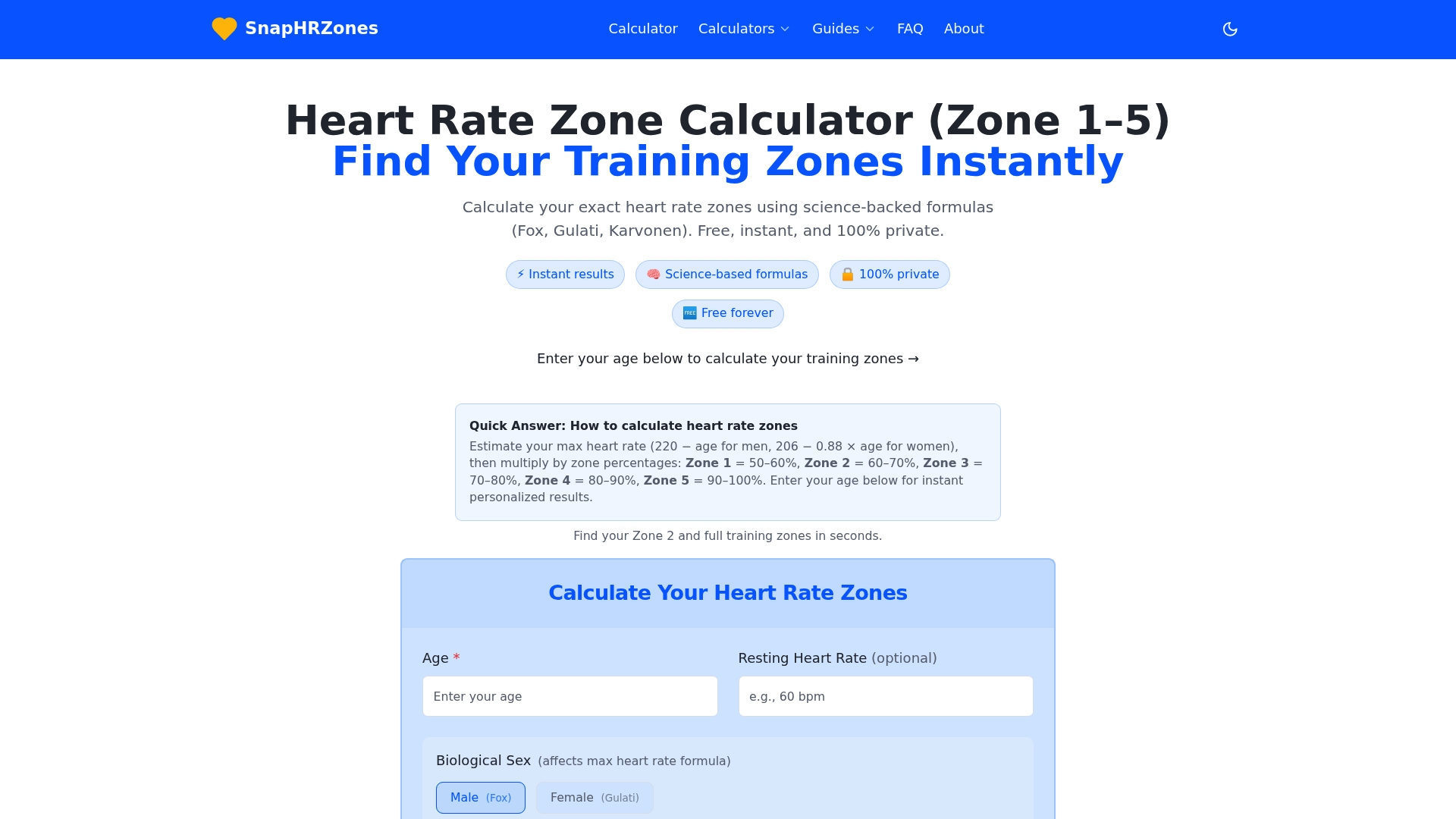
These tools are free. They estimate your zones from formulas, so treat the results as a starting point and adjust by feel and, where appropriate, with advice from a coach or clinician.
FAQ
How much deep sleep do I need per night?
There is no universal individual requirement. A broad descriptive estimate of about 10% to 20% is reported by the Sleep Foundation. This secondary estimate is not a prescribed target or a diagnostic range. Focus first on total sleep and persistent symptoms, not a specific number of deep-sleep minutes.
Does deep sleep decrease with age?
Generally, slow-wave sleep decreases across adulthood, but individuals do not all follow the same trajectory. The population trend is described by the NHLBI. Older adults generally have shorter deep sleep periods and lighter, more fragmented sleep.
How can I get more deep sleep?
No method has been proven to reliably raise it on demand. Steady sleep and wake times, a cool, dark, quiet room, limited caffeine and alcohol, and fewer screens are the habits MedlinePlus recommends for healthy sleep overall.
Is my wearable’s deep sleep number accurate?
Treat it as an estimate. Wearables infer sleep stages from movement and heart rate, not from brain activity, so stage readings can differ between devices and from polysomnography. Longer-term averages may still contain systematic inaccuracies; they do not establish your true deep-sleep duration.
When should I see a doctor about my sleep?
See a health care provider if you have continued trouble falling or staying asleep, or you suspect sleep apnea, as MedlinePlus advises. Do not rely on a tracker’s numbers to decide this.
Sources
- Sleep Foundation: How Much Deep Sleep Do You Need?
- AASM and SRS: Sleep is essential to health (PMC)
- NHLBI: Sleep deprivation and deficiency
- Harvard Division of Sleep Medicine: Sleep and Aging
- Sleep and Nutrition Interactions: Implications for Athletes (PMC)
- Sleep Function: Toward Elucidating an Enigma (PMC)
- MedlinePlus: Healthy Sleep
Find your personal heart rate zones
Enter your age to get all five training zones in seconds.
Open the heart rate zone calculator