Zone 2 Walking: Pace, Incline, Talk Test and Workout Progression
Quick answer: Yes — brisk, controlled walking can be Zone 2 for many people. Use the talk test (full sentences possible, singing difficult) together with an estimated or personalized heart-rate range as guides. If flat walking feels too easy, gradually increase pace or incline; fitter people may need hills, power walking or another low-impact option such as cycling. There is no universal walking pace that defines Zone 2.

Walking is a low-impact way to build aerobic fitness without the joint stress of running, which makes it a practical Zone 2 option for beginners, people returning to training and anyone adding easy aerobic volume.
TL;DR: Public health guidance of 150 to 300 minutes of moderate-intensity activity per week is a useful frame for weekly walking volume. Pace by effort rather than speed on hills and in heat, because the same walking pace can produce very different heart rates from day to day and from person to person.
Table of Contents
- Can walking get you into Zone 2?
- What Zone 2 means, and why 60–70% is only an estimate
- How to find your Zone 2 while walking: talk test, heart rate and RPE
- What if walking does not get you into Zone 2?
- Zone 2 walking workouts and progression
- How long and how often to walk
- Why the same walk can give different heart rates
- Walking and fat burning
- How to measure and track Zone 2 walking
- Safety notes
- FAQ
- Sources
Can walking get you into Zone 2?
For many people, yes. Brisk walking is a genuinely moderate-intensity activity, and public health guidance lists it as a standard example. Whether it reaches your Zone 2 depends on your fitness, age, the terrain and how fast you walk.
Walking has a practical advantage for this kind of training: it is naturally self-limiting. Past a certain speed, most people break into a jog rather than drift into a much harder walking pace, which makes it easier to stay at a steady aerobic effort for a long time. The trade-off is the flip side of the same fact: if you are already quite fit, even brisk flat walking may not raise your heart rate into Zone 2 at all. That is normal, and there are simple ways to adjust, covered below.
What Zone 2 means, and why 60–70% is only an estimate
Zone 2 describes an easy-to-moderate aerobic effort: hard enough that you notice your breathing, easy enough to sustain for a long time. Many consumer 5-zone systems place it at roughly 60–70% of an estimated maximum heart rate, but that figure is a common estimate in some 5-zone models, not a universal physiological boundary. Different zone systems draw their boundaries differently, formulas such as 220 minus age are population-level estimates, and individual thresholds vary enough that two people of the same age can have meaningfully different Zone 2 ranges.
The practical takeaway: treat any calculated range as a starting point, and confirm it with how the effort feels. For the deeper explanation of what Zone 2 is, how the zone systems differ and how to estimate your own range, see our Zone 2 heart rate training guide. This article stays focused on the walking side.

How to find your Zone 2 while walking: talk test, heart rate and RPE
The fastest check needs no equipment at all. The talk test has been shown to correlate reasonably well with ventilatory threshold, which makes your ability to speak a useful stand-in for lab measurements:
- Comfortable full sentences — you are likely in or below Zone 2.
- Sentences possible, but you are working for them — you are probably near the upper edge.
- Only a few words at a time — you have crossed into a harder zone.
An easy-to-moderate aerobic effort usually means conversation in sentences with noticeable but controlled breathing. Recheck every 10 to 15 minutes, since hills, heat and fatigue shift your effort over the course of a walk. The talk test does not map perfectly onto any single heart rate percentage, so treat it as a practical gauge rather than an exact diagnostic.
For a numeric check, a heart rate range gives you something concrete to glance at. Age-based formulas such as 220 minus age are rough estimates; the Karvonen formula, which factors in your resting heart rate, is more individually tailored. Our heart rate zone calculator accepts an optional resting heart rate for exactly this reason, and the max heart rate calculator explains where the age-based estimates come from.
Rate of perceived exertion (RPE) rounds out the toolkit. On a 1 to 10 scale, Zone 2 typically feels like a 3 to 4: noticeably working, but easy to sustain. Like the talk test, RPE is an approximate subjective guide, not an exact Zone 2 diagnostic.
Pro Tip: Run the talk test and a heart rate check side by side for your first few walks. Once you learn what your personal Zone 2 feels like, you can rely on perceived effort alone on days when a device is inconvenient.
What if walking does not get you into Zone 2?
This is common for fitter people, and it is not a problem to solve at all costs. The target is a sustainable aerobic effort, not chasing a number on your watch. If ordinary flat walking stays too easy, you have several practical options:
- Walk faster. A purposeful, brisk pace raises cardiovascular demand. Arm action and stride matter: swinging your arms and taking quicker steps turns casual walking into power walking and increases the effort without running.
- Add incline or hills. Gradient raises cardiovascular demand without requiring you to run. On a treadmill, increase the incline gradually rather than jumping to a steep setting; outdoors, choose a route with rolling hills.
- Use the treadmill deliberately. Speed and incline can be adjusted in small steps, which makes a treadmill useful for finding a combination that brings you into a moderate effort range.
- Extend the duration if appropriate. A longer easy walk still builds aerobic volume, even if the intensity sits slightly below a calculated zone.
- Choose another low-impact modality. If walking cannot comfortably reach the effort you want, cycling or the elliptical can get there without the impact of running.
What not to do: force your heart rate upward by any means necessary. If reaching a calculated Zone 2 number requires an effort that feels hard, the number is probably wrong for you — recheck the estimate and lean on the talk test.
Zone 2 walking workouts and progression
A straightforward continuous walk is the backbone of Zone 2 walking training. Spend the first 5 to 10 minutes warming up at an easy pace, hold a steady moderate effort for the main block, and finish with a few minutes of slower walking so your heart rate eases down before you stop. Session length is flexible: 30 minutes is useful on busy days, 40 to 60 minutes builds more volume, and two shorter walks can work as well as one long one for total weekly minutes.
A sensible progression looks like this:
- Beginner: comfortable brisk walking. Build consistency and duration before worrying about intensity.
- Progression: increase one variable at a time — pace, incline or duration — rather than all three at once.
- When fitness improves: if the same walk produces a lower heart rate than it used to, increase pace or incline modestly, provided the goal is still moderate aerobic training.
Hills complicate pacing because the same speed demands more effort going uphill. Walk by effort, not by pace: slow down on the incline to keep your breathing in talk-test range, and let the descent give some of that effort back. Holding a flat-ground pace on a hill is the most common way a Zone 2 walk accidentally becomes a harder workout.
How long and how often to walk
Public health guidance offers a useful frame: the CDC recommends 150 to 300 minutes per week of moderate-intensity aerobic activity for substantial health benefits, and brisk walking is explicitly listed as a moderate-intensity example. How you distribute those minutes is flexible — three to five sessions across the week is a common, sustainable pattern, but the total matters more than the exact split.
If you are training toward endurance goals rather than general health, building toward the higher end of that range gives you more aerobic volume to adapt to. Add sessions or minutes gradually, and keep at least one fully rested or very light day per week so your body absorbs the training rather than just accumulating fatigue.
Why the same walk can give different heart rates
The same walking route at the same pace can produce noticeably different heart rate readings from one day to the next. That is normal. Factors that shift your heart rate include:
- heat and humidity
- dehydration
- hills and terrain
- fatigue and poor sleep
- caffeine and other stimulants
- stress
- altitude
- medications that affect heart rate
- your current level of cardiovascular fitness
Heart rate drift — where your heart rate climbs over a long walk even though your pace has not changed — can be influenced by heat, dehydration, duration and accumulated fatigue, and some upward drift is a normal part of longer efforts even without obvious dehydration. The fix is to slow slightly, hydrate and manage heat exposure, not to assume you need to work harder. This variability is exactly why the talk test and perceived effort are worth keeping in the loop: they reflect how your body is actually responding today, rather than what a formula predicted.
Walking and fat burning
At lower and moderate intensities, a larger proportion of your energy comes from fat. That is real physiology, but it does not mean Zone 2 walking specifically removes body fat from a particular area, and it does not make walking a shortcut around energy balance. Body-fat change depends on your overall energy intake and expenditure over time. Walking is a sustainable way to contribute to that picture — and to your cardiovascular fitness — which is reason enough to do it.
How to measure and track Zone 2 walking
Tracking options vary in accuracy and convenience. A chest strap reads your heart's electrical signal directly and tends to be the most accurate option, especially during the arm swing of brisk walking, which can throw off wrist-based optical sensors. A wrist monitor is more convenient and good enough for most walkers, though accuracy can dip with a loose fit or in temperature extremes. Phone-based pace tracking tells you speed and distance but nothing about internal effort, so it works best as a supplement to the talk test rather than a replacement.

A simple weekly log helps you spot patterns over time:
- date and duration of each walk
- average heart rate for the session
- talk test result (comfortable, borderline, or hard) at the midpoint
- notes on terrain, weather and how the effort felt
Pro Tip: If your heart rate at the same walking pace trends downward over several weeks, that is a practical sign your aerobic fitness is improving.
Safety notes
Stop and seek medical advice if you experience chest pain, dizziness, unusual shortness of breath or lightheadedness that does not resolve quickly.
People who use medications that alter heart rate — beta blockers are a common example — may find heart-rate-based zones less useful, because the medication changes the numbers independent of effort. The same applies to some cardiovascular conditions. In those cases, the talk test and perceived effort are the more practical guides, and it is worth following professional guidance on what intensity is appropriate for you. Older adults and anyone with a chronic condition should check with a clinician before starting a new walking program that uses heart rate targets.
This article is general information, not medical advice.
Get your personalized zone 2 range with our calculator
Generic age-based charts can miss how your own fitness affects your numbers. Our Heart Rate Zone Calculator asks for your age and, optionally, your resting heart rate, then returns an estimated Zone 2 range based on common formulas. Like any formula-based zone, it is a starting point to check against the talk test and how the walk feels.
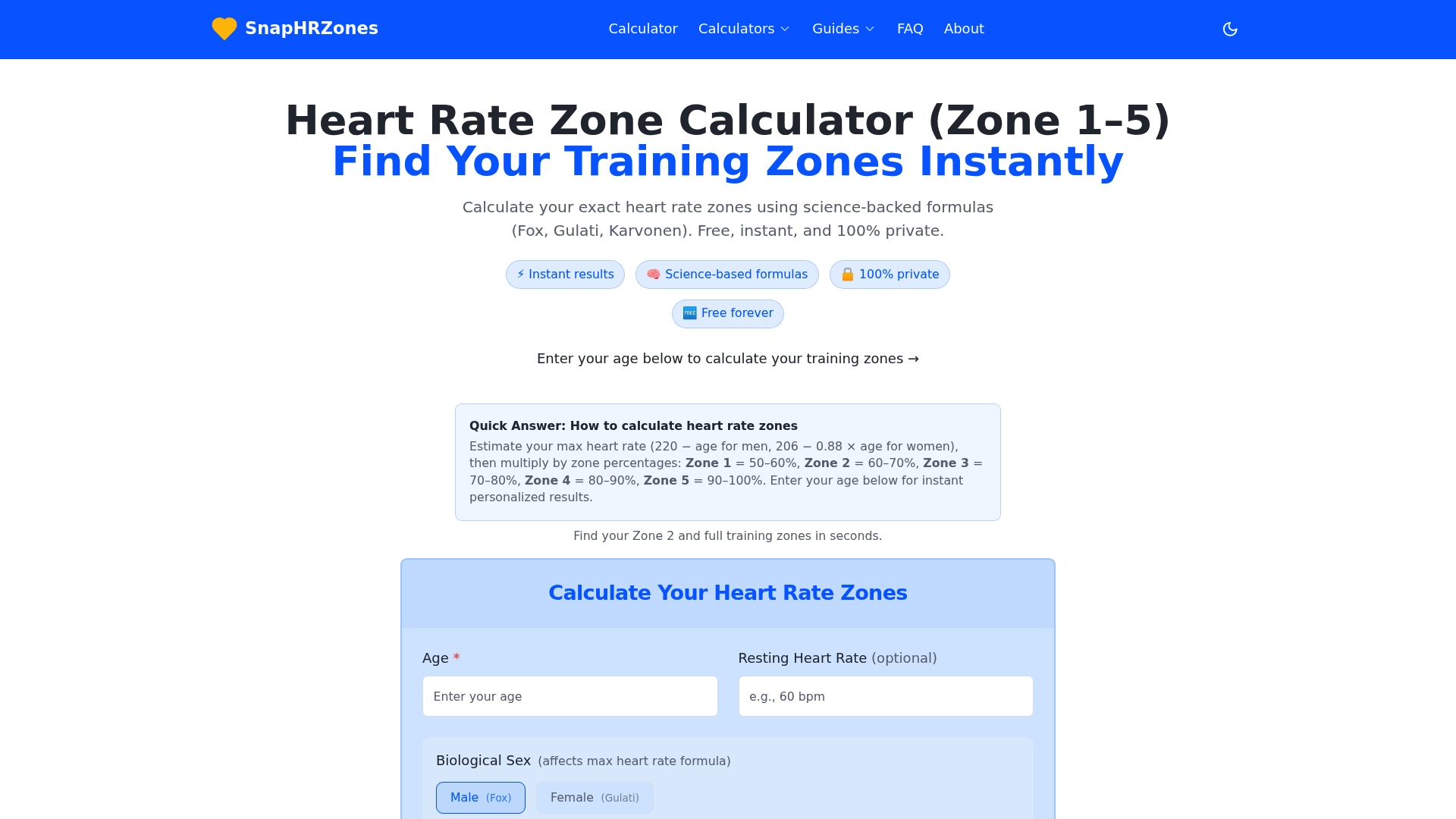
Once you have your estimated range, you can use it like this:
- Set a heart rate alert on your watch or app near the top of your estimated Zone 2 range, and use it as a guide rather than a hard physiological boundary.
- Walk at a pace that mostly keeps you around or below the alert.
- Confirm with the talk test every 10 to 15 minutes to make sure the number matches how you actually feel.
Try the Heart Rate Zone Calculator before your next walk and use the estimated range, together with the talk test, as a guide for your sessions.
FAQ
Can you get Zone 2 by walking?
Yes, brisk walking at a controlled effort falls within Zone 2 for many people, particularly when paced using the talk test or a personalized heart rate range. There is no universal walking pace that defines Zone 2 — heart rate response depends on fitness, age, incline, terrain, heat, altitude, fatigue, medications and individual physiology, so any pace example is illustrative only. If you are already fit and flat walking stays too easy, add pace, incline or hills, or consider another low-impact option.
Is 30 minutes of Zone 2 enough?
A 30-minute walk is a reasonable session, especially when done several times a week toward the public health target of 150 to 300 weekly minutes of moderate activity. Longer sessions or higher weekly frequency build more aerobic volume if that is your goal.
How do you know if you're in Zone 2?
The clearest no-equipment signal is the talk test: you can speak in full sentences comfortably, but singing feels difficult. A steady heart rate within your personalized range — rather than one that keeps climbing — is the second confirmation.
What if my heart rate stays low when I walk?
That is normal for fitter people. Walk faster, add incline or hills, use a more purposeful power-walking style, extend the duration, or switch to another low-impact modality such as cycling if walking cannot comfortably reach the effort you want. Do not force your heart rate upward at all costs — the goal is sustainable aerobic effort, not a watch number.
How long should I walk in Zone 2 to lose weight?
Consistency across the week matters more than any single session. The CDC's 150 to 300 minutes per week of moderate activity is a sustainable target. Body-fat change depends on overall energy balance over time, so treat walking as one contributor rather than a standalone weight-loss method.
Sources
Find your personal heart rate zones
Enter your age to get all five training zones in seconds.
Open the heart rate zone calculator