Normal Resting Heart Rate by Age: Measurement, Athletes and Warning Signs
Quick answer: Adults commonly have a resting pulse of 60–100 bpm; children’s ranges depend on age and trained athletes may be lower. Reference ranges are not diagnoses. Symptoms, medication and persistent changes matter; chest pain, fainting or severe breathlessness requires emergency help.

For teens 13 and older and adults, a commonly cited resting reference range is 60 to 100 beats per minute (bpm), according to Cleveland Clinic’s age table. The number does not change much from your 20s to your 70s. Younger children run faster. If you run, ride or swim a lot, your own normal may sit well below 60, but training status alone does not establish that a low reading is safe. Symptoms, medication, rhythm and your usual pattern matter alongside the range; no calculator can diagnose a reading.
This guide explains how to measure your resting pulse, interpret individual and athlete variation, and recognize symptoms that need medical assessment. For a quick visual lookup rather than a detailed explanation, use our resting heart rate reference chart.
TL;DR
- Resting heart rate is 60 to 100 bpm for adults and teens 13 and older, per Cleveland Clinic and Mayo Clinic. Children and infants have higher ranges.
- Regular endurance training often lowers resting rate. The American Heart Association says active people and athletes may be as low as 40 bpm.
- Resting rate and exercise heart rate are different things. Age-based charts of 100 to 170 bpm are exercise targets, not resting norms.
- Measure it first thing in the morning, lying still, and track the trend over weeks instead of reacting to one number.
- A rate that is regularly above 100, or low with fainting, dizziness or shortness of breath, is a reason to talk to a clinician.
Table of Contents
- Normal resting heart rate by age
- Why runners and triathletes often sit below 60
- Resting heart rate is not your training heart rate
- How to measure your resting heart rate accurately
- Is 85 bpm normal for an endurance athlete?
- When a reading calls for medical advice
- Turning your baseline into training zones
- A simple routine for runners and triathletes
- FAQ
- Sources
Normal resting heart rate by age
Reference, not diagnosis: These are Cleveland Clinic’s awake, non-exercising ranges. Pediatric references differ in age bands and conditions; a child’s illness, distress and symptoms require clinical interpretation. Do not use adult training zones for children.
Resting heart rate is the number of beats per minute while you are awake, calm and not moving. Mayo Clinic defines it this way and gives 60 to 100 bpm as the usual adult range.
Cleveland Clinic publishes this age breakdown for awake, non-exercising people:
| Age | Typical resting range (bpm) |
|---|---|
| Birth to 4 weeks (newborn) | 100 to 205 |
| 4 weeks to 1 year (infant) | 100 to 180 |
| 1 to 3 years | 98 to 140 |
| 3 to 5 years | 80 to 120 |
| 5 to 12 years | 75 to 118 |
| 13 to 17 years | 60 to 100 |
| Adults 18 and older | 60 to 100 |
These figures come from the Cleveland Clinic heart rate guide. They are reference ranges, not a claim that everyone in an age group should sit at one ideal number. Sleeping rates can be lower and active rates are faster.
Why adults share one range
The table has no separate rows for 30, 50 or 70 year olds. That is deliberate. The American Heart Association’s target heart rate page gives the 60 to 100 bpm adult range and does not split it by adult age. If you see a chart claiming a precise resting number for each decade, treat it as an average from a particular group of people, not a standard to match.
Where the 60 to 100 range comes from
The range describes what is typical across the general adult population. It is a wide band on purpose. Fitness, stress, sleep, medication, caffeine and health conditions all move the number, so healthy people of the same age can have different resting readings.
Why runners and triathletes often sit below 60
A reading of 48 can occur in an endurance-trained adult, but a watch value alone cannot establish whether it is appropriate for you. UC Davis Health Sports Medicine explains that regular cardiovascular exercise can lower resting heart rate. The heart gets larger and contracts more strongly, and it has more time to fill between beats. Increased parasympathetic activity, the part of your nervous system that slows the heart at rest, also contributes. Rates below 60 occur more often in endurance-trained people.
Harvard Health describes the same logic in plain terms: a stronger heart muscle pumps more blood per beat, so fewer beats are needed to deliver oxygen at rest. It notes that endurance athletes and people who exercise a great deal can have rates below 40. Its example of a fit, symptom-free runner with a rate around 45 to 48 is one it generally does not see as a concern.
The 2021 JACC review of exercise-induced cardiovascular adaptations discusses exercise-related adaptations. Very low rates can occur in highly trained people, but do not use an athlete example as your personal safety threshold.
The American Heart Association says more active people and athletes may be as low as 40 bpm, and Cleveland Clinic says athletes commonly have resting rates in the 40s or 50s.
Context decides what is normal
The same low number can mean different things in different people. Harvard Health stresses symptoms and training status over the number alone. A low reading may be an athletic adaptation, but new or unusually low readings and symptoms still warrant assessment. A similar reading in someone who is inactive may have a medical cause. Mayo Clinic makes the same distinction: it advises medical discussion when the rate is often below 60 in someone who is not a trained athlete.
There is a practical side to this for you. A gradual resting-rate change can accompany training adaptation, but is not a standalone fitness test. If you want to understand how a related measure behaves alongside it, our piece on HRV versus heart rate covers the difference, and an external discussion of how to improve heart rate variability looks at what influences it.
Resting heart rate is not your training heart rate
- RestingAwake, calm and still · baseline context and trends, not a fitness verdict
- ExerciseDuring activity · workload response affected by conditions and medication, not a resting reference
- MaximumUpper exercise rate · suitable supervised testing or a formula estimate, not a health target
These categories are not diagnostic zones. A resting reference table cannot prescribe exercise intensity.
Much of the confusion around this keyword comes from mixing two different numbers.
- Resting heart rate is your baseline when calm and still.
- Exercise heart rate is what your heart does while you run, ride or swim. It can be two or three times your resting rate.
- Maximum heart rate is the highest rate reached during sufficiently intense exercise. Predicted values are estimates, not a reason to attempt an unsupervised maximal test.
The American Heart Association’s target chart uses an estimated maximum of 220 minus your age. It sets moderate-intensity activity at roughly 50 to 70% of that maximum and vigorous activity at roughly 70 to 85%. Its examples, from the AHA target heart rate chart:
| Age | Target range for exercise (bpm) |
|---|---|
| 20 | 100 to 170 |
| 40 | 90 to 153 |
| 50 | 85 to 145 |
| 70 | 75 to 128 |
These are exercise ranges. A resting heart rate of 100 to 170 would be a very different situation from an exercise heart rate of 100 to 170. If a chart shows numbers like these under the heading “normal heart rate by age,” check whether it is describing rest or effort.
A worked example for a 40-year-old runner
Take a 40-year-old runner. The AHA formula gives an estimated maximum of 180 bpm (220 minus 40). Fifty to eighty-five percent of 180 is 90 to 153 bpm, which matches the AHA table. That illustrates the AHA percentage calculation; it is not a guarantee that any pace or heart rate is suitable for this runner.

The formula is an estimate based on age alone. Real maximum rates vary between individuals of the same age, so treat the result as a starting point and adjust it with how the effort feels. Methods that use your resting rate, such as the Karvonen approach, add a personal baseline to the calculation.
How to measure your resting heart rate accurately
A good measurement is the difference between a useful baseline and noise. Here is a routine built from the guidance of the American Heart Association and UC Davis Health.
- Choose the morning. The AHA recommends checking resting heart rate in the morning after a good night’s sleep, before getting out of bed or having coffee.
- Lie still for at least five minutes. UC Davis Health Sports Medicine recommends measuring while lying quietly for at least five minutes.
- Count or read it. Use two fingers gently on the wrist and count for a full 60 seconds, or use a suitable device while still. Do not use your thumb. Repeat an unexpected device reading manually when practical; an irregular pulse or symptoms warrants clinical advice.
- Repeat over several days. Averaging a week of readings smooths out bad nights and stress.
- Write it down. A trend line over weeks tells you far more than a single morning.
What can nudge the number up or down
The AHA lists stress, anxiety, hormones, medication and physical activity as factors that can affect your rate. UC Davis Health adds that stress, caffeine and excitement can temporarily raise it, while meditation or slow deep breathing may lower it. For athletes the practical translation is simple: a hard session the day before, a poor night, a hot room, alcohol or an early-morning stress spike can all push a reading higher without anything being wrong.
Using a trend, not a single number
Cleveland Clinic points out that what is typical for you matters, and that a sustained change from your usual reading can be noteworthy even if a single reading sits inside the broad population range. So if your baseline is 48 and it sits at 58 for several weeks with no obvious cause, that shift is worth paying attention to, even though 58 may be usual for some trained adults and is below the general 60–100 reference range.
Is 85 bpm normal for an endurance athlete?
For the general adult population, 85 bpm at rest falls inside 60 to 100. For a runner or triathlete whose baseline is in the 40s or 50s, 85 is a large jump. It may simply reflect a bad night, illness coming on, heavy stress, caffeine or a measurement taken after moving around. Check again later in the day to see whether it falls, as Cleveland Clinic suggests for temporary rises. If your resting rate stays well above your own norm for days alongside unusual fatigue or other symptoms, discuss it with your doctor.
This is also why age-based tables are a weak tool for judging yourself. Your own history is useful context, but cannot rule out a medical problem.

When a reading calls for medical advice
Several things can speed up or slow down the heart: fitness level, stress or anxiety, sleep, substances, medicines, pregnancy and health conditions such as an overactive thyroid. According to Cleveland Clinic, you should discuss consistently fast or slow readings with a provider.
The guidance from both major clinics is specific enough to act on:
- Regularly above 100 bpm at rest. Mayo Clinic advises a medical conversation. A single high reading may be temporary during stress or anxiety, so recheck later.
- Often below 60 if you are not a trained athlete. Mayo Clinic advises talking to a clinician. Very fit athletes may sit near 40.
- Any low or high reading with fainting, dizziness or shortness of breath. Mayo Clinic flags these as reasons to seek professional advice.
- Below 35 to 40 bpm, or above 100 with palpitations, shortness of breath, chest pain or dizziness. Cleveland Clinic advises seeking immediate care.
If you have chest pain, fainting or severe shortness of breath, treat it as an emergency and call 911. For a persistent pattern that worries you, see your primary care doctor or a sports cardiologist. Do not rely on a calculator or an article to interpret symptoms.
Athletes and the “athlete’s heart”
The AHA/ACC scientific statement published in 2025 on clinical considerations for competitive sports describes the structural, functional and electrical changes that come with habitual exercise as the athlete’s heart, and emphasizes that clinicians need to tell these changes apart from disease. For you, the takeaway is that unusual findings on a screening should be interpreted by someone who knows athletes, in the context of your training and symptoms.
Turning your baseline into training zones
Once you know your resting rate, you can use it. Zone-based training spreads your effort across easy, moderate and hard intensities, and an accurate zone starts from accurate inputs. That is why a calculator that allows an optional resting heart rate gives a more personal result than age alone. Our Heart Rate Zone Calculator is free, uses gender-specific formulas, and lets you add your resting heart rate if you have measured it.
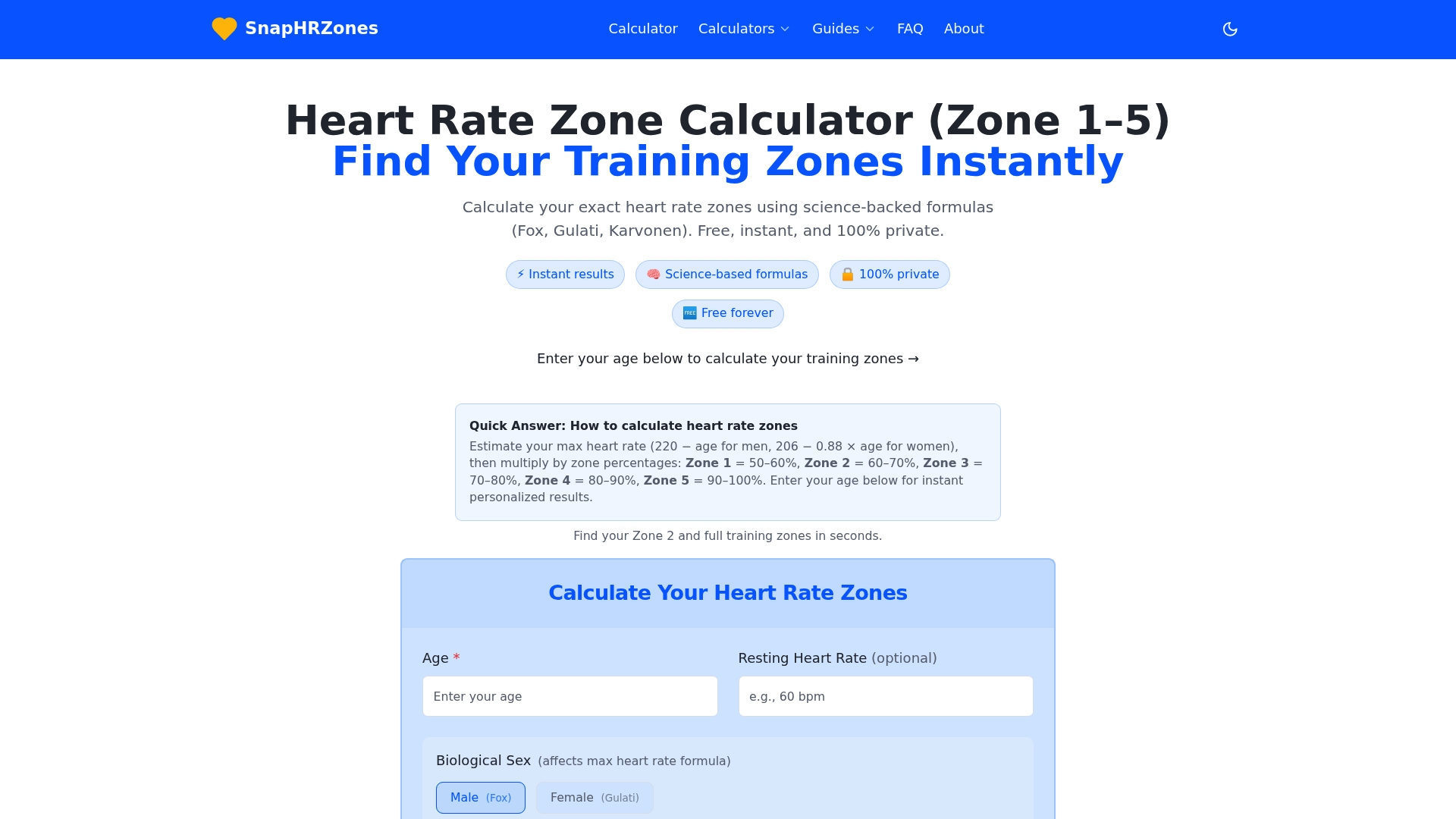
If easy aerobic running is your focus, our Zone 2 guide shows how to find your range, and our age pages show how the numbers shift across a lifetime, for example the heart rate zones for a 32-year-old or the zones for a 52-year-old. If you want a maximum heart rate estimate for your age, there are pages such as max heart rate for a 44-year-old man. Treat any formula result as an estimate and let how the effort feels guide you.
A simple routine for runners and triathletes
This is a low-effort way to use resting heart rate across a season.
- Take a seven-day average at the start of a training block and call it your baseline.
- Re-measure for a week every four to six weeks. A gradual drop is consistent with aerobic adaptation, as UC Davis Health describes.
- On any given morning, compare your reading with your own average, not with a table.
- If a reading is well above your norm, note the context: sleep, alcohol, illness, stress, a hard session. Recheck later.
- If the elevation lasts, comes with symptoms or sits above 100 at rest, speak with a clinician.
This habit costs nothing and pairs well with the heart rate zones you use in training. Reference ranges tell you whether your number is common. Your own history tells you whether it is changing.
FAQ
What is a normal resting heart rate for adults?
For adults and teens 13 and older, the usual range is 60 to 100 bpm, according to Cleveland Clinic and Mayo Clinic. The range does not narrow by adult decade. Fitness, stress, sleep and medication can all move your own reading within or outside it.
Is a resting heart rate of 50 normal for a runner?
Often yes. Cleveland Clinic says athletes commonly have resting rates in the 40s or 50s, and Harvard Health says a fit, symptom-free runner around 45 to 48 is usually not a concern. Fainting, dizziness or unusual weakness alongside a low rate should be checked by a doctor.
Is a heart rate of 100 to 170 bpm normal?
It may occur during exercise, but is not universally appropriate or safe. The AHA’s target range for a 20-year-old is 100 to 170 bpm, and that is an exercise range, not a resting one. At rest, a rate regularly above 100 is a reason to discuss it with a clinician.
What is the best time to check resting heart rate?
The AHA recommends the morning after a good night’s sleep, before getting out of bed or having coffee. UC Davis Health suggests lying quietly for at least five minutes first. Repeat across several days to see your pattern.
When should I worry about a low or high resting heart rate?
Talk to a clinician if your rate is regularly above 100, or often below 60 and you are not a trained athlete. New, unusually low or high readings need assessment in context; do not wait for a particular cutoff if you have symptoms. Chest pain, fainting or severe breathlessness requires emergency help—call 911. Persistent unexplained changes without severe symptoms warrant a clinician appointment.
Sources
- Heart Rate: Normal Rates & What To Know, Cleveland Clinic
- Target Heart Rates Chart, American Heart Association
- Heart rate: What’s normal? Mayo Clinic
- Heart Rate, Sports Medicine, UC Davis Health
- Is a low heart rate worrisome? Harvard Health
- Exercise-Induced Cardiovascular Adaptations, JACC 2021
- Clinical Considerations for Competitive Sports, JACC
Recommended
Find your personal heart rate zones
Enter your age to get all five training zones in seconds.
Open the heart rate zone calculator