Active Recovery Workout: How Easy Should You Really Go?
Quick answer: An active recovery workout is intentionally light activity, not another endurance-training session. The objective is comfortable movement while avoiding meaningful additional fatigue. Keep the effort very easy, keep it fairly short, and use the talk test, perceived exertion and heart rate as supporting checks. A complete rest day may be preferable when you are unusually fatigued, ill, injured or struggling to recover.

An active recovery workout is low-intensity movement done after a hard session or on a rest day, such as an easy walk, a relaxed spin, a gentle swim or mobility work. The goal is comfortable movement without adding real training stress. For most runners and triathletes, the main rule is simple: keep it truly easy, keep it fairly short, and skip it when you are sick, injured or exhausted.
This guide covers what counts as active recovery, how to set the effort using heart rate, sample sessions for runners and triathletes, how often to schedule them, and what the research does and does not show.
TL;DR
- Active recovery means light movement (walking, easy cycling, swimming, mobility, yoga) after hard efforts, not a slower version of a normal workout.
- Effort guidance in published sources runs from about 50% to 60-65% of max heart rate, so keep it well below your usual training zones.
- Sessions in the sources range from about 20 to 90 minutes, and many runners do well at the shorter end.
- Research is encouraging for soreness, but evidence for performance gains is mixed, so treat it as one tool among sleep, food and full rest.
- Skip it when you are injured, sick, short on sleep or simply not up to it.
Table of Contents
- What counts as active recovery?
- How easy should an active recovery workout be?
- Can you use heart-rate zones for recovery?
- Five practical active recovery workouts
- Active recovery for runners
- Active recovery for triathletes
- Should you train when your heart rate is unusually high?
- Does active recovery actually speed up recovery?
- When should you take a full rest day instead?
- A simple weekly example
- Common mistakes
- FAQ
- Sources
What counts as active recovery?
Cleveland Clinic describes active recovery as low-intensity physical activity after exercise that is strenuous or high-intensity for you. The word “for you” matters. A pace that is easy for an experienced marathoner could be a hard effort for someone newer to running.
It helps to separate a few ideas that are easy to mix up. Active recovery is deliberately light movement done to help you bounce back. Easy aerobic training is still training, with a fitness goal of its own. A rest day is exactly that. Deloading means a planned easier week, not a single light session. And a normal warm-up or cooldown is part of a workout, not a session of its own. Not every easy workout is automatically a recovery session.
The idea is that moving during a time you would normally rest helps your body recover while still supporting strength and endurance. Runner’s World UK says the main aim is to increase blood flow to fatigued muscles, delivering oxygen and nutrients that help repair damaged muscle fibers.
It also helps to use different muscles. A Cleveland Clinic sports medicine physician points out that running uses the same muscles over and over, and that recovery exercise at lower intensity can work other muscles that still build strength and stamina. That is one reason triathletes have a built-in advantage: swimming and cycling offer a break from pounding.
Cleveland Clinic lists walking or jogging, stretching, yoga, foam rolling, Pilates, cycling and swimming as suitable low-impact options, and says any low-impact exercise between sets, after a workout or on rest days falls under the umbrella.
Active recovery is different from passive recovery, which means sleep, massage or full days off. You need both. Active recovery is not a replacement for rest.
How easy should an active recovery workout be?
The most common mistake is turning a recovery day into a moderate session. You feel fine, the legs feel good, and the pace creeps up. Before long, you have a medium-hard day sitting between your key workouts, which is the “moderate intensity rut” many athletes fall into.
Three practical checks, used together, keep you honest:
- Conversational effort. You should be able to speak in full sentences without pausing for breath.
- Perceived exertion. On a 1-to-10 effort scale, stay around 2 or 3. Nothing should feel like work.
- Heart rate as a supporting indicator. A heart rate ceiling backs up the first two checks, especially on days when you feel fresh and are tempted to push.
Recovery intensity should generally feel very easy. The published guidance varies a little by source and by sport:
| Source | Suggested effort | Context |
|---|---|---|
| Runner’s World | No more than 60 to 65 percent of max heart rate, under 60 minutes | Active recovery after a marathon |
| University of Washington Medicine | About 50-60% of maximum effort | Six to 10 minute cooldown after a workout |
| Healthline | No more than 50 percent of maximum effort | Active cooldown |
These are not identical, and they were written for different situations, so treat them as a range rather than a single correct number. Note also that “maximum effort” and “maximum heart rate” are not always the same thing in these articles. There is no single universal heart-rate percentage that science has established as the recovery threshold for everyone. If you are unsure, the conservative choice is the lower end.
Can you use heart-rate zones for recovery?
Yes, with a few honest caveats. Heart rate gives you a ceiling that does not depend on how motivated you feel that day.
To turn a percentage into beats per minute, you need a max heart rate. A formula gives an estimate, not a measurement: maximum-heart-rate formulas are population estimates, and individual maximums vary. Where your easy-zone boundary sits also depends on the method you choose, since different zone models divide the range differently. You can get an estimate with our Heart Rate Zone Calculator, then multiply by the percentage that fits your session. For example, if an estimate gave you 180 bpm, 60% would be 108 bpm and 65% would be 117 bpm. That is a ceiling, not a target to chase.
Heart rate itself also moves around. Heat, dehydration, medication, caffeine, poor sleep, accumulated fatigue and simple measurement error can all push a reading up or down on a given day. And because a broad aerobic zone covers a wide range, a recovery workout may need to sit easier than the upper boundary of that zone. Treat the number as a cap and let how you feel have the final say.
Check your heart-rate zones before your next easy session. Enter your age and, if you know it, your resting heart rate on the SnapHRZones calculator to get zone ranges you can use as a ceiling for recovery days.
If you do not use a monitor, effort by feel works too. Our guide to heart rate training without a monitor explains how to use breathing and talking as a guide. A reasonable editorial rule of thumb: you should be able to speak in full sentences, and nothing should feel like work. If you are breathing hard or feeling challenged, you have drifted into training.
Five practical active recovery workouts
These are examples built from the activity types above, not prescriptions. Durations are flexible illustrations, not mandatory physiological prescriptions. Adjust the length to how you feel and what your coach or training plan says.
1. Easy spin on a stationary bike or trainer
Suits almost anyone, especially runners who want zero impact. Spin with light resistance and a comfortable cadence for 20 to 40 minutes. The effort should feel almost too easy, with your heart rate at or below the low end of the ranges above. It becomes too demanding the moment you add sprints, heavy resistance or speed and power targets. If your legs feel heavier as you go, or you are coming back from illness, rest is the better call.
2. Relaxed swim
Suits triathletes and any runner with pool access. Swim 15 to 30 minutes of easy laps, mixing strokes if you like, with a few minutes of kicking with a board or gentle pull work. It should feel smooth and unhurried. It is too demanding if you are gasping at the wall or counting intervals. Runner’s World UK notes that a study in the International Journal of Sports Medicine found that swimming as recovery boosted running performance, which researchers linked to reduced inflammation. That is one study, so think of it as a reason to try it rather than a guarantee.

3. Walk plus mobility
Suits everyone, including complete beginners and anyone coming back from a race. Walk for 20 to 40 minutes at a conversational pace, then spend 10 minutes on easy mobility: hip circles, leg swings, calf and hip flexor stretches, and a few slow bodyweight movements. Add foam rolling if you find it helpful. It is too demanding if the walk becomes a power hike with a racing heart. If even walking feels like a strain, take the day off.
4. Gentle yoga or Pilates
Suits athletes who want mobility and light core work in one session. A 20 to 45 minute session of beginner-level yoga or Pilates covers both. Choose flowing, easy classes and skip anything labeled power or hot if you are already fatigued. It is too demanding when poses become strength holds that leave you shaking. If you are exhausted or sore to the point of altered movement, rest instead.
5. Short post-run cooldown
Suits days when you only have a few minutes after a hard session. University of Washington Medicine says current research shows six to 10 minutes of cooldown at about 50-60% of maximum effort after a workout can help reduce inflammation and muscle breakdown. Walk or jog very slowly until your breathing settles. It is too demanding if you extend it into another training loop.
Active recovery for runners
Picture the day after a hard interval workout or a long run. Your legs are heavy, and another run, even a slow one, repeats the same impact on the same tissues. That is the day when walking or easy cycling is often the smarter choice: you get blood flow without more pounding.
Walking is the simplest option and the one most runners underuse. A brisk-but-relaxed walk, a flat hike on soft trail, or an easy bike ride all fit. Some runners prefer a short, very slow jog, but be honest with yourself about whether it is truly recovery. Runner’s World recommends walking, riding a bike, stretching or swimming for 30 to 60 minutes at low intensity to promote circulation after a marathon, and notes that massage and foam rolling can help with soreness.
Active recovery for triathletes
Switching disciplines is the triathlete’s built-in advantage. Moving from running to cycling or swimming reduces repeated loading of the same structures, without guaranteeing recovery by itself.
Triathlete.com says active recovery for triathletes is usually swimming, easy riding or spinning, or stretching and mobility work. It describes the right feel as low resistance, light load and zero impact, and does not recommend running or gym strength work for this purpose.
USA Triathlon takes a similar view: easy rides, walks, swims, and yoga or light strength training are usually fine on recovery days, while running is the hardest on the body and usually would not be considered a recovery workout for a triathlete. It adds that one or two short, easy maintenance runs can help keep you from detraining on the run.
Should you train when your heart rate is unusually high?
Some runners notice that even at a very slow pace their heart rate sits higher than expected. Heat, poor sleep, caffeine, dehydration and accumulated fatigue can all play a part. An elevated heart rate at a familiar easy pace is a useful contextual observation, but it is not a diagnostic test.
If that sounds familiar, our four checks for a high heart rate on slow runs walk through what to look at before you change your pace. Consider fatigue, illness, temperature, sleep and your overall symptoms alongside the number. On a recovery day, a high reading is a reason to slow down further, or to take the day off.
Does active recovery actually speed up recovery?
Active recovery has a decent body of research behind it, but the findings are more nuanced than headlines suggest. It helps to separate four questions: whether you feel less stiff, what happens to blood lactate, whether your performance is actually restored sooner, and whether long-term adaptation changes.
Soreness. A 2018 systematic review and meta-analysis in Sports Medicine found that active recovery produced a small to large decrease in delayed onset muscle soreness. The authors suggest this may be explained by enhanced blood flow in muscle tissue, which helps remove metabolic waste. A 2022 systematic review in Strength & Conditioning Journal also reported alleviated soreness and decreased inflammation after protocols such as aqua exercise, yoga and combined jogging and running.
Lactate. A 2010 study in the Journal of Sports Sciences found active recovery cleared blood lactate faster than passive recovery, depending on intensity. That finding is about blood chemistry in a lab setting, not about how your legs will feel tomorrow, and soreness is not caused by lactate sitting in your muscles, so avoid reading too much into it. Faster lactate clearance does not prove faster muscle repair.
Adaptation. A 2019 study by Yamagishi and Babraj found that active recovery at 40% of V̇O2 peak during sprint interval training led to greater endurance adaptations, including a 7.9% increase in critical power, compared with passive recovery. That was a specific protocol, recovering between sprints within one session, not a rest-day routine.
Performance and individual differences. A 2019 systematic review in the Journal of Strength & Conditioning Research found consistently positive performance effects in interventions lasting 6 to 10 minutes, but the right intensity was inconclusive. It also noted positive psychological outcomes, a need to individualize recovery, and weak evidence for postexercise active recovery, particularly for performance.
Taken together: active recovery looks helpful for how you feel and probably for soreness, while the case for faster performance gains is less settled. It is not always superior to passive rest. That is a good reason to keep sessions modest and to pay attention to your own response.
When should you take a full rest day instead?
Active recovery is not right for every day. Cleveland Clinic advises avoiding it if you are injured, sick, not getting enough sleep, or do not feel up to the activity, and suggests passive options such as sleep, massage or cryotherapy instead.
Soreness is a useful guide. Cleveland Clinic says that if you are only experiencing low-level soreness, it is probably fine to try a lighter workout, and gives a rule of thumb: soreness of 2 or 3 out of 10 that is not getting worse during exercise and does not limit daily activities is probably normal. If soreness is more painful or makes routine movement harder, avoid strenuous activity until it settles. If your legs are sore rather than tired, our guide to what helps sore muscles after a workout can help you decide between movement and rest.
Ordinary fatigue is one thing; potentially concerning symptoms are another. See a doctor or physical therapist if pain is sharp, localized to a joint or bone, getting worse over days, or comes with swelling, or if you feel unwell in a way that does not match normal training fatigue.
Tracking how you respond
If you want data, resting heart rate, heart rate recovery and HRV can show how well you are bouncing back. Our guide to HRV vs heart rate explains how to choose one and build a baseline, and heart rate recovery after exercise shows how to compare readings at the one-minute mark. These are tools for spotting trends, not for diagnosing anything.
A simple weekly example
There is no single correct duration or schedule. The sources point to a wide window: a cooldown of roughly 6 to 10 minutes after a hard session, sessions of 20 to 90 minutes for triathletes on dedicated recovery days, and less than 60 minutes at light effort for runners returning after a marathon, per Runner’s World. A practical way to choose: start at 20 to 30 minutes and stop early if your legs feel heavier rather than looser. A good recovery session should leave you feeling slightly better than when you started, not tired.
USA Triathlon describes post-workout recovery as the 12 to 48 hours after a challenging workout, and cyclic recovery as a few easy days inside a two-to-four-week training cycle. Active recovery can sit in either spot. For frequency, University of Washington Medicine suggests that if you train five to seven days a week, you switch one or two of those days to active recovery to avoid overtraining. If you train three to four days a week, adding a day or two of active recovery can help keep momentum going.

Triathlete.com recommends at least one full day per week assigned to active recovery, one to three complete rest days within your periodization, and a longer planned break, typically five to 10 days each season. It also advises limiting really intense sessions to three or four per seven-to-10-day cycle, and monitoring easy sessions as carefully as hard ones.
This is an illustration of how the pieces can fit around harder running or triathlon training, not an individual training prescription:
| Day | Session |
|---|---|
| Monday | Active recovery: easy spin or swim |
| Tuesday | Quality session (intervals or tempo) |
| Wednesday | Easy aerobic run or ride |
| Thursday | Quality session |
| Friday | Complete rest |
| Saturday | Long session |
| Sunday | Active recovery: walk and mobility |
If your quality days use intervals, our guide to interval training heart rate targets covers both the work and recovery portions. And if you find yourself drifting into the middle intensity range on easy days, Zone 3 training explains when that effort is useful and when it is not.
Set your recovery ceiling with our calculator
The hardest part of an easy day is staying easy. Our Heart Rate Zone Calculator is free, uses gender-specific formulas, and accepts an optional resting heart rate for more personalization. Enter your details to get an estimated max heart rate and zones, then use the lower end as your cap for recovery sessions. If you want to see where your steady aerobic range sits, calculate your Zone 2 and keep recovery days below it.
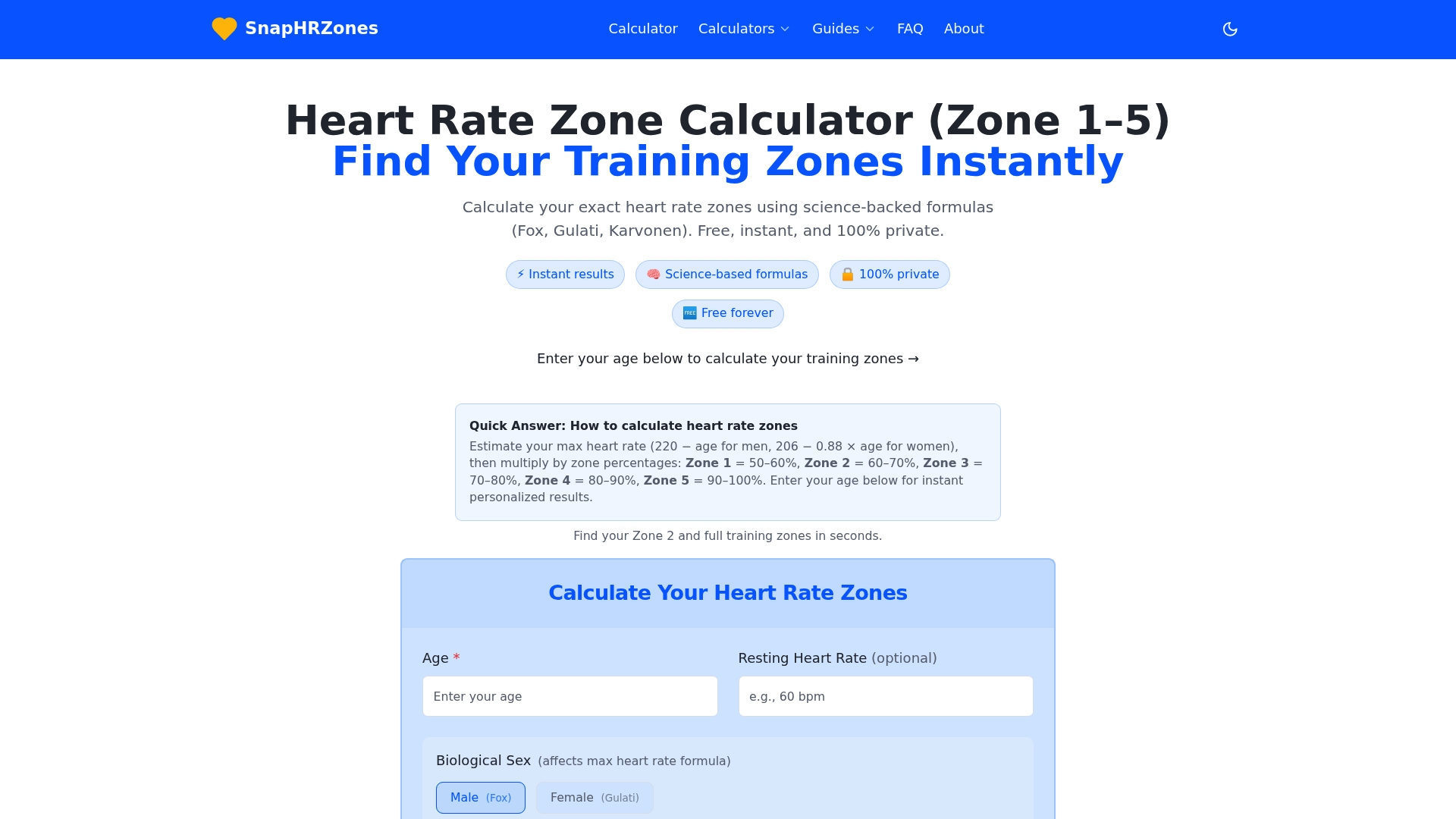
Runners can also see how these numbers translate into pace and effort in our heart rate zones for running guide.
Common mistakes
- Going too fast. If your recovery run feels like a normal run, it is not recovery. Walk, or switch to a bike or pool.
- Chasing numbers. Skip pace, power and distance targets. Heart rate or feel is enough.
- Doing too much. Easy sessions add up. Triathlete.com’s advice to monitor easy sessions as carefully as hard ones applies here.
- Ignoring your body. If you feel sick, injured or wrecked, a full rest day is the better call.
- Treating it as a fix for everything. Sleep, food and hydration still do much of the work.
FAQ
What is the best workout for recovery?
There is no single best option, but low-impact choices like walking, easy cycling, swimming, yoga and mobility work are the most commonly recommended. For triathletes, swimming and easy spinning are common picks because they avoid impact. Choose the one you will actually keep easy.
What is a good recovery workout for stationary bike rides?
Ride with light resistance at a comfortable cadence for about 20 to 40 minutes, staying at the low end of your heart rate range. Published guidance runs from no more than 50% to 60-65% of max, depending on the source. You should be able to talk easily the whole time.
Should I work out after 2 days of being sore?
If the soreness is mild, around 2 or 3 out of 10, and does not get worse as you move, a lighter workout is generally considered fine. If it is more painful or makes everyday movement harder, avoid strenuous activity until it eases. Sharp or worsening pain is worth checking with a doctor.
Can I run on a recovery day?
Some runners use a very slow jog, but running is the hardest recovery option on the body. USA Triathlon says it would usually not count as recovery for a triathlete, though one or two short easy runs can help maintain run fitness. Walking, biking or swimming are lower-impact alternatives.
Sources
- Active Recovery: Workouts and Exercises To Try, Cleveland Clinic
- Is It Normal To Be Sore After a Workout?, Cleveland Clinic
- Active recovery: What is it and how should runners do it?, Runner’s World UK
- How to Recover After a Marathon and Return to Running Safely, Runner’s World
- How Should I Plan My Recovery Days During Triathlon, Triathlete
- The many forms of recovery, USA Triathlon
- How to Reduce Soreness With Active Recovery, University of Washington Medicine
- Active Recovery: How It Works and Exercise Ideas, Healthline
- Systematic review on the effectiveness of active recovery, Journal of Strength & Conditioning Research (2019)
- Active Recovery Induces Greater Endurance Adaptations, PMC (2019)
- Blood lactate clearance during active recovery, Journal of Sports Sciences (2010)
- An Evidence-Based Approach for Choosing Post-exercise Recovery Techniques, Sports Medicine (2018)
- Effect of Active Recovery Protocols, Strength & Conditioning Journal (2022)
Recommended
Find your personal heart rate zones
Enter your age to get all five training zones in seconds.
Open the heart rate zone calculator