What Is a Dangerous Heart Rate? When to Worry and What to Do
Quick answer: There is no single dangerous heart rate for every adult. A typical resting rate is 60 to 100 bpm, and trained athletes can be lower. A rate that is suddenly very high or very low for you, especially with chest pain, fainting or severe shortness of breath, can be an emergency: call 911 or your local emergency number.

No single heart rate number is dangerous for every adult. What matters is the context: whether the reading is at rest or during exercise, how far it sits from what is normal for you, whether it changed suddenly, and above all whether symptoms come with it. A typical adult resting heart rate is 60 to 100 beats per minute (bpm), and well-trained athletes can be lower without any problem.
This guide is general education for adults, with notes for runners and endurance athletes. It is not a diagnosis, and it does not replace a clinician.
- Chest pain, pressure, squeezing or tightnessIncluding discomfort that spreads to the arm, jaw, neck, back or stomach.
- Fainting, near-fainting or collapseAt rest, during exercise or just after it.
- Severe shortness of breathBreathing trouble far out of proportion to what you were doing, or that does not ease with rest.
- A heart rate that is suddenly very fast or very slow for you, with any of these signsAlso with cold sweat, nausea, sudden dizziness or confusion.
Do not drive yourself, and do not stop to check your watch, an app or a training-zone calculator first. If symptoms were milder or have passed, contact a healthcare professional promptly. Sources: American Heart Association, AHA heart attack warning signs.
TL;DR
- There is no universal "dangerous" heart rate number. Context, change from your normal, and symptoms decide what a reading means.
- A typical adult resting heart rate is 60 to 100 bpm. Trained athletes may sit in the 40s or 50s and be healthy.
- A resting rate that is persistently above 100 bpm, or below 60 bpm when you are not a trained athlete, is worth a medical evaluation.
- A heart rate that is suddenly very high or very low for you, especially with chest pain, fainting or severe breathlessness, can be an emergency: call 911 or your local emergency number.
- Estimated maximum heart rate and training zones describe effort. They are not medical safety limits.
Table of Contents
- What counts as a normal resting heart rate
- When to act: a practical reference
- Symptoms turn a number into an emergency
- Heart rate during exercise is a different question
- When an exercise heart rate is a red flag
- Unexpected wearable readings
- What can push your heart rate up or down
- How to know your own baseline
- Putting your zones to work
- How doctors find out what is going on
- FAQ
- Sources
What counts as a normal resting heart rate
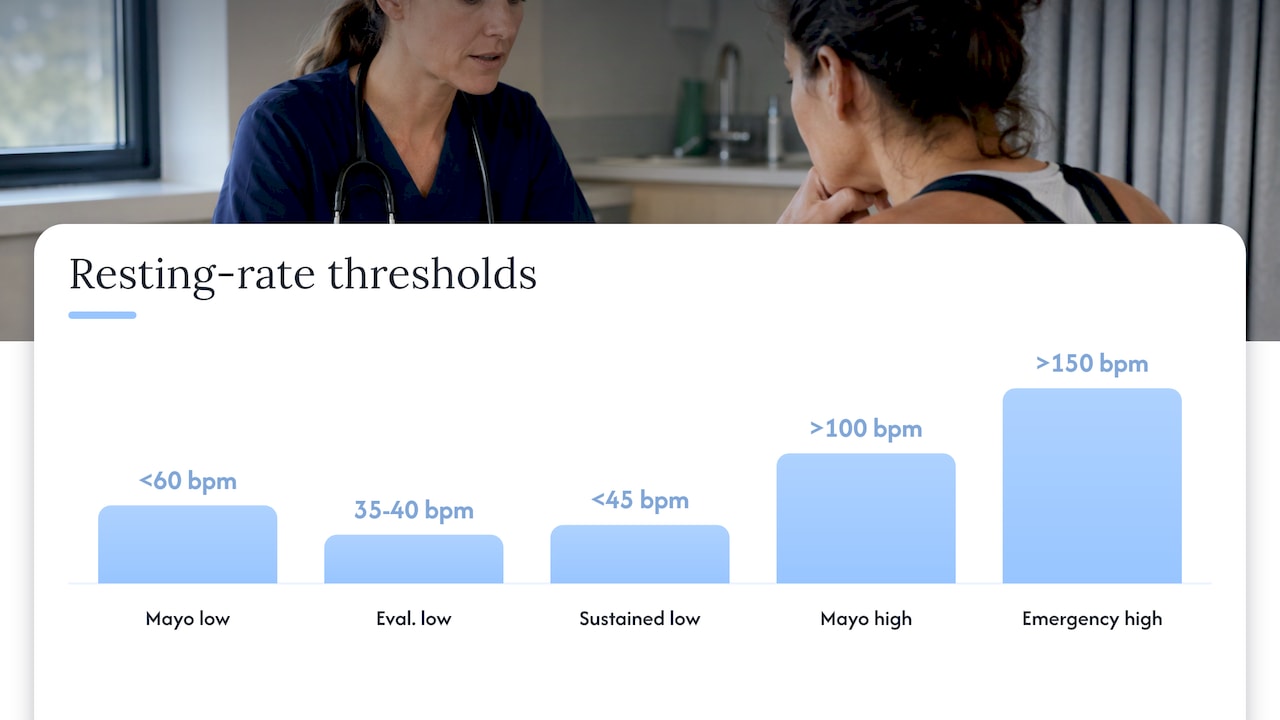
Resting heart rate is your pulse when you are calm, seated or lying down, and not recently active. Mayo Clinic puts the normal range for adults at 60 to 100 bpm and notes that very fit athletes may have resting rates closer to 40 bpm. The American Heart Association gives the same 60 to 100 range and says a rate below 60 can reflect athletic conditioning, but can also come from medication or a health problem.
Two terms describe a rate, not a disease:
- Tachycardia means a heart rate above 100 bpm.
- Bradycardia means a heart rate below 60 bpm.
MedlinePlus, from the U.S. National Library of Medicine, uses these same definitions. A runner with a resting pulse of 48 technically has bradycardia and may be perfectly healthy.
Why trained endurance athletes often have a low resting rate: regular endurance training increases how much blood the heart pumps with each beat and shifts the nervous system's control of the heart toward slower resting rates, so fewer beats are needed at rest. That is a normal adaptation when it is your steady baseline and you have no symptoms. It does not rule out a rhythm problem, so new dizziness, fainting, unusual fatigue or a sudden change from your usual low rate still deserves a medical check. Yale Medicine makes a related point in a Yale Medicine article: heart rate is a number, not a condition, and how you feel matters.
For typical resting values across ages, see our page on normal heart rate by age.
When to act: a practical reference
Instead of a universal danger scale, this table sorts situations by what to do. It is a guide to action, not a diagnostic tool.
| Situation | What it usually means | What to do |
|---|---|---|
| Resting heart rate 60 to 100 bpm | The usual adult range | Nothing specific; it does not make a worrying symptom safe |
| Resting heart rate 40 to 60 bpm in a trained athlete, no symptoms | Often a normal training adaptation | Track your own trend; get checked if it changes or symptoms appear |
| Resting heart rate persistently above 100 bpm, or below 60 bpm when you are not a trained athlete | Needs an explanation | Book a visit with a healthcare professional |
| Sudden, unexplained change from your usual rate, at rest or at an easy effort | May reflect illness, medication, or a rhythm problem | Stop exercising; contact a clinician promptly if it persists or keeps returning |
| Chest pain, fainting, severe shortness of breath, or confusion, with any heart rate | Possible emergency | Call 911 or your local emergency number; do not drive yourself |
Symptoms turn a number into an emergency
The American Heart Association advises calling 911 if your heart rate is suddenly very high or very low for you, especially with chest pain, shortness of breath, dizziness, fainting or other signs that something is wrong. There does not need to be a specific number on the screen for that advice to apply.
MedlinePlus lists warning signs for palpitations that need immediate care, including loss of consciousness, chest pain, shortness of breath, unusual sweating, and dizziness or lightheadedness. It also advises contacting a provider right away if your pulse is over 100 bpm without exercise, anxiety or fever. The AHA list of heart attack warning signs adds discomfort in the arms, back, neck, jaw or stomach, cold sweat, nausea and lightheadedness.
In short, call 911 or your local emergency number for:
- Chest pain, pressure or discomfort, with or without an unusual heart rate.
- Fainting, near-fainting or collapse.
- Shortness of breath that does not match what you were doing.
- Confusion, or other signs of a heart attack or stroke.
Do not drive yourself if you have these symptoms. Do not try home remedies or self-diagnose a fast or slow rhythm; an undiagnosed rhythm can be serious, and the absence of symptoms does not prove an unusual rhythm is harmless.
Signs to bring up at a routine visit
Not everything is an emergency. Cleveland Clinic’s patient reference lists things worth discussing with a provider: a resting rate that is consistently too fast or too slow, skipped or irregular beats, being aware of your own heartbeat, or a vibrating sensation in the pulse. If you notice any of these, write down when they happen and what you were doing, and bring that to your appointment.
Heart rate during exercise is a different question
A high heart rate is the expected response to hard exercise. The American Heart Association estimates maximum heart rate as 220 minus your age, about 200 bpm for a 20-year-old, and suggests roughly 50 to 70 percent of that maximum for moderate-intensity activity and 70 to 85 percent for vigorous activity. Using the same estimate, 90 to 100 percent of 200 bpm is 180 to 200 bpm.
Three cautions keep these numbers in their place:
- Estimated maximum is not a safety ceiling. Age formulas are population averages, and individual maximums vary widely. Seeing a number above the formula on a hard hill finish does not by itself mean something is wrong, and staying below it does not mean you are safe.
- Zones describe effort, not safety. Being inside a calculated training zone does not guarantee that exercise is safe for you. Feeling unwell is a reason to stop, whatever the watch says.
- Medication changes the picture. Beta blockers and some other medicines lower heart rate, so age-based estimates and zones may not apply. Ask your prescriber what to expect.
To see where your estimated zones fall, use our maximum heart rate calculator. For women-specific considerations such as pregnancy and hormonal changes, see our separate guide on what is a dangerous heart rate for a woman.
Wearable estimates of fitness can also differ from lab results. A review of VO2 max norms based on thousands of treadmill tests shows what measured values look like, which is a useful comparison if you want to put your own training numbers in context.
When an exercise heart rate is a red flag
Sinus tachycardia, the normal speeding up of the heart’s natural rhythm, is a common response to exercise. The American Heart Association’s tachycardia page says it is concerning when it happens at rest. It also describes supraventricular tachycardia (SVT), a fast rhythm over 100 bpm that starts in the upper chambers of the heart, with symptoms including rapid heartbeat, palpitations, a bounding pulse in the neck, fatigue, chest discomfort, shortness of breath, lightheadedness, sweating, fainting and nausea.
The Sports Cardiology Core Curriculum published in JACC gives two points that apply directly to athletes:
- Collapse during exercise with loss of consciousness is a medical emergency needing immediate assessment: call 911 or your local emergency number.
- Palpitations during exercise, or a sudden jump or drop in rate that your effort does not explain, should raise suspicion of an arrhythmia (an abnormal heart rhythm) in competitive athletes and highly active people.
So the useful question mid-run is not “Is this number too high?” but “Does this match what I am doing?” A steady climb with pace, hills and heat is expected. A sudden spike or drop at an easy effort, or a pounding, irregular feeling in your chest, is different: stop the session, and get medical advice, urgently if symptoms appear.
Unexpected wearable readings
Optical wrist sensors can misread during intervals, cold weather, or when the strap is loose, sometimes locking onto your running cadence. A reading that looks impossible may be a sensor error, but symptoms always take priority over troubleshooting.
- If you have emergency symptoms: stop and call for help. Do not check the device first.
- If you feel well: slow down or stop, sit, and count your pulse at the wrist for a full minute. Tighten the strap or compare with a chest strap.
- If unusual readings keep returning at rest or at easy effort, note the time and what you were doing and share that with a clinician. A smartwatch alert or app is not a diagnosis.
What can push your heart rate up or down
Before assuming the worst, consider what is known to change heart rate. The American Heart Association lists causes of sinus tachycardia that include anxiety, strenuous exercise, fever, some medications and illegal drugs, pain, anemia, infection, increased thyroid activity, heart muscle damage, severe bleeding, very low blood pressure and lung disease. Allina Health adds pregnancy, electrolyte imbalance, too much caffeine or alcohol, and smoking. A 2022 expert review lists dehydration among the precipitants too.
For runners and triathletes, the everyday ones are easy to spot:
- Dehydration or heat during long sessions.
- Heavy caffeine intake before a race or hard workout.
- Illness or fever, including the days before symptoms appear.
- Poor sleep and high stress.
On the slow side, the American Heart Association says a resting rate under 60 can come from athletic conditioning, but also from medications such as beta blockers. Healthline adds other bradycardia causes including electrolyte imbalance, obstructive sleep apnea, older age and conduction-system problems. If you take any medication that affects heart rate, ask your prescriber what range to expect.
A resting rate that creeps up over a week of training can reflect fatigue or illness rather than heart disease. Our article on HRV versus heart rate explains how the two measures differ when you are tracking recovery.
How to know your own baseline
Because “dangerous” is measured against “normal for you,” a baseline is the most useful thing a runner can have.
- Measure at the same time. Take your pulse first thing in the morning, before coffee and before getting out of bed or sitting up for long.
- Count for 30 seconds and double it, or use a chest strap or watch, then repeat over several mornings.
- Note the range, not one reading. Your usual spread, say a few beats either way, is your baseline.
- Log context. Record poor sleep, illness, alcohol, travel and hard training blocks.
- Compare against your own trend. A sustained shift, combined with symptoms, is something to raise with a clinician.
Watches and chest straps are convenient, and any device reading is a measurement that can be affected by fit, sweat and movement. If a number looks impossible for how you feel, pause, sit down and take your pulse by hand at the wrist for a full minute before drawing conclusions. If you also feel unwell, treat the symptoms as the priority.
Putting your zones to work
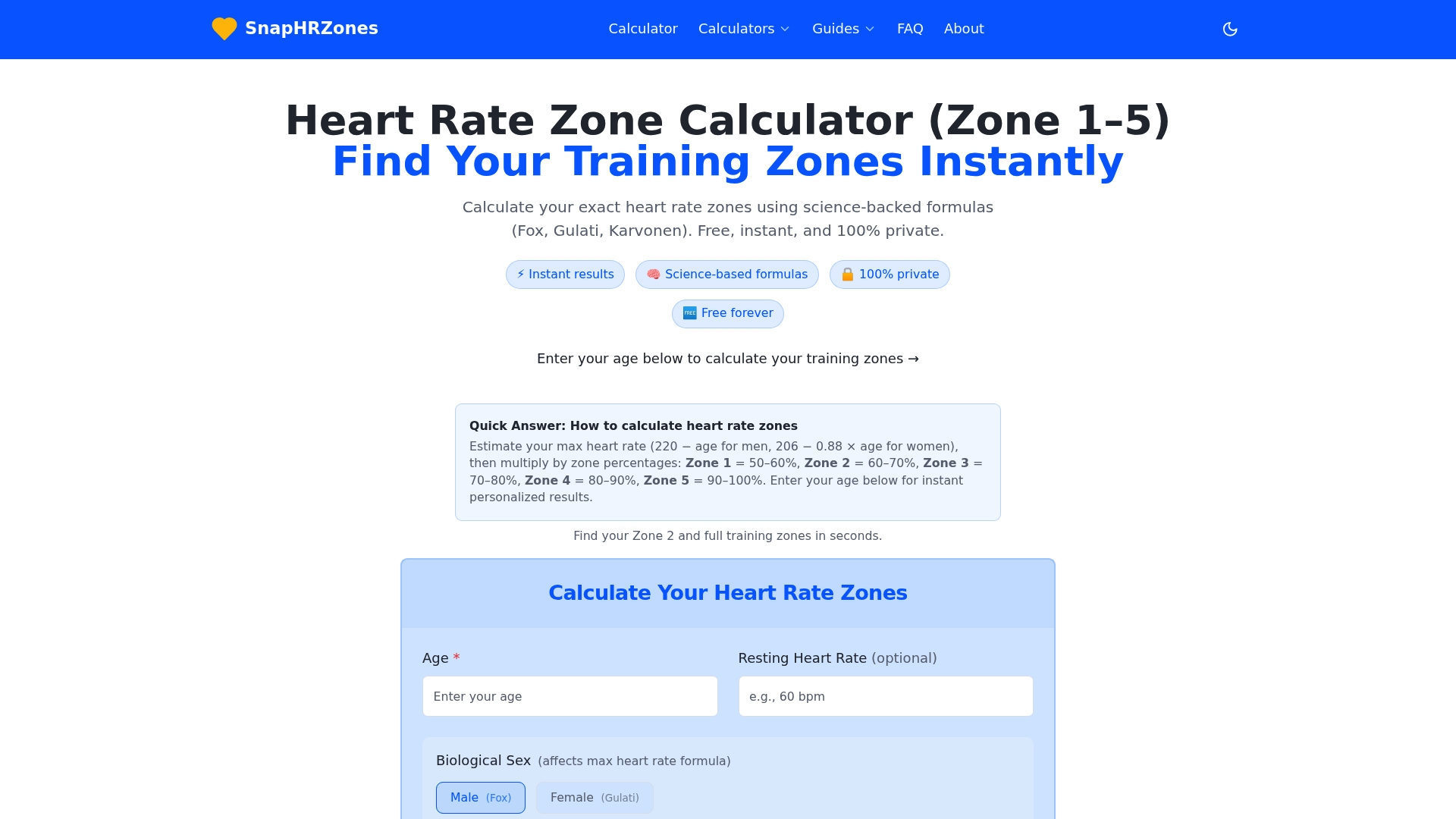
Once you know what is normal for you, training zones help you stay on the right side of effort. Our free Heart Rate Zone Calculator estimates zones using gender-specific formulas and lets you add your resting heart rate for a more personalized result. You can start at the Heart Rate Zone Calculator, or go straight to the Zone 2 calculator if you build your base with easy aerobic running.
The zones are estimates for training, not medical limits. If you have a heart condition, take medication that changes your heart rate, or have had symptoms during exercise, ask your doctor before choosing zones or intensity targets.
How doctors find out what is going on
If you do see a provider about a fast or slow heart rate, expect questions about when it happens, what you were doing and what else you felt. The 2022 expert review says an initial evaluation of sinus tachycardia includes history, a medication review (including illicit drugs), vital signs, a physical exam and an ECG, which records the heart’s electrical activity.
The 2018 ACC/AHA/HRS bradycardia guideline calls the resting 12-lead ECG an essential part of the initial evaluation for suspected slow heart rate or conduction disorders. An ECG recorded during a symptomatic episode may give a definitive diagnosis, and exercise ECG testing may be useful for symptoms during or right after exercise. For short, frequent episodes, the expert review notes that 24- or 48-hour Holter monitoring, a wearable recorder, can capture them.
This is useful for athletes: if your symptoms only appear during hard efforts, tell your provider exactly that, because it changes which test makes sense.
FAQ
What heart rate is an emergency?
There is no single number. The American Heart Association advises calling 911 if your heart rate is suddenly very high or very low for you, especially with chest pain, shortness of breath, dizziness or fainting. Symptoms, not the number alone, decide when it is an emergency.
Is a resting heart rate of 45 dangerous for a runner?
Not necessarily. Mayo Clinic notes very fit athletes may have resting rates near 40 bpm, and Cleveland Clinic says athletes often fall in the 40s or 50s. If it is your steady baseline and you feel well, it is usually part of conditioning. New dizziness, fainting or fatigue with a low rate is a reason to see a doctor.
Is tachycardia a type of arrhythmia?
Tachycardia is a fast heart rate, over 100 bpm in adults at rest. Some forms, such as SVT, are arrhythmias, while sinus tachycardia is a normal response to exercise, fever or anxiety. A provider uses an ECG and your history to tell which one you have.
Should I stop a run if my watch shows a very high heart rate?
Slow down and check how you feel. If the reading matches your effort and you feel fine, it is likely expected or a sensor glitch. If you have chest pain, fainting or near-fainting, or breathlessness out of proportion to your pace, stop and call 911 or your local emergency number. Do not wait to see whether the watch settles.
Does a normal heart rate mean I am fine?
Not necessarily. A reading inside 60 to 100 bpm does not make chest pain, fainting or severe breathlessness safe, and some rhythm problems occur at normal rates. Treat symptoms as the priority.
Sources
- Heart rate: What’s normal? (Mayo Clinic)
- Heart Rate (UC Davis Health Sports Medicine)
- What Is a Normal Resting Heart Rate? (Yale Medicine)
- Heart palpitations (MedlinePlus)
- What Makes a Heart Rate Dangerous (Cleveland Clinic)
- Heart Rate: Normal Rates and What To Know (Cleveland Clinic)
- All About Heart Rate (American Heart Association)
- What is a Normal Heart Rate? (Allina Health)
- Target Heart Rates Chart (American Heart Association)
- Tachycardia: Fast Heart Rate (American Heart Association)
- Sports Cardiology: Core Curriculum (JACC)
- Sinus Tachycardia: A Multidisciplinary Expert Focused Review (PMC)
- 2018 ACC/AHA/HRS Bradycardia Guideline (Circulation)
- Normal Heart Rate: Range, When It’s Dangerous (Healthline)
- VO2 Max Norms: 7,783 Treadmill Tests
- Warning Signs of a Heart Attack (American Heart Association)
Recommended
Find your personal heart rate zones
Enter your age to get all five training zones in seconds.
Open the heart rate zone calculator