Maximum Heart Rate Calculator: How Accurate Is the Estimate?
Quick answer: A maximum heart rate calculator estimates a population average; it does not measure your personal maximum. Fox, Tanaka and Gulati can return different values, and individual error may exceed 10 bpm. Use the result as a starting point, interpreted with exercise mode, medication, effort and measured observations.

A maximum heart rate calculator gives a population-based estimate, not a measurement of your individual maximum. Different formulas can disagree, and two people of the same age can have substantially different measured values. Use the result as a starting point for training zones—not as a precise ceiling or a target you must reach. Our free Heart Rate Zone Calculator remains the interactive calculation destination; this guide explains the uncertainty behind its result.
TL;DR
- The most common estimate is 220 minus your age. The American Heart Association gives 190 bpm at age 30 and 180 bpm at age 40.
- Any age-based formula can miss by 10 bpm or more for an individual, so treat the result as a starting range.
- A valid maximal exercise test can measure HRmax for that test and exercise mode. A peak recorded in an ordinary workout is only an observed peak, not proof of your true maximum.
- Medications such as beta blockers lower maximum heart rate, so percentage-based zones may not apply. Ask your doctor.
- Once you have a number, zones are percentages of it, or of your heart rate reserve if you add your resting rate.
Table of Contents
- How to calculate your maximum heart rate
- How accurate is the estimate for runners and triathletes?
- Getting a better number than the formula
- From maximum heart rate to training zones
- When percentages stop working
- Using the number in your training
- Try it with your own numbers
- FAQ
- Sources
How to calculate your maximum heart rate
Maximum heart rate (MHR, or HRmax) is the highest heart rate reached during a valid maximal effort. It can differ by exercise mode and testing conditions. The standard shortcut is simple: subtract your age from 220. The American Heart Association lists age-predicted maximums from 200 bpm at age 20 down to 150 bpm at age 70.
A second formula is Tanaka’s: 208 − 0.7 × age. The meta-analysis of 18,712 people described in this review refers to Tanaka and colleagues’ 2001 analysis of 351 studies, followed by laboratory cross-validation in 514 healthy adults. It was fitted largely to group means, so its strong age relationship does not make it exact for one person.
Here is how the two compare for a 45-year-old:
| Formula | Calculation | Result |
|---|---|---|
| 220 − age | 220 − 45 | 175 bpm |
| Tanaka | 208 − (0.7 × 45) | 176.5 bpm |
| Gulati | 206 − (0.88 × 45) | 166.4 bpm |
For a 25-year-old, Fox gives 195 bpm and Tanaka gives 190.5 bpm; Gulati gives 184 bpm. The formulas disagree because their equations and source populations differ. Gulati’s equation was derived from 5,437 asymptomatic women aged 35 and older, so the age-25 Gulati calculation is an extrapolation beyond that cohort. Tanaka’s original regression did not differ significantly by sex. None supplies a guaranteed individual value.
If you want to skip the arithmetic, enter your age in our calculator. We also publish worked examples by age and sex, such as a 42-year-old man at 179 bpm and a 57-year-old man at 168 bpm.

How accurate is the estimate for runners and triathletes?
The honest answer: a formula may describe a group average while remaining imprecise for any one person. A point estimate is not a personal confidence interval.
- Formula estimateA calculated population reference, such as 180 bpm—not a promise that your maximum is 180.
- Observed workout peakThe highest value your sensor recorded in that session; it may be below your achievable maximum or affected by measurement error.
- Measured HRmaxThe peak from a valid maximal test, interpreted for that exercise mode, protocol and current health or medication status.
- A 2025 exploratory analysis of 230 healthy adults (76% male) found average biases across equations of about −3 to +6 bpm but wide limits of agreement of roughly ±18 to 24 bpm. These results describe that sample and should not be turned into a universal personal range.
- A 2022 clinical practice statement describes the variability of 220 minus age as a standard deviation of about 10 to 12 bpm in apparently healthy people.
- Harvard Health notes the formula was built in the early 1970s from testing on men and tends to overestimate peak heart rates in women.
What the studies of runners found
A 2023 study of 4,043 runners and 1,026 cyclists who completed maximal exercise tests measured an average HRmax of 184.6 bpm in running and 182.7 bpm in cycling. Nine of the 13 prediction models it tested differed significantly from the measured values; reported RMSE across the evaluated models was 9.1–10.5 bpm.
In 180 recreational marathon runners, 220 minus age and Tanaka’s formula both overestimated women’s measured HRmax by about 5 bpm. For men, 220 minus age underestimated by about 3 bpm, and the authors suggested Tanaka’s formula for male marathoners.
What this means in practice: do not convert a formula result into a supposedly exact upper and lower bound. The direction and size of error vary by formula and population. Sport matters too. Runner’s World notes that MHR can differ between running and cycling, and that genetics, medications, body size and altitude all play a part. Triathletes should expect different peaks in different disciplines and should not assume a bike number carries over to the run.
Getting a better number than the formula
There are two practical routes.
A supervised maximal test
The Cleveland Clinic says the best way to find your actual maximum is a medically supervised maximal graded exercise test. This is the choice if you have a heart condition, high blood pressure or diabetes, or take medication that affects your heart rate.
Interpreting your highest recorded heart rate
Runner’s World suggests considering the highest heart rate captured during a hard workout. Treat that as an observed peak, not automatically as HRmax: you may not have reached a true maximum, and optical sensors can produce erroneous spikes. Do not undertake an unplanned all-out test just to replace a formula. If maximal testing is appropriate for you, use a structured protocol with suitable supervision; people with symptoms, cardiovascular risk factors or relevant medical conditions should seek clinical guidance first.

Reliable observations from repeated sessions can help you assess whether an estimate seems plausible. They do not establish an exact maximum on their own, and a higher reading is not always a better reading.
From maximum heart rate to training zones
Once you have an estimate, a zone model converts it into training ranges. Runner’s World lists runner-oriented zones. Rather than treating one publication’s percentages as universal, keep these limitations visible:
| Decision | What an estimated HRmax can do | What it cannot establish |
|---|---|---|
| Start a zone estimate | Provide an approximate numerical reference | Your exact physiological thresholds |
| Choose easy intensity | Give a range to compare with the talk test and RPE | That every beat inside the range is easy for you today |
| Plan hard sessions | Offer context alongside pace, power and the workout protocol | A universal pace or heart-rate target for every interval |
Sources define Zone 2 slightly differently. Another Runner’s World guide gives roughly 60 to 70% of maximum with an effort around 4 out of 10 as a check. Because of this, treat zone edges as ranges rather than hard lines. Our Zone 2 calculator shows your range, and our guide to Zone 3 training covers when runners and cyclists might use the harder band.
Worked example. An estimated max of 180 bpm gives 108–126 bpm at 60–70%, or 117–135 bpm at 65–75%. The arithmetic is exact; the underlying maximum and zone definitions remain estimates. Use the talk test and perceived effort as additional checks rather than assuming one percentage scheme is universally correct.
Adding resting heart rate
The heart rate reserve (Karvonen) method uses your resting rate. The 2022 clinical statement writes it as (maximal HR − resting HR) × 60% to 80% + resting HR. With a max of 180 and a resting rate of 55, 60% is (125 × 0.6) + 55 = 130 bpm and 80% is (125 × 0.8) + 55 = 155 bpm. This method incorporates resting heart rate, but it does not correct an inaccurate HRmax estimate or guarantee a more accurate personal zone. Our calculator accepts an optional resting heart rate for exactly this reason. Measure it first thing in the morning, before getting up. The American Heart Association says 60 to 100 bpm is normal for most adults, and athletes can be as low as 40 bpm. For context by age, see our normal heart rate by age page. Our heart rate reserve guide shows why the same percentage gives a different target than percent of max.
When percentages stop working
Some situations make heart rate percentages unreliable, and you should know them before you build a plan.
- Beta blockers. The ACE expert panel states these drugs blunt maximal and exercise heart rates by 10 to 40 bpm depending on drug, dose and the individual. Without a maximal test on your current dose, percentage zones cannot be relied on. Ask your doctor what heart rate range suits you.
- Other conditions. The American Society for Preventive Cardiology notes that calcium channel blockers and diabetes-related nervous system changes can also alter the heart rate response.
- Heat, altitude, sleep and stress. These shift your heart rate for a given pace, so day-to-day readings can drift even when fitness has not changed.
When your true maximum is unknown, rate of perceived exertion (RPE) is a sound guide. ACE lists RPE 12 to 13 on the 6 to 20 scale as moderate, 14 to 17 as vigorous. The talk test works the same way. Stop for chest pain, fainting, severe dizziness or unusual breathlessness. Seek urgent medical care for severe, persistent or alarming symptoms rather than trying to finish a test or workout.
Using the number in your training
An estimate is enough to start. A practical routine for runners and triathletes:
- Enter your age (and resting heart rate if you have it) in the calculator and note your zones.
- Run most easy sessions in Zone 2, and check the effort against the talk test.
- If your easy runs feel consistently harder or easier than the zone suggests, treat that as information about your estimate, not a failure.
- Use repeated observations to review the estimate, but do not label a single recorded workout peak as your true maximum.
- Watch for fatigue that builds up. Our overtraining symptoms checklist helps you spot it.
If you pair zones with a watch or app, our guide to the best training app for runners and triathletes covers what to look for.
Try it with your own numbers
Our free Heart Rate Zone Calculator estimates your maximum heart rate with gender-specific formulas and an optional resting heart rate input, then lays out your training zones so you can use them on your next run.
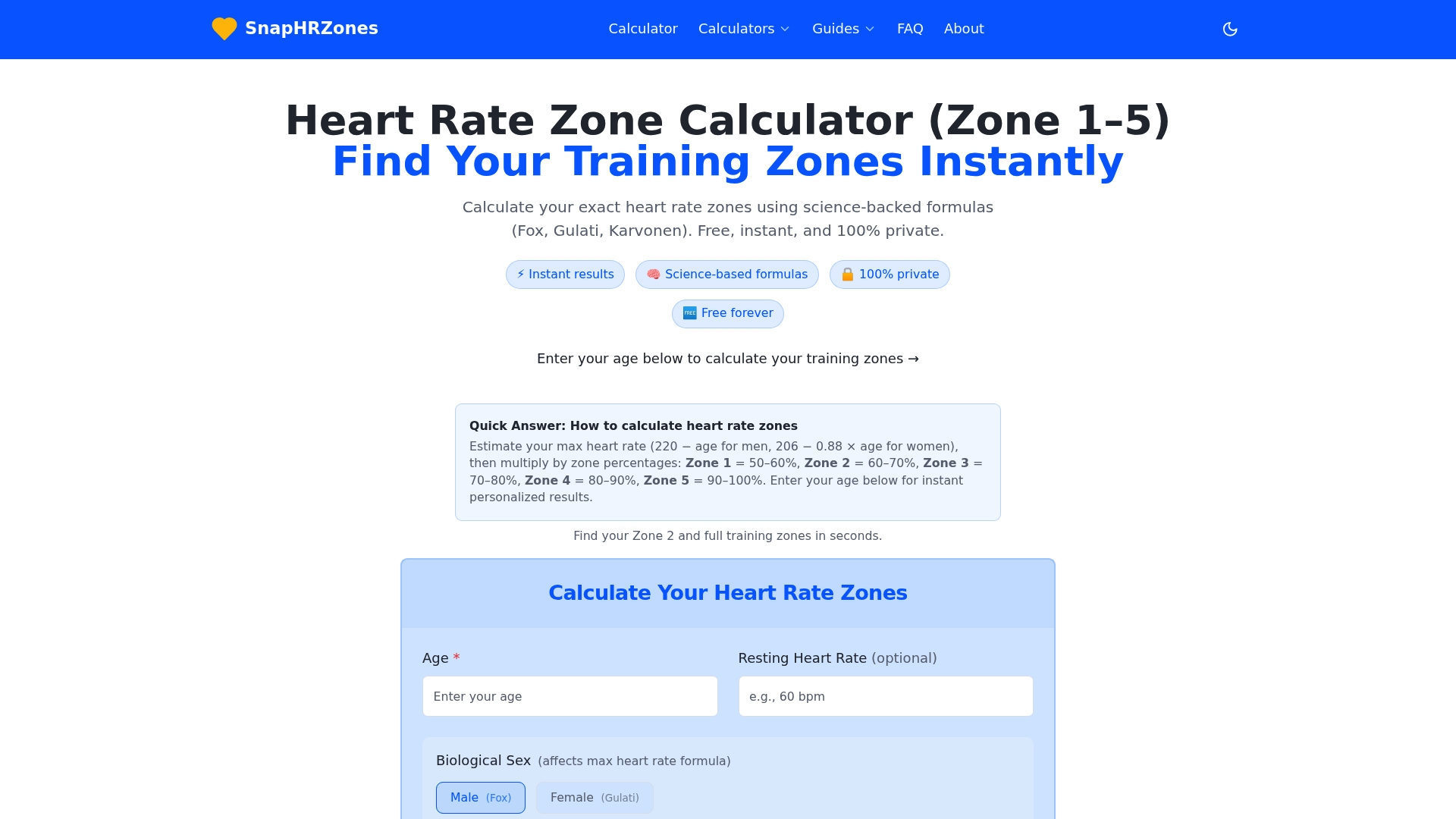
The result is a starting range. Update it as you learn your own peaks, and talk to your doctor first if you take heart medication or have a cardiac condition.
FAQ
What is the maximum heart rate for my age?
The common estimate is 220 minus your age, so 190 bpm at 30 and 180 bpm at 40, according to the American Heart Association. Individual values vary, often by 10 bpm or more in either direction.
Is the 220 minus age formula accurate?
It can approximate a group average while remaining imprecise for an individual. In the large athlete sample above, formula RMSE was 9.1–10.5 bpm. Use it as a starting estimate, not a measured maximum.
Can my maximum heart rate go up with training?
The research summarized here points to age as the main driver, and a 2025 analysis found fitness had only a limited effect on prediction error. Better fitness mostly shows up as a lower heart rate at a given pace, not a higher maximum.
Should women use a different formula?
Harvard Health notes that 220 minus age was developed from male data and can overestimate women’s peaks. Gulati offers a women-derived alternative, but individual error remains and its original cohort began at age 35. Our calculator provides gender-specific estimates for this reason.
Sources
- Target Heart Rates Chart, American Heart Association
- Exploratory analysis of the accuracy of age-based maximal heart rate equations (PMC)
- Physical activity, cardiorespiratory fitness and cardiovascular health, 2022 statement (PMC)
- All about your heart rate, Harvard Health
- Validity of the maximal heart rate prediction models among runners and cyclists (PMC)
- Age-predicted maximal heart rate in recreational marathon runners, Frontiers in Physiology
- Estimating Maximal Heart Rate, ACSM Health & Fitness Journal
- Your pulse and your target heart rate, Cleveland Clinic
- How to find your true Zone 2 heart rate range, Runner’s World
- Max heart rate: target heart rate training for runners, Runner’s World
- Ask ACE: How to help clients who have heart-related concerns exercise safely
- Age-predicted maximal heart rate revisited, Tanaka et al. (2001)
- Heart Rate Response to Exercise Stress Testing in Asymptomatic Women, Gulati et al. (2010)
Recommended
Find your personal heart rate zones
Enter your age to get all five training zones in seconds.
Open the heart rate zone calculator