Dangerous Heart Rate for Women: Numbers and Warning Signs

No single heart rate is dangerous for every woman. Concern depends on three things together: the number, how it compares with your own usual rate, and whether symptoms come with it. A resting rate that is consistently above 100 beats per minute (bpm) is the textbook definition of a fast heart rate, and a rate below 60 bpm is the definition of a slow one. Neither is automatically an emergency, and a reading inside the normal range does not make a worrying symptom safe. For adults in general, see what is a dangerous heart rate.
This guide answers one question: when should a woman be concerned about her heart rate, at rest and during exercise? It is general education, not a diagnosis.
- Chest pain, pressure or tightnessEspecially if it spreads to the arm, jaw, neck or back, or comes with sweating or nausea.
- Fainting or near-faintingIncluding collapse during or just after exercise.
- Severe shortness of breathTrouble breathing that does not ease with rest.
- A racing or very slow heartbeat with any of the signs aboveDo not stop to check your zones or a calculator first.
If symptoms are milder or have already passed, contact a healthcare professional promptly rather than waiting for your next routine visit.
TL;DR
- A normal adult resting heart rate is 60 to 100 bpm. That range, used by the American Heart Association and the NIH, applies to women too.
- A resting rate that is consistently above 100 bpm (tachycardia) or below 60 bpm without an athletic explanation (bradycardia) is worth discussing with a healthcare provider. Symptoms such as palpitations, chest pain, dizziness or shortness of breath make that more urgent.
- Trained runners and triathletes often rest in the 40s and 50s without any problem. A rate that is unusual for you, or comes with symptoms, is what counts.
- The familiar 50 to 85% of estimated maximum is a training intensity guide, not a medical safety limit. Stop for chest tightness, faintness, dizziness or trouble breathing, whatever the watch says.
- A heart rate that stays high long after you stop, or a pattern of unusual readings, belongs in a conversation with your doctor.
Table of Contents
- Resting heart rate: where normal ends
- Too fast: tachycardia
- Too slow: bradycardia, and the athlete exception
- A quick reference for resting rates
- What is too high while you run or race
- Symptoms that matter more than the number
- When your heart rate will not come back down
- Medications and conditions that change the picture
- Putting it to work as a runner or triathlete
- Check your zones with the SnapHRZones calculator
- FAQ
- Sources
Resting heart rate: where normal ends
Your resting heart rate is how many times your heart beats per minute when you are calm, seated or lying down, and not ill or just back from exercise. The Mayo Clinic states that a normal resting rate for adults is 60 to 100 bpm. The American Heart Association and the National Heart, Lung, and Blood Institute give the same 60 to 100 bpm range, and MedlinePlus (U.S. National Library of Medicine) lists 40 to 60 bpm as typical for well-trained athletes.
Hormones, pregnancy, stress, sleep and fitness all shift a woman’s resting rate within that range, as Franciscan Health notes. Population averages are not a target for you. A resting rate of 85 or 90 is not alarming on its own; what matters more is a lasting change from your own baseline.
For a baseline you can trust, measure it the same way each time: first thing in the morning, before coffee, before you get out of bed or after a few minutes of sitting quietly. A single reading after a stressful commute or a hard session tells you little. A week of mornings tells you more.
Too fast: tachycardia
Tachycardia is the medical term for a fast heart rate. The American Heart Association defines it as a resting heart rate over 100 bpm. Cleveland Clinic adds the qualifier that matters for athletes: the rate must be consistently above 100 bpm when you are not exercising to suggest a possible health problem. MedlinePlus likewise says a resting rate that is continually high may mean a problem and is worth discussing with a provider.
Tachycardia covers a wide range. Cleveland Clinic describes it as ranging from mild to life-threatening, depending on the type. Supraventricular types start in the upper chambers of the heart and include atrial fibrillation. Ventricular types start in the lower chambers and are the ones the AHA flags as potentially life-threatening.
Symptoms the AHA lists with a fast heart rate include:
- Rapid heartbeat or palpitations (a fluttering or pounding feeling)
- Fatigue
- Chest discomfort
- Shortness of breath
- Lightheadedness
- Sweating
- Fainting
A resting rate above 100 is a reason for medical evaluation, not automatically an emergency. If it happens repeatedly and you feel fine, book an appointment with your provider. Fever, dehydration, caffeine, anxiety, pregnancy and some medications can also raise it. If it comes with chest pain, shortness of breath or fainting, treat it as an emergency. The AHA advises calling 911 when your heart rate is suddenly very high or very low for you, especially with chest pain, shortness of breath, dizziness or fainting. Call 911 in the US, or your local emergency number.
Why a woman’s resting rate may run high
A few causes show up more often in women, and they are worth knowing before you blame your training.
- Anemia. Yale Medicine cardiologist Srijan Shrestha, MD, notes that a higher baseline heart rate in women can reflect anemia related to menstruation and blood loss. Runners with heavy periods who feel unusually tired may want to ask about it; anemia is confirmed with a blood test, not with a heart rate reading.
- Certain arrhythmias. Cleveland Clinic lists atrial tachycardia, AVNRT, long Q-T syndrome and POTS among rhythm conditions more common in women. These are diagnosed with medical testing, such as an ECG, not by a training watch. POTS, or postural orthostatic tachycardia syndrome, causes a fast heartbeat, dizziness and fainting when you stand up.
- Pregnancy, thyroid and medications. Resting heart rate normally rises during pregnancy, and thyroid conditions and some medications can raise or lower it. Ask your provider which range is expected for you.
- Everyday factors. Age, weight, activity level, anxiety, diabetes and sleep apnea can all affect whether a rate outside the usual range is a concern, according to Cleveland Clinic.
Too slow: bradycardia, and the athlete exception
A resting rate under 60 bpm is called bradycardia. The AHA notes it can come from beta blockers or from athletic conditioning, which is why the label alone says little.
For runners and triathletes this is the most common source of unnecessary worry. Cleveland Clinic says a heart rate in the 40s or 50s is normal for athletes and very active people, but that a low rate is concerning if it is unusual for you or paired with dizziness, lightheadedness or fatigue. Franciscan Health similarly notes that women who exercise regularly may have resting rates in the 50s or lower as a sign of an efficient heart.
Yale’s Dr. Shrestha puts it plainly: heart rate is a number, not a condition. Some people live symptom-free at 40 to 50 bpm, while others feel tired at the same rate. What moves a low reading from “fit” to “get checked” is:
- A rate that is new or much lower than your own usual.
- Fatigue, dizziness or shortness of breath alongside it.
- A rate that is unusually low for you, especially with symptoms. The American Heart Association defines bradycardia as an adult resting rate under 60 bpm, while noting that athletes and active adults can normally rest below 60; a very low rate is worth evaluation by a provider. This is not a line above which every rate is safe: a rate in the 40s or 50s with fainting or breathlessness still needs attention.
If you are not an athlete and your rate often sits below 60, the Mayo Clinic and the American Heart Association advise talking to a healthcare professional, particularly if you also faint, feel dizzy or get short of breath.
A quick reference for resting rates
| What you notice at rest | Symptoms | Sensible next step |
|---|---|---|
| Resting rate in your usual range, 60 to 100 bpm, or 40s to 50s if you train regularly | None | Normal variation for many women. Keep tracking your own baseline. |
| Resting rate consistently above 100 bpm, or below 60 bpm without an athletic explanation | None, or mild tiredness | Book a routine appointment. Fever, dehydration, caffeine, pregnancy, medications and thyroid problems are common contributors. |
| A clear change from your own usual rate over days or weeks | Unusual fatigue, palpitations or dizziness on standing | Contact your provider promptly. Bring your readings and note sleep, illness, training and medications. |
| Any rate, including one inside the normal range | Chest pain, fainting, severe breathlessness or confusion | Emergency. Call 911 in the US, or your local emergency number. |
These thresholds come from the AHA, NIH and MedlinePlus pages linked above, with Mayo Clinic and Cleveland Clinic as additional references. They describe when to seek advice, not personal limits, and symptoms always take priority over the number.
What is too high while you run or race
Resting numbers are only half of it. When you train, your heart rate is meant to rise. The question is how high is reasonable, and when does the body tell you to stop.
Most guidance starts from an estimate of maximum heart rate: 220 minus your age. The AHA’s target heart rate guidance uses this estimate, with moderate-intensity activity at 50 to 70% of maximum and vigorous activity at 70 to 85%. It adds that if your heart rate is too high, you are straining and should slow down, and that beginners should start near the lower end and build up. Cleveland Clinic gives a typical exercise target of 60 to 85% of maximum, for example 170 bpm at the top of the range for a 50-year-old. These ranges describe training intensity for healthy adults. They are not medically established safety limits, and going above 85% in a race or interval is a normal part of hard training for many athletes.
A worked example for a 40-year-old runner, using the AHA’s 220 minus age estimate:
- Estimated maximum: 180 bpm
- Easy to moderate running at 50 to 70%: 90 to 126 bpm
- Hard efforts up to 85%: about 153 bpm
For women, the SnapHRZones calculator uses the Gulati formula (206 − 0.88 × age), which gives about 171 bpm at 40, so its zones sit slightly lower than this example. That 90 to 126 range matches Nike’s running guide, which also quotes an exercise physiologist and a running coach saying you generally should not stay at 90 to 100% of maximum for long.
Two cautions are worth keeping in mind. First, 220 minus age is a population estimate, and individual maximums vary, so treat your zones as a guide rather than a limit that applies to everyone. Second, a monitor can misread. Wrist sensors can lag or jump during intervals, so a single odd spike that comes with no symptoms is not by itself a sign of danger. Consumer wearables are useful for trends but cannot diagnose an arrhythmia or other heart condition; how you feel is the better alarm, and a medical device such as an ECG is needed for a diagnosis.
If you want zones that are tuned to you rather than a generic formula, our free Heart Rate Zone Calculator uses gender-specific formulas and an optional resting heart rate input. For a sense of what the numbers look like, see our estimates for a 28-year-old woman, a 42-year-old woman and a 52-year-old woman. If you want to understand how resting rate feeds into the zones, a guide on training in five heart rate zones with the Karvonen method walks through the approach.
| Guidance | % of estimated max | 40-year-old, 220 − age |
|---|---|---|
| Moderate intensity (AHA) | 50–70% | 90–126 bpm |
| Vigorous intensity (AHA) | 70–85% | 126–153 bpm |
| Typical exercise target (Cleveland Clinic) | 60–85% | 108–153 bpm |
Symptoms that matter more than the number
The most important line for a runner is this: a heart rate that is within the textbook range does not make a symptom safe. Stop and take it seriously when you feel any of the following.
The U.S. Office on Women’s Health says to stop activity if you feel very out of breath, dizzy, nauseated or have pain, and to stop right away if your chest feels tight or painful, you feel faint or you have trouble breathing. It advises calling 911 (or your local emergency number) if you lose consciousness or cannot breathe. The American College of Obstetricians and Gynecologists lists similar warning signs: problems breathing, faintness, dizziness, nausea, vomiting, unusual pain, feeling very tired for the whole workout and an irregular heartbeat.
Nike’s running guide adds a fluttering heartbeat and significant blood pressure changes to the list of reasons to stop. Medical News Today, summarizing AHA guidance, says that if chest pain always occurs with exercise, you should slow down and seek an immediate medical opinion. A practical rule from these sources:
- Stop the session for chest tightness, faintness, dizziness, trouble breathing, a fluttering or irregular heartbeat or unusual nausea.
- Sit or lie down and let your heart rate settle.
- Call 911 in the US, or your local emergency number, right away for chest pain or pressure, fainting, or trouble breathing, and for any symptom that does not settle within a few minutes of stopping. Do not drive yourself.
- Book an appointment with your doctor for anything that repeats, even if it passes.
One more sign for the pacing-by-feel crowd: Medical News Today lists being unable to talk while running as a sign you are pushing too hard. It is not an emergency on its own, but it is a cue to ease back.
When your heart rate will not come back down
How quickly your heart rate falls after you stop is another useful clue. Runner’s World reports that Cleveland Clinic sports cardiologist Tamanna Singh advises that if you have stopped and rested for 5 to 10 minutes and your heart rate has not dropped much from its peak, you should flag it to your doctor. Possible causes include poor sleep, overtraining, dehydration or caffeine, but also a cardiovascular or autonomic abnormality.
Research thresholds come from clinical exercise testing, not everyday runs. In the best-known study (Cole and colleagues, New England Journal of Medicine, 1999), 2,428 adults undergoing symptom-limited treadmill tests for diagnostic reasons had their heart rate measured from peak exercise to one minute after stopping. A drop of 12 bpm or less was defined as abnormal and was associated with higher mortality. That cut-off depends on the test protocol and recovery method, so it should not be applied to a watch reading after a jog.
A single slow recovery is not a diagnosis. A repeated pattern, or slow recovery with symptoms, is worth raising with your doctor.
Persistently elevated readings can also be a training load issue. If your resting rate has crept up over several weeks along with heavy legs and poor sleep, our checklist of overtraining symptoms can help you sort out whether recovery is the question. If symptoms such as dizziness or chest discomfort are involved, that is a medical question first.
Medications and conditions that change the picture
Beta blockers, a common class of heart and blood pressure medication, can lower heart rate, which is one reason the AHA notes a low resting rate is not always about fitness. If you take a medication that affects your heart rate, your zones and your “normal” may both shift, so ask your prescriber what range is right for you before you use any formula-based target.
The same applies to a diagnosed heart condition, thyroid problems, anemia or POTS. The generic ranges above are for healthy adults. They are not personal limits, and a cardiologist can give you limits that are.
Putting it to work as a runner or triathlete
A practical routine takes about five minutes a week:
- Log your morning resting rate a few days a week, and note it with sleep and stress.
- Learn your own range. A reading is only unusual relative to your own normal.
- Set your training zones from an estimated maximum and, if you can, your resting rate. Our Zone 2 calculator shows the easy aerobic range most endurance plans build on.
- Pair every number with how you feel. Zones guide effort. Symptoms override zones.
- Write down anything odd: palpitations, a rate that will not settle, dizziness on standing. Take the list to your doctor.
If you are new to training with heart rate, start at the lower end, as the AHA advises, and increase gradually.
Check your zones with the SnapHRZones calculator
Knowing which part of your heart rate range is easy, moderate or hard makes it much simpler to notice when something is off. The SnapHRZones Heart Rate Zone Calculator is free, uses gender-specific formulas and lets you add your resting heart rate for a more personal estimate. For a broader look at what typical readings look like at different ages, see our page on normal heart rate by age.
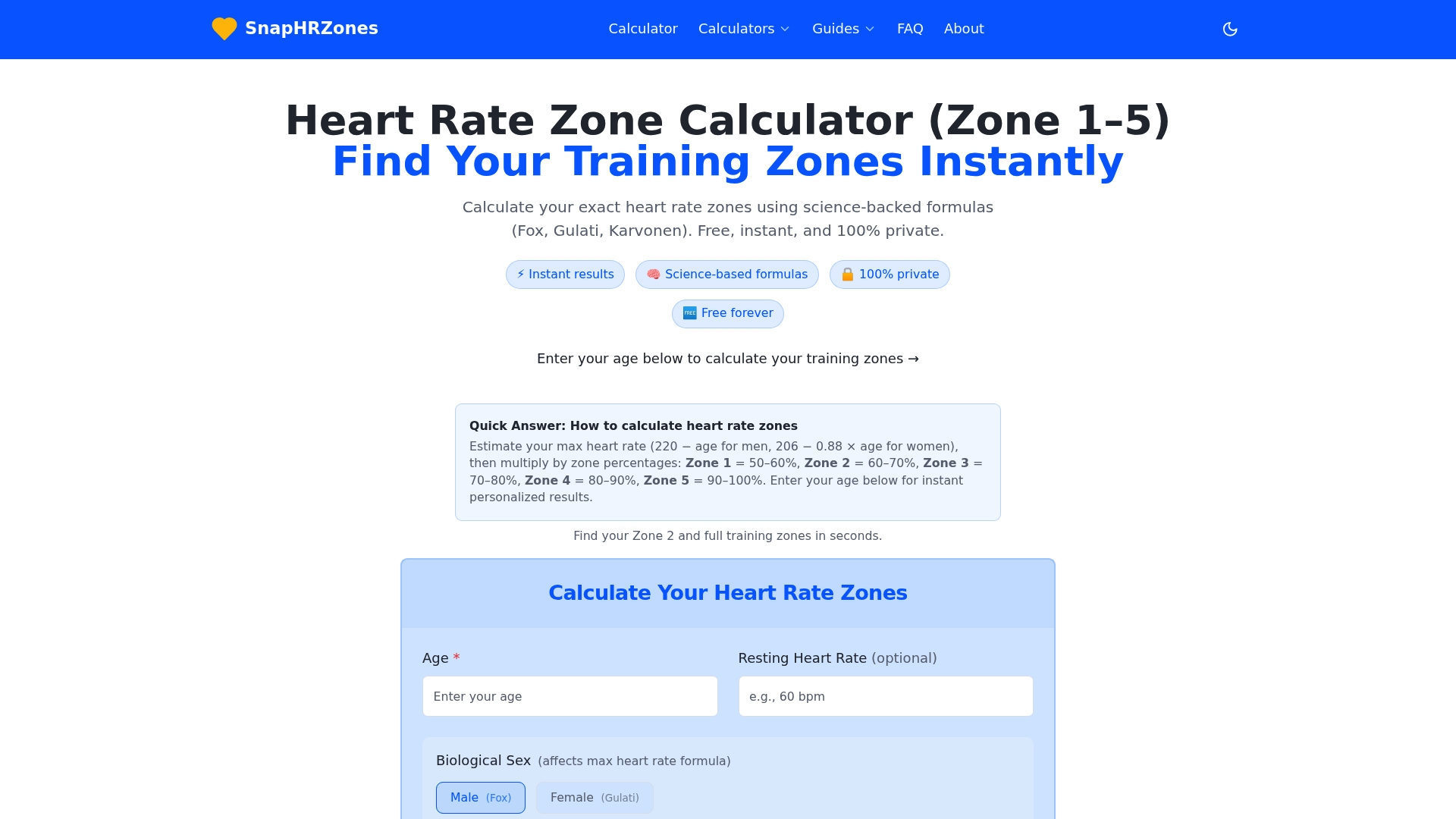
The calculator estimates training zones for fitness purposes. It does not diagnose, and it cannot tell you whether a particular reading is safe for your body. For that, you need your doctor.
FAQ
What heart rate is dangerous for a woman at rest?
No single number is dangerous for everyone. A resting rate consistently above 100 bpm (tachycardia) or below 60 bpm without an athletic explanation (bradycardia) is worth checking with a provider, and a sudden change from your own usual rate deserves attention. Chest pain, fainting or severe breathlessness are an emergency at any heart rate.
Is a heart rate of 120 or 130 dangerous when I am running?
Not by itself. For many women, 120 to 130 bpm falls within the moderate range of exercise. General training guidance uses roughly 50 to 85% of estimated maximum, about 90 to 153 bpm for a 40-year-old with 220 minus age. That is an intensity guide, not a safety limit. What makes any exercise heart rate a problem is how you feel: chest tightness, faintness, dizziness or trouble breathing mean stop.
Is a resting heart rate in the 40s or 50s dangerous for a female runner?
Often it is not. Cleveland Clinic says the 40s and 50s are normal for athletes and very active people. The American Heart Association also notes that athletes can rest below 60. It becomes a concern if the rate is unusual for you or comes with dizziness, lightheadedness, fainting or fatigue.
When should I call 911 about my heart rate?
Call if your heart rate is suddenly very high or very low for you and you have chest pain, shortness of breath, dizziness or fainting, according to the American Heart Association. Also call if you lose consciousness or cannot breathe during activity. Outside the US, use your local emergency number.
Can anemia or my period make my heart rate higher?
It can. Yale Medicine’s Dr. Shrestha notes that a higher baseline heart rate in women may reflect anemia related to menstruation and blood loss. If your resting rate has risen along with unusual tiredness, mention it to your doctor.
Sources
- Women’s Heart Rate: What’s Normal & What Impacts It, Cleveland Clinic
- Heart rate: What’s normal?, Mayo Clinic
- All About Heart Rate (Pulse), American Heart Association
- Bradycardia: Slow Heart Rate, American Heart Association
- Types of Arrhythmias, National Heart, Lung, and Blood Institute
- Pulse, MedlinePlus
- Tachycardia: Fast Heart Rate, American Heart Association
- Tachycardia (High Heart Rate): Symptoms & Treatment, Cleveland Clinic
- All About Heart Rate, American Heart Association
- What Makes a Heart Rate Dangerous, Cleveland Clinic
- What Is a ‘Normal’ Resting Heart Rate?, Yale Medicine
- Women’s Heart Rate: Factors, Fluctuations and Exercise, Franciscan Health
- Target Heart Rates Chart, American Heart Association
- Heart Rate: Normal Rates & What To Know, Cleveland Clinic
- What Should My Average Heart Rate Be While Running?, Nike
- Running and heart rate: Ideal zones, safety, Medical News Today
- Stay safe during physical activity, Office on Women’s Health
- Staying Active: Physical Activity and Exercise, ACOG
- Cardio recovery rate: Why it matters for runners, Runner’s World UK
- Heart-rate recovery immediately after exercise as a predictor of mortality, N Engl J Med (1999)
- Training heart rate zones with Karvonen and live heart rate
Recommended
Find your personal heart rate zones
Enter your age to get all five training zones in seconds.
Open the heart rate zone calculator