Box Breathing Technique: How to Do It and When Runners Use It

Box breathing is a four-part pattern: breathe in for four counts, hold for four, breathe out for four, hold for four, then repeat. Cleveland Clinic suggests three to four rounds, once or twice a day. With counts of about a second, a few rounds take roughly a minute. Runners and triathletes can experiment with it for relaxation while resting, before an event, or in the evening; it is not proven to improve performance or speed recovery. Start gently and do not force the holds.
TL;DR
- Box breathing is a 4-4-4-4 pattern: inhale, hold, exhale, hold, each for a count of four.
- Start with three to four rounds, once or twice a day. Some people prefer a few minutes, and a few go up to 15.
- Research suggests structured breathing may help with stress and mood, but results vary and not every measure improves.
- Runners and triathletes may try it while resting before an event or in the evening. One 2025 post-HIIT study found higher heart rate and perceived exertion than with six-breaths-per-minute breathing, but no significant difference in time to return to baseline heart rate.
- If holding your breath is uncomfortable, shorten or skip the holds. If you have a medical condition, check with a clinician first.
Table of Contents
- What box breathing is
- How to do box breathing, step by step
- How long and how often
- What the research shows
- Box breathing for runners and triathletes
- A simple weekly plan
- If holding your breath feels uncomfortable
- Pair breathing with your training zones
- Box breathing compared with other patterns
- FAQ
- Sources
What box breathing is
Box breathing is a deep-breathing practice, also called sama vritti pranayama in yogic tradition, and Cleveland Clinic notes that U.S. Navy SEALs use it. The name comes from the shape: four equal sides. Each side is one phase of the breath, and each phase lasts the same number of counts.
Harvard Health calls the practice tactical breathing and presents it as a relaxation exercise. Slow, controlled breathing can influence autonomic activity, but that does not establish a predictable nervous-system response or benefit for every person or every box-breathing session.
The appeal is simplicity. Dr. Young at Cleveland Clinic points out that some forms of breathwork can make people more anxious because they overthink the technique. Box breathing is just breathing and counting, which works a bit like a mantra. That is also why it suits athletes. You already know how to count cadence and splits, so counting breaths is a small step.
How to do box breathing, step by step
Here is the sequence Cleveland Clinic describes:
- Breathe out gently to begin. Do not force your lungs empty.
- Breathe in through your nose as you slowly count to four.
- Hold your breath for a count of four.
- Exhale for another count of four.
- Hold your breath again for a count of four.
- Repeat for three to four rounds.
A few practical notes make it easier.
Sit or stand tall. Posture is not a rule of the technique, but an upright, relaxed position lets the ribs and belly move. Many people practice in a chair, on the floor, or standing in a quiet spot.
Make the count slow and even. Each count should be about a second. Silent counting works. So does tapping a finger on your thigh.
Trace a square. Margo Swann, LMSW at Trinity Health Michigan, says one of the easiest ways to practice is to trace an imaginary square with your eyes or mind. Each side matches one phase, so your attention has a job and stays in the present moment.
Keep the breath easy. The goal is calm, not a maximal effort. If you feel strained, lightheaded, or tense in the shoulders, shorten the count and let your breathing return to normal.
Mouth or nose?
Guidance varies slightly. Cleveland Clinic’s steps use the nose for the inhale. Some other guides suggest exhaling through the mouth. Pick the version that feels smooth and quiet, and keep it consistent from session to session.
How long and how often
There is no single correct dose, and the sources reflect that.
- Cleveland Clinic recommends three to four rounds, practiced one or two times a day.
- Trinity Health Michigan suggests four to five minutes as a practice example, not a guaranteed time to feel a benefit.
- The BBC reports that breathwork coach Stuart Sandeman says there is no set length. Some people notice a benefit after a few minutes, and others prefer up to 15 minutes. He suggests using it before a stressful event such as an exam or presentation.
One round of the 4-4-4-4 pattern lasts about 16 seconds. Three to four rounds is therefore roughly a minute. Four to five minutes is about 15 to 18 rounds.
Start with a comfortable short session and extend it only if useful. Bentley and colleagues (2023) reviewed 58 studies containing 72 breathing interventions of different kinds, not box breathing alone. Its proposed framework emphasized guidance, repeated sessions and longer-term practice, and noted limited evidence concerning sessions under five minutes. However, session duration of at least five minutes was not independently associated with effectiveness in the reported analysis. The review does not establish a universal minimum effective duration for box breathing or prove that shorter sessions are ineffective.

What the research shows
Box breathing is popular, and the research is encouraging but mixed. Here is a fair reading.
Stress and relaxation. Cleveland Clinic says studies show that regulating your breath can lower cortisol and may help lower blood pressure. That statement concerns regulated breathing broadly, not proof that box breathing reliably changes cortisol or blood pressure in healthy athletes. Harvard Health suggests using tactical breathing to calm a racing mind when you are trying to sleep and to help soothe pain; this is practical guidance, not a guarantee of better sleep, pain relief or anxiety reduction.
The breath hold. The BBC discusses a proposed explanation for the greatest physiological change during the hold after exhaling. A news explanation is not evidence that the hold trains the brain, improves carbon-dioxide tolerance, or produces a particular health or performance benefit. There is no need to prolong the holds; stop if they feel uncomfortable.
Reviews of many breathing methods. The Bentley review concerns varied breathing practices and self-reported stress and anxiety, not a proven dose for box breathing. Its findings do not show that every effective session must last five minutes or that a particular pattern is best for athletes.
Where the picture is less clear. Box breathing is one of several structured techniques, and the studies often compare it with other breathing methods or with normal breathing, in small groups. Results depend on the measure used. That is a reason to treat box breathing as a simple tool you can try and adjust to how you feel, rather than a guaranteed fix for anxiety, sleep, or performance.
If you have a diagnosed anxiety disorder, high blood pressure, or a respiratory condition, breathing exercises can complement care from your clinician but are not a substitute for it.
Box breathing for runners and triathletes
Runners and triathletes already pay attention to breath rate and heart rate. Box breathing can fit into a training week, as long as it is placed with some thought.
Before a race or key workout
Race-morning nerves are a normal activation response, not a sign that something is wrong. A short set of box breathing in the start area or at the transition setup is a low-effort way to give your attention a simple task. Following the usual guidance, three to four rounds is a reasonable starting point. Practice it on regular days first, so that race morning is not the first time you try it. If a four-count hold feels tight when you are already amped, shorten the counts to three or two.
Evening and rest days
A few comfortable rounds in the evening may be part of winding down. Harvard Health suggests tactical breathing to calm a racing mind at bedtime, but better sleep is not guaranteed. If you track HRV, remember that breathing pattern itself can influence a measurement and that day-to-day changes have many causes. Our guide to HRV versus heart rate discusses baselines; do not interpret a higher reading as proof that box breathing improves recovery.
Right after hard intervals: be careful
A 2025 randomized crossover study by Kasap and Aydin tested 40 physically active university students after HIIT on a stationary bike. It compared immediate post-exercise box breathing (4-4-4-4), six breaths per minute (5 seconds in, 5 seconds out), and spontaneous breathing. Compared with six-breaths-per-minute breathing, box breathing produced higher post-exercise heart rate and perceived exertion. This describes the specific protocols and population studied, not all athletes or recovery situations.
Time to return to baseline heart rate did not differ significantly in the reported analysis (p = 0.128). Mean times were longer with box breathing, but that nonsignificant difference does not establish that box breathing delays recovery.
This single study does not prove box breathing is generally harmful or unsuitable after exercise, and it does not establish a superior strategy for every athlete. Let breathing settle naturally and do not force breath holds while breathless. If you later experiment with a slow, no-hold pattern, keep it comfortable rather than trying to reproduce a study protocol during distress.
If you are tracking how quickly your heart rate settles after effort, our page on heart rate recovery at the one-minute mark shows how to compare readings. For workout structure, see interval training heart rate targets for work and recovery periods.
Stress outside the run
Life stress and training load can interact. Breathing practice is an optional relaxation tool, not a proven way to offset excessive training. Our article on stress and exercise looks at when training helps and when it adds load.
A simple weekly plan
Here is one low-pressure way to build the habit. It is a suggestion drawn from the ranges above, not a prescription.
| Situation | What to try | Notes |
|---|---|---|
| Daily, any time | 3 to 4 rounds, 1 to 2 times a day | Matches Cleveland Clinic’s range |
| Evening | 4 to 5 minutes, seated | Trinity Health Michigan’s suggested duration |
| Before a race or big workout | 3 to 4 rounds | Rehearse in training first |
| After hard intervals | Let breathing settle first, then use an easy, no-hold pattern if you like | Based on the Kasap and Aydin findings |
| Holds feel uncomfortable | Shorten the counts or drop the holds | See below |
Try the routine only while it remains comfortable and useful. The Bentley review identified repeated sessions and longer-term practice in its framework, but it does not prove cumulative benefits for every person or a required schedule for box breathing.
If holding your breath feels uncomfortable
You do not need to force four seconds. WebMD advises starting with two or three seconds if four is too much. Duke Health says you can shorten or eliminate the breath-holding time altogether.
Duke Health also advises talking to a healthcare professional before trying box breathing if a medical condition, such as a respiratory issue or an anxiety disorder, affects your ability to hold your breath. Verywell Health advises that pregnant people and people with high blood pressure should talk to their provider before trying it for the first time.
Stop and breathe normally if you feel dizzy, short of breath, panicky, or otherwise unwell. Do not force prolonged holds. Never practice while driving, swimming, cycling, or doing anything where reduced attention or dizziness would be dangerous. Breath holds in or near water carry particular risk, so keep this practice on dry land. Seek emergency help for severe breathlessness, chest pain or fainting rather than treating these as ordinary stress.
Pair breathing with your training zones
Breathing practice and heart rate training share one idea: pay attention to what your body is doing instead of guessing. If you are building an easy-running base and your heart rate seems high on slow runs, calm, controlled breathing is not a fix on its own. Our guide to high heart rate on slow runs walks through four checks first.
We built the SnapHRZones Heart Rate Zone Calculator to take the guesswork out of your intensity. It uses gender-specific formulas and an optional resting heart rate input for a more personalized estimate, and it is free to use. Enter your details, get your zones, and plan which days call for easy aerobic work and which days call for rest and recovery habits, such as a few minutes of box breathing in the evening.
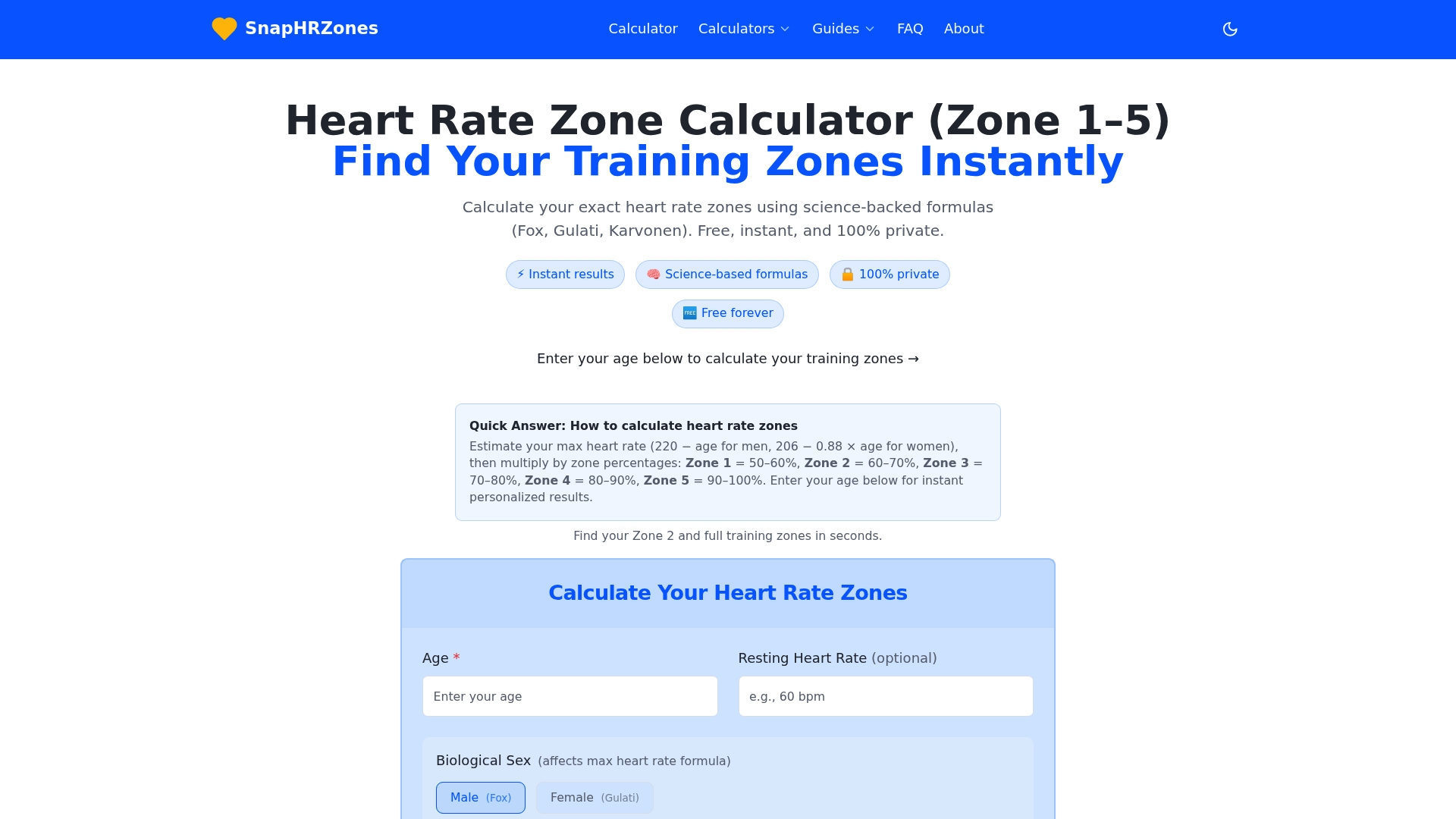
If you want an easy-pace target, our Zone 2 heart rate page lets you calculate yours.
Box breathing compared with other patterns
Box breathing is one of several breathing patterns. The most useful distinction is the presence of holds. Box breathing has two, which some people find calming and others find uncomfortable. Slower patterns without holds, such as breathing in and out for equal counts at about six breaths per minute, are the alternative the 2025 study used after exercise.
Choose a comfortable pattern rather than assuming one technique is best. The Bentley review does not prove that sessions under five minutes are ineffective or identify an optimal box-breathing schedule. If holds feel easy, you may try them while resting; if not, a gentle hold-free pattern is an alternative. Neither is established here to increase endurance, improve race performance, or reliably raise HRV.
FAQ
What is 4-4-4-4 box breathing?
It is a pattern of four counts breathing in, four counts holding, four counts breathing out, and four counts holding again. Cleveland Clinic describes it as four equal phases repeated for three to four rounds. The equal sides are why it is called a box.
Do Navy SEALs really use box breathing?
Yes. Cleveland Clinic states that box breathing is used by the United States Navy SEALs. Harvard Health calls it tactical breathing. That origin does not mean it will produce the same results for everyone, but it shows the technique is simple enough to use under pressure.
How long are you supposed to box breathe?
Cleveland Clinic suggests three to four rounds, one or two times daily. Trinity Health Michigan gives four to five minutes as an example, while the BBC reports a coach’s view that there is no set length. These are suggestions, not a proven dose or a promise of benefit. Start short, keep it comfortable and stop if unwell.
Can I do box breathing right after a hard run?
Let your breathing settle naturally before attempting holds. In one 2025 study of physically active students after stationary-bike HIIT, box breathing produced higher heart rate and higher perceived exertion than six-breaths-per-minute breathing, but time to baseline heart rate did not differ significantly. This does not prove general harm or establish a recovery recommendation for every runner.
Sources
- Box Breathing Benefits and Techniques, Cleveland Clinic
- Try this: Take a tactical breather, Harvard Health
- Breathing Practices for Stress and Anxiety Reduction, Bentley et al. (2023), PMC
- Box breathing or six breaths per minute, Kasap and Aydin (2025), PMC
- Box breathing: A Simple Technique to Calm Stress and Anxiety, Trinity Health Michigan
- Box breathing: Inside the ‘most powerful hack’, BBC
- Box Breathing: Getting Started, WebMD
- Mastering Box Breathing, Duke Health
- Box Breathing: How to Do It, Benefits, Who Avoids It, Verywell Health
Recommended
Find your personal heart rate zones
Enter your age to get all five training zones in seconds.
Open the heart rate zone calculator