Heart Rate Reserve (HRR): Formula, Calculator and Training Zones
Quick answer: Heart rate reserve is maximum heart rate minus resting heart rate, in bpm. With a maximum of 185 and a resting rate of 55, HRR is 130 bpm, and a 70% Karvonen target is 55 + 130 × 0.70 = 146 bpm. That is not the same as 70% of maximum heart rate (130 bpm).

Heart rate reserve (HRR) is the difference, in beats per minute, between your maximum heart rate and your resting heart rate: HRR = HRmax − HRrest. With a maximum of 185 bpm and a resting rate of 55 bpm, your reserve is 130 bpm. The Karvonen method uses that number to set training targets: target HR = HRrest + (HRmax − HRrest) × intensity.
Because it includes your resting heart rate, an HRR target can differ between two people of the same age. Try the explorer below, or use the full Karvonen calculator for all five zones.
TL;DR
- Heart rate reserve = maximum heart rate − resting heart rate. It is a single difference in bpm, not a range. Cleveland Clinic notes the target formula built on it is also called the Karvonen method.
- Target heart rate = resting HR + (max HR − resting HR) × intensity. Forget to add resting HR back and your targets come out far too low.
- 70% of HRR and 70% of maximum heart rate are different numbers and different efforts. Pick one method and stay consistent.
- HRR is a training tool, not a diagnostic or heart-risk score, and it is not the same as heart rate recovery.
- Heart-rate-altering medication such as beta blockers can make age-based estimates and HRR targets unsuitable; ask your clinician.
Table of Contents
- What heart rate reserve means
- The heart rate reserve formula
- From reserve to target heart rate: the Karvonen method
- HRR vs. max HR: why the two give different targets
- HRR training zones
- Heart rate reserve vs. heart rate recovery
- Is a higher heart rate reserve better?
- Safety notes before you use HRR zones
- FAQ
- Sources
Heart rate reserve explorer
Uses the same Karvonen math and input limits as our full calculator. Educational only.
Your entry. Use a measured value if you have one; an age formula is only an estimate.
Your entry. A typical value from several morning readings.
- Heart rate reserve
- 130 bpm
- 185 − 55
- 70% of reserve (Karvonen)
- 146 bpm
- 70% of maximum HR
- 130 bpm
Gold bar = reserve, from resting (55) to maximum (185). Solid marker = Karvonen target; faded marker = % of max.
The same percentage in the two methods does not mean the same effort. For all five zones, use the full Karvonen calculator.
What heart rate reserve means
Your heart has a floor and a ceiling. The floor is your resting heart rate (RHR), the beats per minute when you are calm and still. The ceiling is your maximum heart rate (MHR), the highest rate your heart can reach during all-out effort. Heart rate reserve is the difference between them, expressed in beats per minute.
Cleveland Clinic defines HRR as peak heart rate minus resting heart rate, and notes it can change with training. Think of it as the working room between your resting and maximum rates.
Fitness widens that room mostly from the bottom. As your heart gets stronger, your resting rate tends to fall, so the reserve grows even if your maximum stays similar. A sports science write-up gives an illustration: an athlete going from 40 to 200 beats has 160 beats in reserve, while a less trained person going from 70 to 200 has 130.
That is why runners and triathletes who build a solid aerobic base often see resting heart rate drift downward over months. A lower resting rate is often, but not always, a sign of improving aerobic fitness; illness, medication, sleep and stress also move it.
The heart rate reserve formula
The basic formula is one subtraction:
HRR = maximum heart rate − resting heart rate
The formula is simple. Getting good inputs is the harder part.
Step 1: Estimate or measure maximum heart rate
Age formulas are population estimates. Common ones are Fox (220 − age), Tanaka (208 − 0.7 × age), Gellish (207 − 0.7 × age) and, for women, Gulati (206 − 0.88 × age). The SnapHRZones calculators default to Tanaka for men and Gulati for women. Cleveland Clinic lists 220 − age and 207 − (0.7 × age), and says the 220 formula can be off by 10 to 12 beats. An ACSM’s Health & Fitness Journal article puts the possible miss at 12 to 15 beats and adds that the estimate does not account for medications such as beta-blockers.
Healthline explains that 220 minus age tends to overestimate max heart rate in young adults and underestimate it in older adults, and presents 207 − (0.7 × age), the Gellish equation, as an alternative. A maximum measured in a supervised exercise test is the best input. A peak you saw during an ordinary hard workout is not necessarily your true maximum; it is a lower bound. Our maximum heart rate calculator shows the estimate for your age and sex.
Step 2: Measure resting heart rate
Harvard Health advises measuring resting heart rate first thing in the morning, before getting out of bed, by counting your wrist pulse for 15 seconds and multiplying by four. Do this on several mornings and use a typical value, not the single lowest reading. A poor night, illness, alcohol, heat or a hard session the day before can all push the number up, so a one-off reading may mislead you.

Resting heart rate also tells you something about how you are coping with training. The partner page on Zone 2 versus Zone 3 calibration is a good companion read when you are deciding how much of your week to spend at easy aerobic effort.
Step 3: Subtract
Take the two numbers and subtract. Say your maximum is 185 bpm (for example from 220 − 35 for a 35-year-old) and your resting rate is 55 bpm: HRR = 185 − 55 = 130 bpm.
From reserve to target heart rate: the Karvonen method
HRR itself is a single number, not a training zone. To turn it into a target, you take a percentage of the reserve and add resting heart rate back. ACSM’s journal gives the equation as target HR = (max HR − resting HR) × % intensity + resting HR.
The University of Minnesota’s open textbook shows the same calculation, with a 25-year-old at 60 to 70% intensity landing at 143 to 156 beats per minute.
A worked example for a runner
Using the 35-year-old runner above (MHR 185, RHR 55, HRR 130):
| Intensity | Low end | High end |
|---|---|---|
| 60 to 70% of HRR | 130 × 0.60 + 55 = 133 bpm | 130 × 0.70 + 55 = 146 bpm |
| 70 to 80% of HRR | 130 × 0.70 + 55 = 146 bpm | 130 × 0.80 + 55 = 159 bpm |
| 80 to 90% of HRR | 130 × 0.80 + 55 = 159 bpm | 130 × 0.90 + 55 = 172 bpm |
The most common mistake is forgetting the final “+ resting HR.” Without it, 60% of 130 gives 78 bpm, far below the intended 133 bpm target. That is a calculation error, not a training target.
HRR vs. max HR: why the two give different targets
Percent-of-max zones use only one input. Everyone the same age gets the same zones, whatever their fitness. The National Council on Strength & Fitness points out that the 220 − age formula has a standard deviation of 10 to 12 beats, and that the Karvonen method adds resting heart rate because fit people have a lower resting rate and a broader reserve.
Here is the same 35-year-old runner comparing the two approaches for a 60 to 70% easy range:
- % of MHR: 185 × 0.60 = 111 bpm to 185 × 0.70 = 129.5, shown as 130 bpm
- % of HRR: 133 to 146 bpm
The HRR range sits higher because it starts from the resting rate. Percentages also mean different things in the two systems, so do not mix them. A “Zone 2 at 60 to 70%” label in a percent-of-max table is not the same effort as 60 to 70% of reserve. Pick one method and keep it consistent. Neither is universally better; they are different scales.
Harvard Health’s Kieran F. Reid, PhD, MPH, describes the Karvonen formula as a more personalized estimate because it accounts for resting heart rate, which reflects overall fitness. Both methods still rely on estimates, so treat any target as a starting range to check against effort.
HRR training zones
There is no single universal zone chart. Sources split the range differently, so check how your watch, plan or coach defines zones before you compare numbers.
Here are a few published reference points:
- The Divers Alert Network describes a three-zone HRR protocol: 50 to 60% for warm-up and cool-down, 60 to 80% for aerobic training and conversational pace, and above 80% as the anaerobic transition.
- Healthline and a university fitness text, citing ACSM, give 40 to 59% of HRR as moderate and 60 to 89% as vigorous.
- Harvard Health maps five zones to percent of maximum heart rate, with Zone 2 at 60 to 70% of max, and pairs them with a 1 to 10 perceived exertion scale.
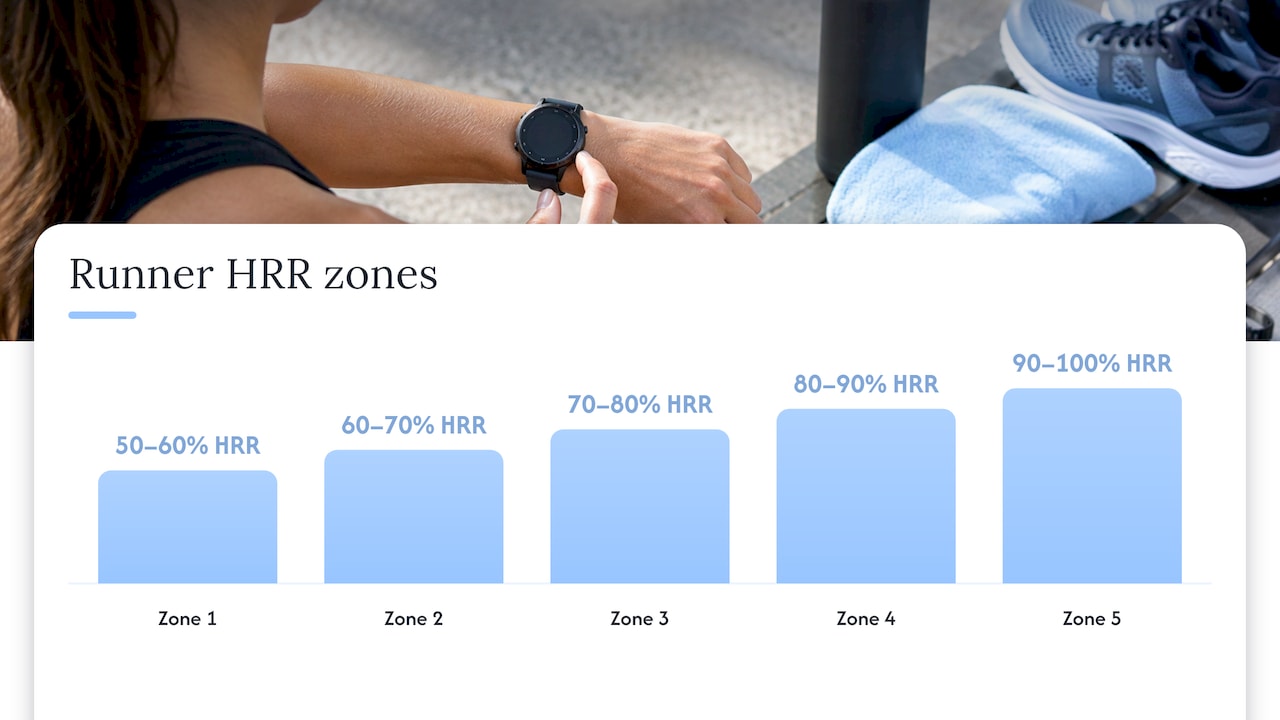
For most runners, the practical translation is a five-zone layout. These HRR bands are one reasonable way to organize them, built from the ranges above, not a standard:
| Zone | Typical feel | Example HRR band |
|---|---|---|
| 1 | Very easy, warm-up, recovery jog | 50 to 60% |
| 2 | Easy aerobic, full sentences | 60 to 70% |
| 3 | Steady, comfortably hard | 70 to 80% |
| 4 | Hard, threshold-type effort | 80 to 90% |
| 5 | Very hard, short intervals | 90 to 100% |
With the worked example (HRmax 185, resting 55), these bands give 120–133, 133–146, 146–159, 159–172 and 172–185 bpm. They are illustrative training zones, not medical safety thresholds. Pick the bands your plan uses and calculate them with the formula above. The aim is a repeatable framework for your easy days and your hard days, not a precise boundary. If you want to see how steady middle-zone running fits into a week, our guide to Zone 3 training for runners and cyclists covers it, and the Zone 2 heart rate page shows how to find your easy aerobic range.
Harvard Health’s Reid also notes that you do not need to train in Zone 4 to get cardiovascular benefits, and that consistent easy to moderate exercise is very effective. That is a useful reminder for triathletes juggling three sports: most of the week can be controlled and easy.
Using zones alongside effort
Heart rate lags effort, and it drifts with heat, hills, caffeine, dehydration, fatigue and sleep. On a hot day your pulse can sit higher at the same pace. Use the number as one signal, with the talk test and perceived exertion as the others. On interval days, give the pulse a minute or so to catch up before judging the effort.
On a treadmill, a gentle incline can help you hold an easy range without pushing pace, which our Zone 2 treadmill workout page covers.
Heart rate reserve vs. heart rate recovery
The abbreviation HRR is used for both, and the two are easy to confuse.
| Heart rate reserve | Heart rate recovery | |
|---|---|---|
| What it is | Max HR minus resting HR | Peak exercise HR minus HR one minute after stopping |
| When you use it | Before training, to set zones | After effort, to see how quickly your pulse falls |
| Typical use | Target heart rate and zone calculation | A clinical and fitness marker |
Cleveland Clinic’s recovery article defines recovery as the drop from peak exercise heart rate to the rate one minute later, and gives about 18 beats or more in the first minute as a reference. That figure depends on the test protocol: whether you stop or keep walking, the effort beforehand and how peak heart rate was measured all change the result, so it is not a universal cut-off. A 2023 review in the International Journal of Environmental Research and Public Health found that heart rate recovery relates to outcomes in people with heart failure and coronary artery disease. That is a clinical context, so if your recovery number worries you, take it to your doctor instead of trying to interpret it alone.
Is a higher heart rate reserve better?
Not automatically. A reserve can grow because resting heart rate falls with fitness, which is usually a good sign. It can also change for reasons unrelated to fitness: medications, illness, age-related changes in maximum heart rate, or simply an inaccurate estimate of either input. A bigger number on its own does not mean better health.
Some research links lower exercise heart rate reserve, measured during clinical exercise testing, with higher cardiovascular risk. A Finnish study of 1,967 men followed for a median of 25 years found an association between the lowest third of exercise heart rate reserve and sudden cardiac death. That was an observational study in men, using lab measurements; it does not make a home HRR calculation a risk score.
HRR is not a standalone diagnostic measure. For runners, the most useful way to read your own numbers is as a training trend. If you have symptoms or concerns about your heart, talk to a clinician.
Safety notes before you use HRR zones
The formulas assume a typical heart responding typically. Some groups should get individual guidance first.
- Beta-blockers and similar medication: These can lower heart rate, so age-based estimates and standard HRR targets may be unsuitable. The ACSM journal notes the age formula does not account for them, and Divers Alert Network says people on beta-blockers should consult a physician first. Your doctor or cardiac rehab team can give you a target that fits your medication.
- Heart disease or symptoms: Chest pain, dizziness or an unusually high pulse that stays high after you rest are reasons to stop and speak to a healthcare provider. USC’s trainer Q&A gives the same advice to see a provider if heart rate stays high after resting.
- Beginners and less fit people: The University of Oklahoma’s page, citing an ACSM position stand, lists 40 to 49% of HRR for unfit individuals as a starting range, while 50 to 85% is the general endurance range.
If you want to know what rates are considered unusual for your age and sex, see our pages on normal heart rate by age and what is a dangerous heart rate for a woman.
Calculate your zones with SnapHRZones
Doing the Karvonen arithmetic once is easy. Redoing it for each zone, each time your resting rate changes or when you compare formulas, is where small mistakes creep in. The SnapHRZones Heart Rate Zone Calculator is free and uses gender-specific formulas, with optional resting heart rate input for greater personalization.
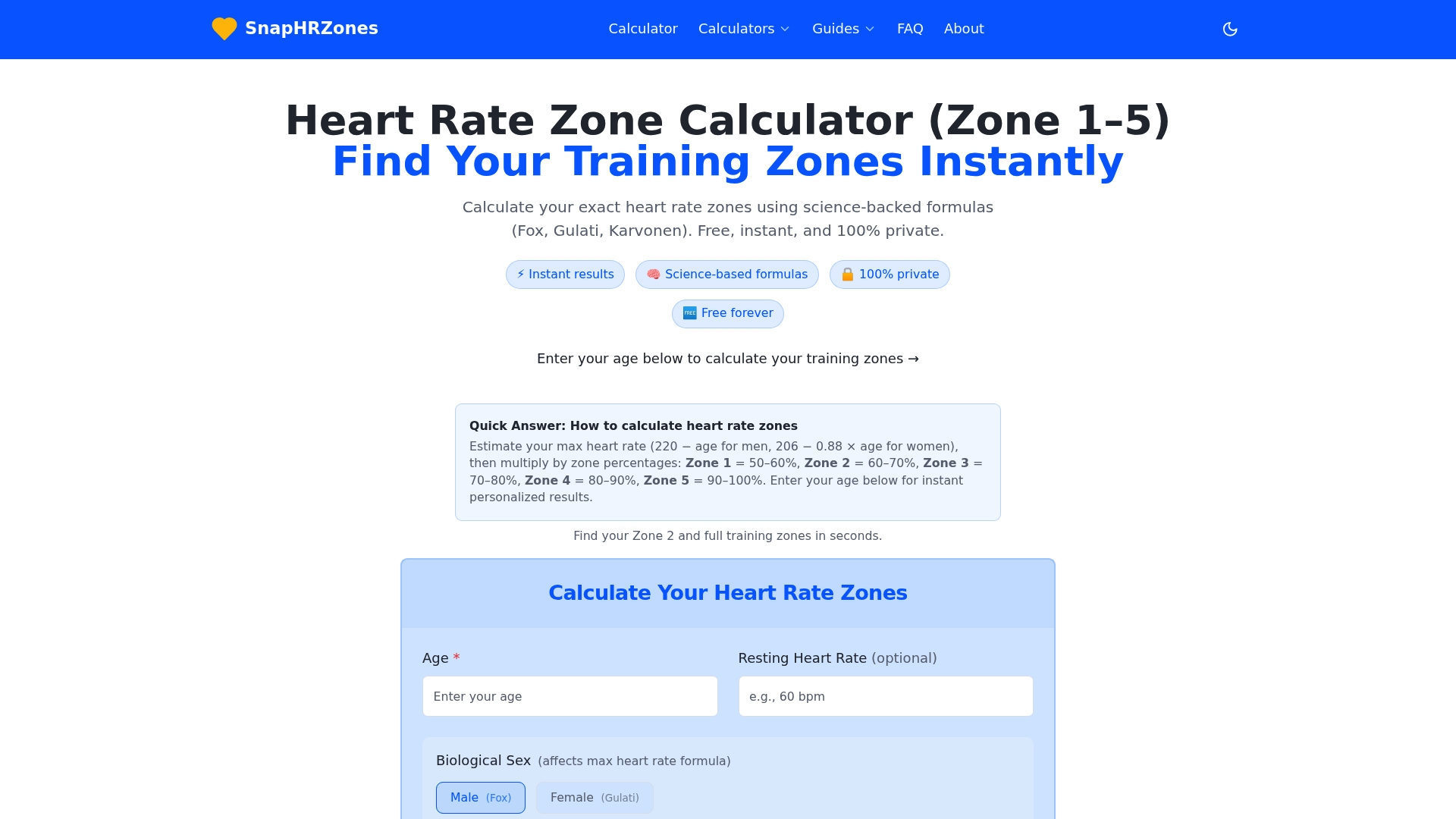
Enter your age, add your resting heart rate from a few morning readings, and use the output as a starting range for your easy days and quality sessions. If you are building a plan, our guides to HIIT workouts for runners and triathletes and what to look for in a training app can help you put the zones to work.
FAQ
What is HRR?
In training, HRR stands for heart rate reserve: your maximum heart rate minus your resting heart rate. The same letters are also used for heart rate recovery, which is the drop in pulse after you stop exercising. In most running and fitness articles, HRR means the reserve.
What is the heart rate reserve formula?
HRR = maximum heart rate − resting heart rate. To get a target heart rate, multiply HRR by your chosen intensity and add resting heart rate back. For example, with an HRR of 130, an RHR of 55 and a 70% target, you get 130 × 0.70 + 55 = 146 beats per minute.
What is the difference between HRR and MHR?
MHR is a single number, the highest heart rate you can reach. HRR is a difference: MHR minus resting heart rate, in bpm. Zones based on MHR use only one input, while HRR-based zones also reflect your resting rate, so they can differ between people of the same age.
Should I use 220 minus age or 207 minus 0.7 times age?
Both are population estimates. 207 − 0.7 × age is the Gellish equation; the similar Tanaka equation is 208 − 0.7 × age. A maximum measured in a supervised test is the best input; a peak from an ordinary workout may be below your true maximum.
How do I calculate target heart rate on beta-blockers?
Age-based formulas do not account for medications that lower heart rate, so ask your doctor or cardiac rehab team for a target range that fits your situation. They can set it using your prescription and your own response to exercise.
Is heart rate reserve the same as heart rate recovery?
No. Reserve is max HR minus resting HR, used to set targets. Recovery is how much your heart rate falls after you stop exercising, and its value depends on the test protocol.
Sources
- Heart Rate Reserve: How to Calculate It & What It Means, Cleveland Clinic
- Heart Rate Recovery: What It Is and How to Calculate It, Cleveland Clinic
- Heart Rate Recovery Assessed by Cardiopulmonary Exercise Testing, International Journal of Environmental Research and Public Health
- Revisiting Heart Rate Target Zones, ACSM’s Health & Fitness Journal
- Measures of Physical Activity, University of Minnesota
- Exercise to increase endurance, University of Oklahoma Health Sciences Center
- Cardiovascular Endurance, The Basics of Health, Wellness, and Fitness
- Ask the trainer, USC Staying Well
- Heart Rate Reserve: What It Is and How to Use It, Healthline
- Understanding exercise heart rate zones, Harvard Health
- Heart-Rate Training, Divers Alert Network
- Heart rate measures in sport, Sports Science Support
- Determining Heart Rates from MET Intensities, National Council on Strength & Fitness
- Exercise heart rate reserve and recovery as risk factors, PubMed
- Zone 2 vs Zone 3, Calibrate with VT1
Find your personal heart rate zones
Enter your age to get all five training zones in seconds.
Open the heart rate zone calculator