Cardiovascular Endurance: What It Is and How It Improves

Cardiovascular endurance is the ability of your heart, lungs, blood vessels and muscles to supply and use oxygen during sustained exercise. It improves when regular aerobic training triggers adaptations in the heart, the blood and the working muscles. This guide explains what those adaptations are, which measures describe them, what heart rate can and cannot tell you, and how to check whether your endurance is actually improving. For a practical, week-by-week training approach, see our companion guide on how to increase stamina.
TL;DR
- Cardiovascular endurance, also called aerobic fitness or cardiorespiratory fitness, depends on both oxygen delivery (heart, lungs, blood) and oxygen use (muscles).
- VO2max, lactate or ventilatory thresholds and exercise economy are different measures. None of them alone describes endurance.
- U.S. adults are advised to accumulate 150 minutes of moderate or 75 minutes of vigorous activity a week, or an equivalent mix.
- Heart rate shows the internal cost of an effort, but it cannot measure endurance by itself. Calculated zones are estimates, not measured thresholds.
- Judge progress by repeated, comparable sessions and long-term trends rather than single readings.
Table of Contents
- What cardiovascular endurance means
- Why it matters for endurance athletes
- The physiology behind better endurance
- VO2max, thresholds and exercise economy
- Types of activities that improve cardiovascular endurance
- How training intensity influences adaptation
- What heart rate zones can and cannot tell you
- How to measure cardiovascular endurance progress
- How much exercise is recommended?
- FAQ
- Sources
What cardiovascular endurance means
Cleveland Clinic describes cardiovascular endurance, or aerobic fitness, as how well your heart and lungs supply the oxygen you need during medium- to high-intensity exercise. The practical result is that you can keep going at a moderate effort for longer before fatigue forces you to slow down or stop.
Two processes are involved. Oxygen delivery is the job of the lungs, which load oxygen into the blood, and the heart and blood vessels, which carry it to working muscles. Oxygen utilization is the job of the muscles, which take up that oxygen and use it to produce energy. Endurance can be limited by either side, and training improves both.
This matters in every endurance sport. A runner on a long climb, a cyclist holding a steady pace into a headwind and a swimmer finishing a long set all depend on the same oxygen supply chain. You will also see the terms cardiorespiratory fitness, aerobic capacity and stamina. They overlap heavily in everyday language, and none of them can be read directly from heart rate alone.
Why it matters for endurance athletes
For general health, the American College of Sports Medicine (ACSM) notes that cardiorespiratory fitness reflects the heart and lungs’ ability to deliver oxygen during maximal-effort exercise and is associated with lower risk of cardiovascular disease, diabetes and several cancers. Association is not a guarantee for any one person, but it is a strong reason to treat aerobic fitness as a long-term habit.
For performance, endurance is not a single measurement. ACSM’s 2026 perspective for endurance athletes says VO2max, lactate threshold and running or movement economy all matter, but success depends on how they combine to support sustainable pace, durability and consistency. For a runner, that means a big engine helps only if you can train consistently enough to use it. For a triathlete, it means building aerobic capacity across three sports without digging a recovery hole.
The physiology behind better endurance
Several distinct systems contribute to cardiovascular endurance. They adapt at different rates and are measured in different ways.
Stroke volume and cardiac output
Stroke volume is the amount of blood the left ventricle ejects with each beat. Cardiac output is the total pumped per minute, which equals heart rate multiplied by stroke volume. With endurance training, stroke volume typically increases, so the heart can deliver the same blood flow with fewer beats at a given submaximal effort. That is one reason heart rate at a familiar pace often falls as fitness improves. Our heart diagram guide explains the chambers and vessels involved.
Aerobic energy production
During sustained exercise, most energy comes from aerobic metabolism, where muscles use oxygen to break down carbohydrate and fat. The more effectively muscles can do this, the longer a given pace can be held before the body relies heavily on faster, less sustainable energy pathways.
Peripheral adaptations in the muscles
Endurance training also changes the muscles themselves. Over time, trained muscles generally develop a denser network of capillaries, which brings blood closer to muscle fibers, and greater mitochondrial capacity, which increases their ability to use oxygen. These “peripheral” changes are part of why endurance improves even when heart rate at maximal effort barely changes.
VO2max, thresholds and exercise economy
These three measures are often treated as interchangeable fitness scores. They describe different things.
- VO2max is the maximum rate at which your body can take up and use oxygen during intense exercise. It reflects the upper limit of the aerobic system.
- Lactate and ventilatory thresholds describe intensities at which blood lactate or breathing changes markedly. They indicate how large a fraction of your maximum you can sustain. Our guide to the aerobic threshold heart rate explains the lower threshold in more detail.
- Exercise economy is how much oxygen you need to move at a given speed or power. Two athletes with the same VO2max can perform very differently if one is more economical.
Why a single VO2max number says little
Cleveland Clinic’s overview describes maximum oxygen consumption as a common measure of cardiovascular endurance. VO2max varies widely between individuals with age, sex, genetics, body size and training history, and estimates from watches or field formulas can differ from laboratory measurements. Rather than ranking yourself against general reference values, compare repeated measurements taken with the same method under comparable conditions.
Types of activities that improve cardiovascular endurance
Any rhythmic activity that raises your heart rate for a sustained period counts. The National Heart, Lung, and Blood Institute lists walking, hiking, jogging, running, swimming, bicycling, jumping rope, dancing, tennis, soccer, hockey and basketball as aerobic activities, with intensity varying by fitness level.
Cleveland Clinic gives five easy examples for a general reader: swimming, cycling, dancing, jogging and walking. It also lists jumping rope and stair climbing. Cross-training counts too: a walk, an easy spin or a pool session can add aerobic volume with less impact on the legs than another run.
How training intensity influences adaptation
Different intensities stress the oxygen supply chain in different ways. A University of Colorado Denver sports-medicine guide describes three training methods used by athletes: slow-to-moderate continuous distance training, moderate-to-high-intensity intervals, and high-intensity continuous exercise.
- Easy to moderate continuous work allows a large volume of training with manageable fatigue, which supports adaptations such as capillary and mitochondrial development.
- Sustained, comfortably hard efforts near threshold train the ability to hold a higher fraction of your maximum for longer.
- Short, hard intervals place a high demand on the heart and oxygen delivery, which challenges VO2max.
The American Council on Exercise (ACE) describes one common order for combining them: a base-building aerobic phase first, then steady-state threshold sessions, then high-intensity intervals. The principle is that a broad aerobic base makes harder work more tolerable and more productive.

How to apply this in a training week is covered in our practical guides: how to increase stamina for building a routine, and interval training heart rate for target heart rates during work and recovery periods.
What heart rate zones can and cannot tell you
Heart rate is useful because it shows the internal cost of an effort, not just the speed. On a hot day or a hilly route, the same pace costs more, and your heart rate reflects that. The American Heart Association says measuring heart rate before, during and after exercise can help you assess whether your effort is sufficient and monitor overall fitness.
It is important to separate two kinds of zones:
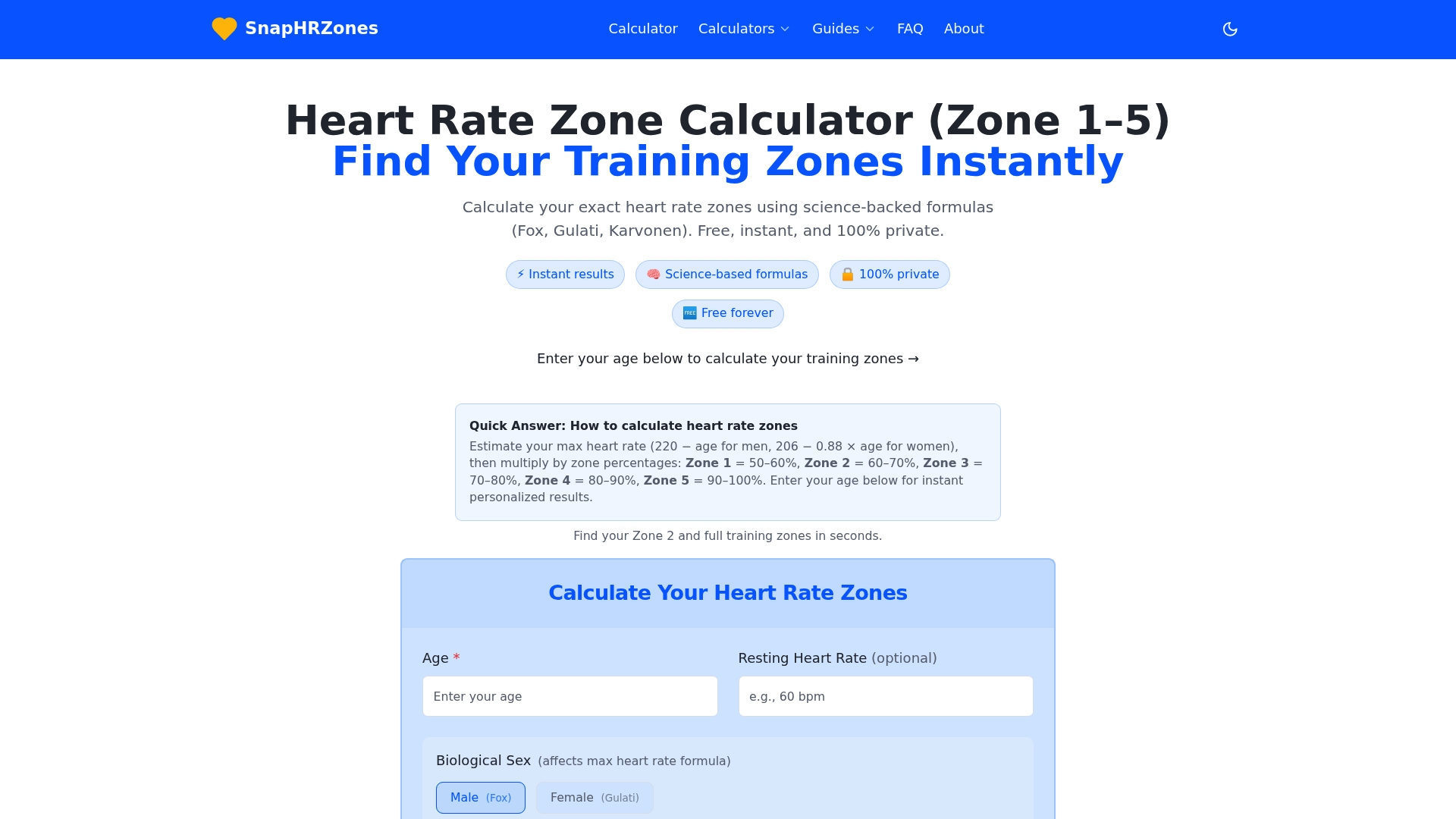
- Zones from fixed percentages of an estimated maximum heart rate, or of heart rate reserve as in the Karvonen method, are population-based estimates. Our Heart Rate Zone Calculator works this way.
- Zones from measured thresholds, such as a laboratory or field-tested lactate or ventilatory threshold, are anchored to your own physiology.
Zone 2 is a good example. Different systems define it differently, and a calculated Zone 2 range does not automatically match a measured aerobic threshold. Our Zone 2 heart rate guide explains why. Our heart rate zones for running guide covers each zone in running terms, and if you wear a Fitbit, how Fitbit heart rate zones work explains how its zones compare with the ones you calculate yourself.
ACSM emphasizes that estimated maximum heart rate, and heart rate measured by a wearable or by hand, both have limitations. It advises interpreting heart rate zones alongside perceived exertion and standardized test conditions, and notes that estimated maximum heart rate varies substantially between individuals. A simple cross-check is the talk test: according to the CDC, vigorous intensity means you are breathing hard enough that you can say only a few words before pausing. Our guide to heart rate training without a monitor shows how to use effort cues. Sleep, heat, caffeine, stress and illness can all move your heart rate on a given day.
How to Measure Cardiovascular Endurance Progress
Cardiovascular endurance changes slowly, so the best evidence comes from repeated, comparable measurements. ACSM’s endurance-athlete experts recommend trend-based monitoring because performance, recovery, sleep, stress and physiological metrics interact. A single VO2max, heart rate or HRV value cannot represent readiness or progress by itself. They suggest judging progress from trends in performance, heart rate, HRV, training load, fatigue, mood, sleep and perceived effort.
Repeated standardized submaximal sessions
The most accessible marker is a repeatable easy session. Choose the same route or treadmill setting, warm up the same way, and run, ride or walk at a steady easy effort for a fixed time. Record your pace or power, average heart rate and perceived effort. Over weeks and months, a faster pace or higher power at a similar heart rate and effort suggests your aerobic fitness is improving. Keep the conditions as consistent as possible: terrain, temperature, time of day, footwear and measurement device all affect the numbers.
Threshold field tests are optional
Monitoring fitness with submaximal sessions is different from estimating a threshold. ACE describes a demanding threshold field test in which, after a 5- to 10-minute warm-up, you run or speed-walk for 30 minutes at the maximum effort you can sustain, at 1% grade on a treadmill, and use the average speed and heart rate as threshold estimates. The treadmill grade is part of that particular protocol rather than a universal requirement, and the test is a hard, sustained effort.

You do not need a maximal test to track endurance. If you are new to training, returning after a break, have a health condition or are unsure whether a hard sustained effort is right for you, stick with the submaximal session above, after speaking with a doctor if needed.
Other markers to track
- Heart rate recovery: how quickly your heart rate falls after hard work can add supplementary information when measured the same way each time. Read more on heart rate recovery at 60 seconds.
- Resting heart rate: the AHA notes resting heart rate is commonly 60 to 100 beats per minute for adults and may be lower in trained athletes. Watch your own trend rather than comparing with others.
- HRV: our guide on HRV versus heart rate explains how to build a baseline over a few weeks.
- VO2max assessment: Cleveland Clinic lists stationary-bike, treadmill-walking, timed-distance running and shuttle-run tests as ways to estimate maximum oxygen consumption. ACSM adds that VO2max can be assessed with submaximal treadmill, cycle-ergometer or step tests. Estimates differ between methods, so compare like with like.
Writing these numbers down makes the trend visible. A simple log works, and gym progress tracking explains what is worth recording and how to read it. Improvements in these markers describe fitness. They do not by themselves establish clinical cardiovascular health.
How much exercise is recommended?
The CDC recommends that U.S. adults get 150 minutes of moderate aerobic activity, 75 minutes of vigorous activity, or an equivalent combination each week. That is a public-health baseline, not a ceiling. Athletes training for events usually do more. The CDC also says weekly activity can be split into smaller sessions. According to the CDC, moderate intensity usually means you are breathing harder and your heart rate is up, and you can talk but not sing.
Cleveland Clinic suggests beginners start with 10 to 15 minutes of cardiovascular exercise a day and add time gradually, and recommends asking a healthcare provider to help make a plan.
The CDC advises inactive older adults, people who are overweight, or anyone with concerns to talk to a doctor before vigorous activity such as jogging. People with chronic conditions or disabilities are advised to discuss an activity plan with a doctor. For arthritis, CDC guidance recommends starting or increasing activity slowly, paying attention to symptoms and contacting a health professional when pain or other symptoms are severe. Chest pain, dizziness, unusual shortness of breath or any symptom that worries you is a reason to stop and see a doctor before continuing.
FAQ
What are five examples of cardiovascular endurance activities?
Swimming, cycling, dancing, jogging and walking are five common examples, and Cleveland Clinic also lists jumping rope and stair climbing. Running, hiking, tennis and basketball also count.
What is the difference between VO2max and cardiovascular endurance?
VO2max is one measure of the upper limit of your aerobic system. Cardiovascular endurance in practice also depends on how much of that maximum you can sustain, which thresholds describe, and how economically you move.
How long does it take to improve cardiovascular endurance?
It varies from person to person, so the research does not support one fixed timeline. The better approach is to repeat the same submaximal session every few weeks or months and watch for a faster pace at a similar heart rate and effort. Trends matter more than any single result.
Can heart rate zones tell me if my endurance is improving?
Not on their own. Heart rate at a given pace, resting heart rate, recovery and how hard sessions feel all add information. ACSM recommends using perceived exertion alongside heart rate and judging progress from trends rather than one metric.
Sources
- Cardiovascular Endurance: What It Is & How To Improve It, Cleveland Clinic
- Physical Activity and Your Heart: Types, NHLBI
- Estimating cardiorespiratory fitness, ACSM
- The Endurance Athlete webinar Q&A, ACSM
- Lactate Threshold Training Program, ACE
- What Counts as Physical Activity for Adults, CDC
- Training for Cardiovascular Fitness, University of Colorado Denver
- Heart rate and blood pressure, American Heart Association
- Older Adults: Adding Activity Recommendations, CDC
- About Physical Activity and Arthritis, CDC
Recommended
Find your personal heart rate zones
Enter your age to get all five training zones in seconds.
Open the heart rate zone calculator