HIIT Workouts for Runners and Triathletes: Practical Sessions
Quick answer: Choose a HIIT session by its purpose: longer aerobic intervals, controlled medium repetitions or short relaxed intervals. Use pace, power and perceived effort for short bouts because heart rate lags. Start with one weekly hard session, warm up thoroughly and add volume only when recovery is good.

A HIIT workout alternates hard efforts with easier recovery. The practical challenge is completing the planned session at the intended effort—not forcing every repetition to a predetermined heart rate. Heart rate responds too slowly to steer many short intervals, so runners and triathletes should combine it with pace, cycling power and perceived exertion. Our free Heart Rate Zone Calculator can provide reference ranges, while the session formats below explain when those ranges are useful and when another intensity measure should lead.
This guide focuses on choosing and executing a workout: long aerobic intervals, controlled medium repetitions and short intervals, with recovery and weekly scheduling for runners and triathletes.
TL;DR
- HIIT includes several formats. Long aerobic intervals, short intervals and sprint intervals require different intensity controls; there is no single best workout.
- Heart-rate percentages in research describe specific protocols, not universal targets. Short repetitions are usually better controlled by pace, power or RPE because heart rate lags.
- A common aerobic HIIT example is 4 × 4 minutes with 3 minutes of active recovery, but beginners can start with fewer or shorter repetitions.
- Start with one weekly hard session and keep most other endurance work easy. Add a second only when recovery and the rest of your training support it.
- Warm up, finish with easy movement, and stop if you cannot maintain good form or the planned effort becomes uncontrolled.
Table of Contents
- What counts as a HIIT workout
- Setting HIIT intensity with heart rate
- HIIT formats and how they differ
- What the research shows for endurance athletes
- Sample interval sessions in heart rate terms
- How often to do HIIT in a training week
- HIIT, calories and fat loss
- Starting safely
- Put your numbers to work
- FAQ
- Sources
What counts as a HIIT workout
HIIT stands for high-intensity interval training. The American College of Sports Medicine (ACSM) describes it as short intense efforts of 15 seconds to 4 minutes at 80–95% of maximum heart rate, alternating with recovery periods. Recovery is passive rest or mild activity at about 40–50% of max HR. The efforts repeat 6–10 times for a total of 10 to 40-plus minutes, bracketed by a 5–10 minute warm-up and cool-down.
Other respected sources set the bar a little differently. Harvard’s Nutrition Source says a session raises heart rate to at least 80% of maximum during the hard periods and recommends a 5-minute warm-up plus a 5–10 minute cool-down. Cleveland Clinic defines high intensity as above 70% of maximum heart rate, and notes that a useful session can be as short as 10 minutes plus warm-up and cool-down, typically 20–30 minutes, and rarely beyond an hour.
The takeaway: HIIT is a broad training category, not one fixed recipe. The appropriate effort depends on the protocol and the athlete. “High intensity” does not require an all-out sprint, and a sensible session is one you can execute consistently and recover from.
Setting HIIT intensity with heart rate
Heart rate can describe the internal response, particularly during longer repetitions, but it is not always the best real-time controller. If you use percentages, you need an appropriate HRmax estimate or measured value—and the uncertainty still matters.
Max heart rate: the starting estimate
The common shortcut is 220 minus your age. A 28-year-old gets 192 by that rule, and our max heart rate page for a 28-year-old man shows 188 bpm using a different formula. The gap is a reminder that any formula is an estimate. Real max heart rate varies from person to person, so treat the result as a starting point and adjust with how the effort feels.
Our calculator uses gender-specific formulas and lets you add a resting heart rate for more personalization. If you want to see typical figures at other ages, the pages for a 42-year-old man, a 44-year-old man, a 57-year-old man and a 70-year-old man show how the estimate falls with age.
The Karvonen method for interval targets

The Karvonen method uses heart rate reserve: maximum heart rate minus resting heart rate. A target is resting heart rate plus a chosen percentage of that reserve. It incorporates a measured resting value, but it does not remove uncertainty in HRmax and is not automatically the best way to steer every interval.
Here is an illustration with made-up numbers. Say your max is 188 bpm and your resting rate is 55 bpm. Your reserve is 133.
- 90% of reserve: 55 + (0.90 × 133) = about 175 bpm for hard intervals.
- 70% of reserve: 55 + (0.70 × 133) = about 148 bpm for active recovery.
Compare that with the simple percentage-of-max approach: 90% of 188 is about 169, and 70% is about 132. These are arithmetic illustrations, not interchangeable prescriptions. Use the method specified by your chosen protocol. Chin and colleagues used heart rate reserve in a 2020 study of overweight men, with 1-minute bouts at 90% of reserve and 1-minute recoveries at 70%.
Heart rate lags, so pair it with effort
Heart rate takes time to climb, so a 20–30-second repetition may end before heart rate approaches the intended range. Use pace, power and RPE for short efforts. During 3–4-minute repetitions, heart rate becomes more informative later in each bout, but the first repetition can still read lower than later ones. Do not sprint the opening minute simply to make the monitor catch up.
- Short running repetitionsLead with controlled pace and RPE; review heart rate afterward rather than chasing it during each bout.
- Longer running repetitionsUse sustainable pace and RPE, with heart rate as a later-repetition guardrail.
- Cycling repetitionsUse power when available, supported by RPE and heart rate; do not assume running heart-rate values transfer directly.
- Pool repetitionsUse send-off time, pace and RPE; wrist heart rate can be less dependable in water.
HIIT formats and how they differ
Choose a format by the training quality you want and the measure you can control. These examples are deliberately differentiated rather than interchangeable work:rest labels:
| Practical format | Example starting session | Primary intensity control |
|---|---|---|
| Long aerobic intervals | 3–4 × 4 minutes hard but repeatable; 3 minutes easy | Pace or power and RPE; heart rate later in repetitions |
| Medium controlled intervals | 4–6 × 3 minutes controlled-hard; 2–3 minutes easy | Pace or power and RPE, with heart rate as a guardrail |
| Short intervals | 6–10 × 30 seconds controlled-fast; 60–90 seconds easy | Relaxed speed and RPE, not a short-interval heart-rate target |
| Original Tabata protocol | 8 × 20 seconds at the protocol’s very high intensity; 10 seconds rest | A specialized research format—not a default beginner workout |
Outside Magazine, summarizing work by researchers Laursen and Buchheit, sorts intervals into five types: long intervals (2–5 minutes of work), short intervals (10–60 seconds), short sprints (3–10 seconds), long sprints (20–30 seconds all-out with passive rest) and game-based HIIT. Each can be varied by intensity, duration, recovery, number of sets and mode. For runners and triathletes, long and short intervals are the ones that most often appear in training plans.
HIIT versus Tabata
Tabata is a form of HIIT, but not all HIIT is Tabata. Cleveland Clinic explains that Tabata is 20 seconds of maximal effort and 10 seconds of rest for eight rounds, which makes four minutes. Four rounds make a 20-minute circuit with 1 minute of recovery after each. General HIIT is more flexible in length and intensity. Because the original Tabata format is exceptionally demanding, it is not necessary for general endurance training. Longer, controlled intervals are usually easier to pace and progress.
What the research shows for endurance athletes
The studies below are examples of what researchers have tested, not prescriptions. Participants were often young, well-trained and monitored, and your response may differ.
Long intervals, 4 × 4 minutes. A 2022 randomized study of 48 well-trained men found that 4 × 4-minute intervals at about 95% of maximal aerobic speed, with 3 minutes of active recovery at 70% of max HR, raised VO2max by 6.5% over 8 weeks at three sessions a week. That was more than two sprint-interval protocols (8 × 20 seconds and 10 × 30 seconds), and 3000-m performance improved by 5.9%. VO2max is the maximum rate at which your body can use oxygen, a common measure of aerobic fitness.
Cyclists and triathletes. A 2020 case series included just seven national-level cyclists and triathletes who completed 14 sessions of 4 × 4-minute uphill treadmill running at 90–95% of max HR over nine days. Average cycling time-trial performance improved by 75.6 seconds, but group-level VO2max did not improve significantly in either cycling or running. Individual VO2max changes ranged from −8.2% to +14.5%. With seven participants and no control group, this is evidence of variable responses—not a recommendation to copy a 14-session block.
An older study of 38 cyclists and triathletes found that adding HIIT twice a week on top of regular low-intensity training improved 40-km time-trial performance by 4.4–5.8% over two to four weeks. Examples included 12 × 30-second sprints with 4.5 minutes of recovery.
Protecting your legs. A 2015 running protocol of 8 × 3-minute bouts at 90% of VO2max with 3 minutes of active recovery, after a 10-minute warm-up, produced acute fatigue without a rise in creatine kinase, a blood marker of muscle damage. That finding applies to the measured markers in this study; it does not prove that the protocol causes no muscle damage, soreness or excessive fatigue for everyone.

Practical interval sessions by sport
These are starting templates, not copies of research protocols. Warm up thoroughly, choose a controlled effort you can repeat with good form, and reduce the number of repetitions when you are new to intervals.
- Long aerobic intervals. Warm up 10–15 minutes easy. Run or ride three or four 4-minute efforts at a hard but repeatable pace or power, with 3 minutes of very easy recovery. In the researched 4 × 4 format, heart rate may approach 90–95% of max late in later repetitions; do not force it there at the start. Cool down 5–10 minutes.
- Medium controlled intervals. After a similar warm-up, do four to six 3-minute efforts at a controlled-hard pace with 2–3 minutes of easy recovery. Finish knowing you could complete one more repetition at the same quality; add volume gradually over later weeks.
- Short relaxed intervals. Do six to ten 30-second controlled-fast repetitions with 60–90 seconds very easy recovery. Keep the fast segments smooth rather than all-out, and use RPE and pace because heart rate will lag.
- Treadmill or hill option. Use the long-interval structure on a gentle incline if it helps you control speed. Uphill running still adds substantial muscular and cardiovascular load, so reduce the pace and keep the recovery easy.
For triathletes, adapt the format to the sport rather than copying a running heart-rate target. Use cycling power when available, pool pace and send-off times for swimming, and RPE in every discipline. Heart-rate responses and sensor reliability differ by mode.
How often to do HIIT in a training week
A 2016 systematic review discussed plans that combine 2–3 HIIT sessions per week with continuous runs for recreational endurance runners. A 2025 review in Frontiers in Physiology notes that considerable adaptations can come from HIIT once or twice weekly, including at lower-than-maximal intensities. So more is not automatically better. For many runners, one or two sessions alongside mostly easy running is a reasonable pattern.
A simple week might look like this:
- One interval session, such as three or four controlled long repetitions.
- Two or three easy aerobic runs or rides, which you can keep in Zone 2 using our Zone 2 heart rate page.
- One longer easy-to-steady session appropriate to your current training.
- One or two days of rest or light movement. An optional second interval day belongs only in a plan you are already recovering from well.
Strength work also fits around hard days. For how to balance lifting and cardio over a week, see this piece on strength training versus cardio. If you want a middle option between easy and hard efforts, our guide to Zone 3 training explains where it fits for runners and cyclists.
Watch for signs that the load is too much: heavy legs that do not clear, a resting heart rate that stays elevated, poor sleep or a dip in motivation. Our overtraining symptoms checklist walks through them, and our piece on HRV versus heart rate explains two signals you can track.
HIIT, calories and fat loss
People often search HIIT for fat loss. The evidence is encouraging but should be read carefully. In the 2020 study by Chin and colleagues, 56 overweight or obese men who did just one HIIT session a week of 12 × 1-minute bouts for 8 weeks improved aerobic capacity, lowered body fat mass and reduced systolic blood pressure. The 2025 Frontiers review adds that HIIT and sprint interval training increase fat oxidation during exercise, likely linked to changes in enzymes such as citrate synthase.
These findings describe groups of people in specific protocols, not a guaranteed result for you. Body composition also depends on nutrition, sleep and overall training load. If fat loss is a goal, you may like our guides to fat-burning workouts and fat-burning strength workouts, which sit alongside interval work.
Starting safely
HIIT is demanding, so build up gradually. ACSM advises that older adults, people with chronic conditions and previously inactive individuals should check with a health care provider before starting HIIT. It also recommends warming up and cooling down for 5–10 minutes, building gradually toward 8–10 repetitions, and not making recovery too short.
In practice:
- Start with fewer repeats, such as three 2-minute controlled-hard efforts, and add volume gradually.
- Use an effort that remains repeatable and technically controlled; RPE 4–6 is moderate work, not a universal HIIT target.
- Leave at least a day of easy training or rest between hard sessions.
- Stop for chest pain, fainting, severe dizziness or unusual shortness of breath. Seek urgent medical care for severe, persistent or alarming symptoms.
Put your numbers to work
Our free Heart Rate Zone Calculator estimates your maximum heart rate and training zones with gender-specific formulas, and you can add resting heart rate for a Karvonen-based result. Use the output as context for your chosen protocol—not as a command to hit the same number in every repetition. Record the workout, effort and recovery response in your training notes.
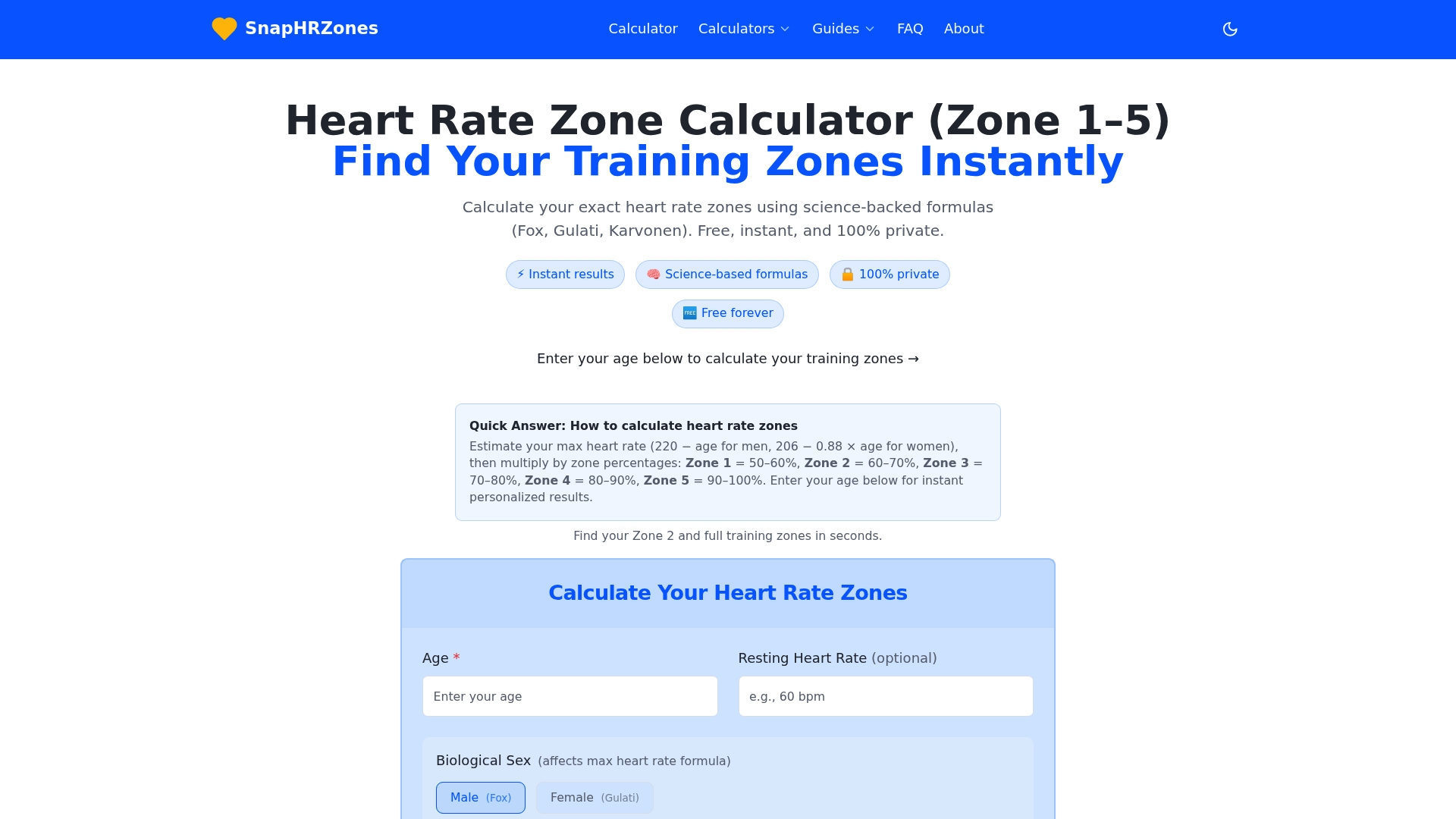
Calculate your heart rate zones before your next interval session, and check the cardiovascular endurance guide to see what the sessions are building.
FAQ
What’s considered a HIIT workout?
A HIIT workout alternates short, intense efforts with recovery periods. ACSM describes efforts of 15 seconds to 4 minutes at 80–95% of maximum heart rate, repeated several times, with a 5–10 minute warm-up and cool-down. Cleveland Clinic uses a lower threshold of above 70% of max HR, so the exact line varies by source.
What’s the difference between HIIT and Tabata?
Tabata is one specific HIIT format: 20 seconds of maximal effort and 10 seconds of rest, repeated for eight rounds. General HIIT can use many work and rest lengths and does not require all-out effort.
How often should runners and triathletes do HIIT?
A 2016 review of recreational runners suggests 2–3 sessions a week combined with continuous runs, and other research reports gains from once or twice weekly. Start at the low end, and let your recovery decide whether to add more.
Will HIIT burn belly fat?
Studies show HIIT can reduce body fat mass in some groups, but you cannot choose where fat comes off. Results depend on the whole picture, including nutrition, sleep and total training.
Sources
- High-Intensity Interval Training, ACSM’s Health & Fitness Journal (2013)
- HIIT, Harvard T.H. Chan Nutrition Source
- HIIT Workouts: They’re Good for Everyone!, Cleveland Clinic
- Tabata vs. HIIT: What’s the Difference?, Cleveland Clinic
- Aerobic high-intensity intervals and VO2max, 2022 randomized study
- Development of a non-damaging high-intensity intermittent running protocol, 2015
- Large inter-individual differences in responses to a block of HIIT, 2020
- Interval training program optimization in highly trained endurance cyclists, Medicine & Science in Sports & Exercise (2002)
- 12 Science-Backed Ways to Customize Your HIIT Workout, Outside
- Low-frequency HIIT improves body composition, Medicine & Science in Sports & Exercise (2020)
- Customizing intense interval exercise training, Frontiers in Physiology (2025)
- How does high-intensity intermittent training affect recreational endurance runners?, 2016 systematic review
Recommended
Find your personal heart rate zones
Enter your age to get all five training zones in seconds.
Open the heart rate zone calculator