What Is Cardiovascular Endurance? Meaning, Tests and Fitness Indicators
Quick answer: Cardiovascular endurance is the ability to sustain activity through coordinated oxygen delivery and use. Laboratory tests, field performance and comparable easy-session trends assess different aspects; VO₂max and heart rate alone do not describe the whole picture.

Cardiovascular endurance is the ability to sustain whole-body activity through coordinated oxygen delivery and use by the lungs, heart, blood and muscles. This article explains the concept and how to assess it—not a weekly training plan. Assessments answer different questions: maximum oxygen uptake, functional performance, or the cost of a familiar effort.
Choose an assessment that fits your health, experience and goals. Laboratory gas-exchange testing, practical field tests and everyday trends give different information; they are not interchangeable fitness scores.
TL;DR
- Cardiovascular endurance is your body’s ability to take in, deliver and use oxygen during prolonged exercise such as running, cycling or swimming.
- It shows up in practice as a lower heart rate at a given pace, faster recovery between efforts and the ability to hold effort for longer.
- Choose assessments by what they measure; field and watch estimates are not laboratory measurements.
- Heart rate alone cannot distinguish fitness adaptation from heat, fatigue, medication or measurement error.
- Progress is gradual and individual, so judge it over weeks and months, not single workouts.
Table of Contents
- Cardiovascular endurance, defined
- What is happening inside your body
- Why runners and triathletes should care
- How much activity does it take?
- How cardiovascular endurance is measured
- Building cardiovascular endurance with heart rate zones
- Sample week for a runner building aerobic fitness
- How to progress without overreaching
- Common mistakes
- Set your zones with SnapHRZones
- FAQ
- Sources
Cardiovascular endurance, defined
Three systems share the job. Your lungs bring oxygen into the body. Your heart pumps oxygenated blood through your vessels. Your muscles then pull that oxygen out of the blood and use it to produce energy. Cardiovascular endurance describes how well that whole chain keeps up when you ask it to work for more than a few minutes at a time.
You will see several names for the same idea. Cardiorespiratory endurance, aerobic fitness, aerobic capacity, cardio fitness and stamina all point to it. “Cardiovascular” stresses the heart and vessels, while “cardiorespiratory” adds the lungs. These terms overlap in everyday use, but aerobic capacity generally describes an upper physiological limit, while stamina also involves muscular, skill and pacing factors.
It is different from two other qualities that people confuse with it:
- Muscular endurance is the ability of a specific muscle group to keep working against resistance, like holding a plank or repeating bodyweight squats.
- Speed or power is how fast or forcefully you can move over a short effort, like a 100-meter sprint.
A runner can have strong cardiovascular endurance and still tire early in the legs on a hilly course, which is a muscular and strength question. The two qualities overlap and support each other, but they are trained a little differently. We cover the overview version on our page about cardiovascular endurance and how it improves.
What is happening inside your body
When you start running at an easy pace, your breathing and heart rate rise to meet the new demand for oxygen. Over weeks of consistent aerobic training, several adaptations are commonly described by exercise physiologists:
- The heart pumps more blood per beat. This is called stroke volume. With more blood moved per beat, the heart can often work at a lower rate for the same effort.
- Muscles use oxygen more efficiently. Training is associated with more mitochondria, the structures in muscle cells that produce energy using oxygen, and with a denser network of tiny blood vessels around the muscle fibers.
- A familiar effort can feel less demanding. The same pace feels less labored.
The practical result runners notice first is simple: the same route at the same pace comes with a lower heart rate or a lower perceived effort. That pattern can be consistent with fitness improvement, but is not proof on its own. How quickly each of these changes appears varies from person to person and depends on training history, sleep, age and genetics.
Why runners and triathletes should care
Endurance performance involves oxygen delivery and use as well as economy, pacing, fuel availability, muscular fatigue and conditions. The longer the event, the more the aerobic system carries the load. Even in a 5K, most of the energy comes from aerobic pathways, and in a marathon or half-distance triathlon the dependence is nearly total.
Good cardiovascular endurance supports several things you probably care about:
- Pace you can hold. A stronger aerobic base moves the pace you can sustain comfortably higher over time.
- Recovery between hard sessions. A well-developed aerobic system is generally associated with recovering faster from intervals and tempo work, which lets you train consistently.
- Less drift late in races. Heart rate often climbs over a long effort even when pace is steady. Drift also depends on duration, heat, hydration and pacing; reduced drift alone does not establish improved fitness.
- Everyday health. Beyond racing, regular aerobic activity is the kind of movement public health guidance recommends for adults, as covered below.
How much activity does it take?
The U.S. Centers for Disease Control and Prevention says adults should get at least 150 minutes of moderate-intensity aerobic activity per week, or 75 minutes of vigorous activity, or an equivalent mix, along with muscle-strengthening activity on two or more days. That is a general health guideline. Most runners and triathletes training for an event exceed it, but it is a useful anchor for beginners and for returning athletes.
If you are new to running, or returning after time off, or if you have a heart or lung condition, are pregnant or take medication that affects heart rate, talk with your doctor before raising your training load. That conversation is worth having before you start structured intensity work.

How cardiovascular endurance is measured
VO₂max describes the highest oxygen uptake reached under suitable maximal-test criteria; a test may instead report VO₂peak when those criteria are not established. Endurance performance also depends on sustainable fraction, movement economy, durability and local muscular capacity. Two people with the same VO₂max can sustain different speeds.
| Assessment | What it measures | Limitations and best use |
|---|---|---|
| Laboratory CPET | Breath-by-breath gas exchange during a graded treadmill or cycle test; oxygen uptake and ventilatory responses. | Qualified supervision and screening are needed. VO₂peak/max depends on protocol and effort. Useful for detailed performance or clinical questions; interpretation is not a DIY diagnosis. |
| Six-minute walk test | Distance walked under a standardized protocol; functional exercise capacity. | Not direct VO₂max. Course length, instructions, learning and symptoms affect results. Common in clinical populations; fit runners may encounter a ceiling effect. |
| Timed run or shuttle test | Running performance; validated equations may estimate aerobic capacity. | Pacing, motivation, surface and turns matter. Demanding tests are optional and inappropriate for some people; do not self-test maximally if unprepared. |
| Submaximal step or cycle test | Response to a standardized workload; some protocols estimate fitness. | Heart-rate-based estimates depend on medication, heat and protocol assumptions. Follow a validated protocol rather than inventing a score. |
| Repeat familiar easy session | Pace or power at comparable effort and pulse over time. | Personal trend, not a clinical test or direct VO₂max. Keep route, duration, conditions, device and recovery similar. |
| Watch VO₂max estimate | Algorithmic estimate, often from pace/power and heart rate. | Device, activity and algorithm matter; compare like with like rather than treating it as a precise laboratory change. |
Clinical guidance on the six-minute walk test explains protocol and interpretation limits. The ATS/ACCP statement on CPET explains supervised gas-exchange assessment.
There are lab measures, field tests and everyday signals. You do not need a lab to track direction of travel.
VO2 max
VO2 max is the highest rate at which your body can take up and use oxygen during maximal exercise, usually reported in milliliters of oxygen per kilogram of body weight per minute. It is the classic lab measure of aerobic capacity. Many watches and apps display an estimated VO2 max, but these are estimates built from pace and heart rate data, and they can differ from a lab test. Treat the trend, not a single number, as the useful signal.
Field tests
Common performance tests include a timed run over a fixed distance, a fixed-time run where you cover as much distance as you can, or a step test where heart rate recovery is checked after a short bout of stepping. These give a repeatable benchmark when you run them under similar conditions, on the same course, at a similar time of day and after similar rest.
Everyday signals
Runners can also watch:
- Heart rate at a steady pace. If your heart rate at a given easy pace drifts down over several weeks, aerobic fitness is likely improving. Heat, poor sleep, caffeine, stress and illness can all push it up, so look for patterns, not one-off readings.
- Heart rate recovery. How quickly your heart rate falls in the minutes after you stop hard effort.
- Talk test. The CDC describes the talk test as a simple way to gauge intensity: on moderate effort you can talk but not sing, while on vigorous effort you cannot say more than a few words without pausing for breath.
None of these is a diagnosis or a precise score. They are practical signals to combine with how you feel.
Interpreting heart rate during an assessment
During assessment, record heart rate alongside pace or power, breathing, effort and symptoms. A high pulse can reflect heat, illness, medication or sensor error; a lower pulse does not prove improvement.
Zone definitions differ between systems. Some use a percentage of maximum heart rate, others use heart rate reserve, which accounts for your resting heart rate (the Karvonen method), and others use threshold-based zones set from a field test. Our heart rate zones for running guide walks through how these approaches compare for runners.
Record the test method, protocol and device. A heart-rate percentage cannot convert one assessment into another.
A percentage-based zone is an estimated intensity band, not an assessment score, measured threshold or evidence of clinical cardiovascular health.
These are general descriptions. Exact boundaries depend on the system you use and your individual physiology, so treat a calculated range as a starting point and adjust with how you feel.
Why Zone 2 gets so much attention
For practical easy-training details, use our Zone 2 heart rate page, and our Zone 2 treadmill workout guide. For assessment, keep workload consistent instead of changing incline to chase a pulse; a calculated zone is not automatically a measured threshold.

A training-intensity split is not an assessment method. Use the practical training guides for session design rather than inferring a plan from a test score.
Where Zone 3 fits
For this separate practical intensity topic, our guide to Zone 3 training for runners and cyclists explains session choices. For fitness tracking, a familiar easy session is easier to compare than a session with changing intensity.
Choosing a repeatable assessment routine
This is a measurement routine, not a training prescription. For endurance development, use the established cardiovascular endurance guide and stamina-building guide.
- Define the question: fitness trend, sport performance or symptoms requiring clinical assessment.
- Choose a suitable method; use a familiar easy session if a demanding test is unnecessary.
- Record protocol, conditions, device and effort.
- Repeat under comparable conditions after a meaningful training period.
- Interpret changes alongside recovery and symptoms, not one isolated value.
Assess the activity you want to improve: running, cycling and swimming results are not automatically interchangeable. Cross-training adds variety, but a skill-heavy game is not a standardized VO₂max test. Ideas such as this pickleball cross-training routine illustrate a supporting activity rather than a validated assessment method.
How to progress without overreaching
Assessment can inform realistic goals, but cannot automatically prescribe training. Choose a repeatable objective and interpret it alongside recovery:
- Match the goal to the test. Walking distance, estimated VO₂max and running time are different outcomes; do not rank them as one score.
- Use realistic comparisons. Set goals relative to your own reproducible baseline, not another athlete’s watch estimate.
- Track trends. Note heart rate at a steady pace, resting heart rate on waking and how you feel. A gradual drop in resting heart rate can accompany improved fitness, though it also moves with stress, sleep and illness.
- Watch for warning signs. Persistent fatigue, a resting heart rate that stays elevated, poor sleep and declining performance can signal that you are doing too much. Our overtraining symptoms checklist lists what to look for. If you have chest pain, dizziness, fainting or unusual shortness of breath during exercise, stop. Chest pain, fainting or severe breathlessness requires urgent medical help—call 911 for an emergency. Seek clinical advice before resuming unexplained symptoms.
Common mistakes
Comparing unlike tests. A treadmill estimate, a shuttle run and a watch number are not interchangeable. Keep the method constant and record protocol changes.
Trusting a single formula blindly. Age-based maximum heart rate formulas are population averages, and individual maximums vary widely. A formula gives a starting range, not a verdict on your physiology.
Ignoring conditions. Heat, humidity, altitude, hills, caffeine and fatigue all raise heart rate. A high reading on a hot day does not mean you lost fitness.
Judging progress too soon. Aerobic adaptation unfolds over weeks to months. Compare similar runs over time rather than day to day.
Set your zones with SnapHRZones
Our free Heart Rate Zone Calculator offers population-based maximum-heart-rate estimates and optional heart-rate-reserve zones. It supports intensity planning after assessment; it does not measure VO₂max, diagnose cardiovascular health or certify a test result.
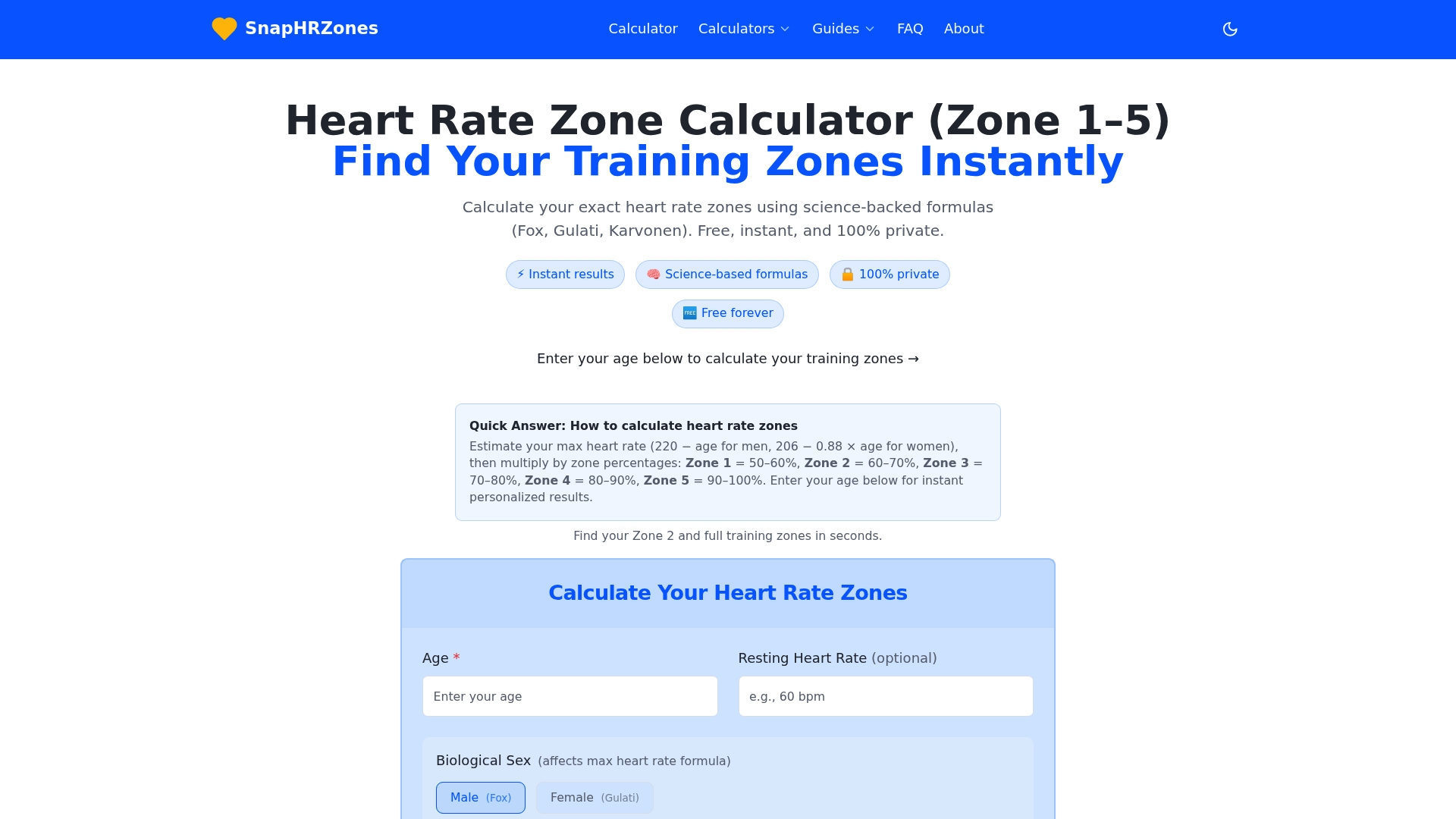
If you want sport-specific guidance next, start with our running zone guide, then move on to the Zone 2 page for base-building ranges.
FAQ
What is cardiovascular endurance in simple terms?
It is how long and how comfortably your heart, lungs and muscles can keep working together during sustained exercise like running, cycling or swimming. The better it is, the less breathless and fatigued you feel at a given effort.
What is the difference between cardiovascular endurance and muscular endurance?
Cardiovascular endurance concerns oxygen delivery and use across the whole body during prolonged activity. Muscular endurance is about how long a particular muscle or group can keep working against a load. Runners need both, and they train them in somewhat different ways.
How do I know if my cardiovascular endurance is improving?
Look for a lower heart rate at the same easy pace, easier breathing at the same effort, quicker heart rate recovery and better times on repeat field tests under similar conditions. Because weather, sleep and stress affect these signals, judge the pattern across several weeks.
How often should I train to build it?
The CDC’s general adult guideline is at least 150 minutes of moderate activity weekly, or 75 minutes of vigorous activity, or a mix. Runners training for races usually do more, building up gradually. If you are unsure what suits your health, check with your doctor first.
Is heart rate the only way to track it?
No. Pace, perceived effort, the talk test and estimated VO2 max from a watch are also used. Heart rate zones are popular because they give a consistent reference that is easy to repeat from day to day.
Sources
Recommended
Find your personal heart rate zones
Enter your age to get all five training zones in seconds.
Open the heart rate zone calculator