Walking 1 Hour a Day for a Month: What to Expect
Quick answer: A month of daily walking can build a sustainable habit, but no amount of weight loss, blood-pressure reduction or fitness gain is guaranteed in 30 days. Start with a tolerable duration; one hour every day is not required.

Walking an hour a day for a month can help establish a routine and may improve how you feel, but it does not guarantee weight loss, lower blood pressure or measurable fitness gains within 30 days. Starting fitness, pace, food intake, health and your existing training all matter. For runners and triathletes, comfortable walking can complement sport-specific work—but an extra daily hour is still added load. This guide separates realistic four-week expectations from results measured in longer studies.
TL;DR
- An hour of walking burns roughly 280 to 460 calories for a 154-pound person, depending on pace. Over 30 days that adds up to meaningful energy use, but weight change depends heavily on what you eat.
- Walking trials report average improvements in weight, blood pressure and aerobic capacity over varied durations. Their pooled results are not forecasts for a 30-day walking challenge.
- Health benefits do not depend on the scale moving. Fitness, blood pressure, sleep and mood can improve even when weight barely changes.
- For runners and triathletes, walking works best as easy aerobic work or active recovery. It should complement key workouts, not replace them.
- Build up from what you can comfortably tolerate. The 10% progression rule is a rough heuristic, not a universally validated injury-prevention threshold.
Table of Contents
- How many calories an hour of walking burns
- What a month of hour-long walks can change
- How much weight you might lose
- Why two people get different results
- What this means for runners and triathletes
- How to structure your hour
- Build up without getting hurt
- Use heart rate to keep the hour honest
- What a realistic month looks like
- FAQ
- Sources
How many calories an hour of walking burns
Calories are the starting point for every claim about weight, so get the estimate right first. The CDC estimates that a 154-pound person burns about 280 calories in an hour of walking at 3.5 mph and about 460 calories at 4.5 mph. Heavier people burn more and lighter people burn less. Mayo Clinic gives about 314 calories per hour at 3.5 mph for a 160-pound person, and notes that the number depends on effort, body weight and other factors.
Here is what those figures look like across a 30-day month, using the CDC numbers for a 154-pound person:
| Pace | Calories per hour | Calories over 30 days |
|---|---|---|
| 3.5 mph (moderate) | About 280 | About 8,400 |
| 4.5 mph (vigorous) | About 460 | About 13,800 |
These are approximate total energy-use estimates, not measurements or extra calories above resting expenditure. They do not translate directly into pounds lost. A watch or treadmill display can be off by a wide margin, and your own burn will differ with weight, terrain, incline and stride. Treat the table as a range to plan around, not a promise.
What a month of hour-long walks can change
The most reliable evidence comes from reviews that pool many randomized trials, not from single before-and-after stories. A 2015 meta-analysis of 32 randomized trials of walking programs in initially inactive adults found average improvements across several measures. Eligible trials lasted at least four weeks, with varied durations and walking doses; these pooled results do not isolate one-hour daily walks for exactly 30 days:
- Aerobic capacity rose by 3.04 mL/kg/min.
- Systolic blood pressure fell by 3.58 mmHg and diastolic by 1.54 mmHg.
- Body weight fell by 1.37 kg (about 3 pounds), body fat by 1.22 percentage points, and waist circumference by 1.51 cm.
- The pooled analysis did not detect a significant change in blood lipids; that is not proof that no individual experienced a change.
An earlier review of 24 trials looked at programs averaging about 35 weeks and found improved aerobic fitness in previously sedentary adults. These results are not four-week targets. Those programs ran far longer than a month, and the participants were not trained runners, so read them as a picture of what walking does for people starting from modest fitness. A trained athlete should expect less change in aerobic capacity, because there is less room to improve.
Broader health benefits are well documented too. Mayo Clinic lists regular brisk walking as helping with weight management, heart health, bone and muscle strength, energy, mood, memory, sleep and stress, and says faster, farther and more frequent walking is linked to greater benefits. Cleveland Clinic adds that daily 30-minute brisk walks are associated with lower resting heart rate, lower blood pressure and lower LDL cholesterol, and discusses light walking after meals as a way to reduce the immediate post-meal glucose response. That short-term response is different from a lasting change in diabetes risk or blood pressure.
A month is short. Some changes, like a post-meal blood sugar response, show up immediately. Others, like blood pressure and fitness, move slowly and need the habit to continue.
How much weight you might lose
There is no reliable number of pounds that everyone should expect to lose after 30 days. Walking increases energy use, but changes in appetite, food intake, other activity and water weight can offset or obscure it. No change on the scale does not mean the habit has no value.
A first-person account in Today described a reporter who added an hour-long daily walk and lost 5 pounds in a month, with better sleep, mood and energy. That is one person’s experience, not a forecast. Neither that anecdote nor the pooled trial average of about 3 pounds is a reliable one-month forecast.
What you eat matters as much as how far you walk. The CDC says most weight loss comes from decreasing calories, and that losing weight and keeping it off requires a high amount of physical activity unless you also adjust your diet. Healthline reports a 12-week study in which people with obesity who walked 3 hours a week while also cutting 500 to 800 calories a day lost about 4 pounds (1.8 kg) more than the group that did not walk.
The federal Physical Activity Guidelines for Americans linked here are the historical 2008 edition, retained for reference—not the current recommendation. They discuss higher activity volumes for weight control, but neither a fixed exercise dose nor a percentage weight-loss goal guarantees a result. The current second edition (2018) recommends 150–300 minutes of moderate-intensity aerobic activity or 75–150 minutes of vigorous activity weekly, plus muscle strengthening on at least two days. An hour daily totals 420 minutes weekly, but only time at the relevant intensity counts toward those targets; passing a minute total does not guarantee weight loss. The same guidelines note that health benefits are largely independent of body weight. A month of daily walking can be a good month for your health even if the scale barely moves.
One practical point: hunger often rises with more activity. If you are using walking to manage weight, keep an eye on how much you eat afterward. For a plan built around your own energy needs, a step-by-step guide to personalized weight loss plans explains how food intake and activity work together.
Why two people get different results
The same hour of walking does not give everyone the same outcome. These factors do most of the work:
- Body weight. Heavier people burn more calories per mile, as the CDC figures show.
- Pace and incline. Faster walking and uphill walking raise effort. At 4.5 mph the CDC estimate is far higher than at 3.5 mph.
- Starting fitness. Someone coming off the couch has far more to gain than a runner logging 30 miles a week.
- Food intake. Food intake can partly or fully offset added activity; short-term scale changes also reflect fluid and other factors.
- Consistency. A sustainable routine matters more than completing a streak; shorter walks or rest days can be appropriate.
- Sleep and stress. These shape appetite and recovery, and walking can help both.
The CDC also notes that the amount of activity needed to maintain weight varies greatly from person to person. That is why the best test is your own trend over several weeks, not a calculator’s output.
What this means for runners and triathletes
If you already train, the question is not whether walking will transform you. It is whether an hour a day helps or hurts the rest of your plan. It may help if the added volume fits your recovery and training goals; it is not automatically beneficial.
Walking as easy aerobic volume
Walking is low impact. It lets you add time on your feet without the stress of an extra run. At the right effort, a long brisk walk sits in the low-intensity range that endurance athletes use to build an aerobic base. If you train by heart rate, the sensible approach is to find your Zone 2 range and see whether your walking pace reaches it. Many fit people find that an easy walk keeps their heart rate below Zone 2, while hills or a faster stride push it into range.
Our Zone 2 walking guide covers pace, incline and the talk test, and the page on a 3 to 6% incline for a Zone 2 treadmill workout offers incline examples, not a grade everyone should use. Do not chase a heart-rate target at the expense of comfortable effort. As male Tanaka-formula examples using 60–70% of estimated maximum heart rate, with no resting heart rate entered, the Zone 2 range for a 48-year-old is 104 to 122 bpm, and for a 55-year-old it is 102 to 119 bpm. Those are rounded estimates, not measured aerobic thresholds. Other formulas and zone systems differ; entering resting heart rate switches to heart-rate-reserve calculation. Medication, heat and measurement error can also alter interpretation.
Walking as active recovery
The day after a hard interval session or long run, an easy walk can keep you moving without adding strain. Our guide to active recovery workouts explains how easy that effort should actually be. Recovery walks should feel comfortable and can stay below estimated Zone 2. Moderate-intensity work can improve fitness, but it is not interchangeable with a recovery session.
What walking does not replace
Walking does not replace the sessions that make you faster. Threshold runs, intervals, brick workouts and race-pace work still need to happen. An American Society for Preventive Cardiology statement recommends exercise sessions that include a 10-minute warm-up, a 5 to 8 minute cool-down and a 30 to 60 minute conditioning phase based mainly on endurance exercise, complemented by flexibility and resistance work. Strength sessions also matter. Our guide to fat burning strength workouts shows how to fit them around endurance training. Public guidelines also call for muscle-strengthening activity on at least 2 days a week, per the CDC.
If you want to keep quality high, treat the walk as the thing that flexes. On a hard day, shorten it or move part of it to an easier time. If you feel unusually flat or sore for several days, reassess the whole training load; do not preserve hard workouts at the expense of recovery.

How to structure your hour
An hour does not have to be one steady effort. A few formats work well:
- Steady brisk walk. Hold a pace where you can talk in full sentences. This is a moderate session for many people; for recovery, slow down to an easy, comfortable effort.
- Incline walk. Use a treadmill at a modest grade to raise heart rate without a faster stride.
- Interval walk. Mayo Clinic describes alternating fast and slow minutes as a form of interval training that can improve heart health and fitness in a time-efficient way. Our page on interval training heart rate gives targets for work and recovery.
- Split walks. Two 30-minute walks count just as well for most purposes, and a short walk after meals suits blood sugar.
For treadmill sessions, a library of treadmill workouts by discipline shows ways to vary pace and structure across the week.
Build up without getting hurt

An hour daily can be a large increase if you currently walk little. Start with a duration that feels comfortable, repeat it until you tolerate it well, and add small amounts only when recovery is good. Cleveland Clinic describes a 10% limit as clinician advice, but it is not a universally validated injury threshold. Progression depends on your recent activity, symptoms, age, health and total training load—not one percentage.
An illustrative progression for someone who already tolerates 20–30 minutes comfortably is shown below. There is no requirement to reach an hour by week four; hold a week, shorten sessions or take longer if needed:
| Week | Daily target | Notes |
|---|---|---|
| 1 | 20 to 30 minutes | Easy pace, find your routine |
| 2 | 30 to 40 minutes | Increase only if the previous week felt comfortable |
| 3 | 40 to 50 minutes | Optional brisk segments only if well tolerated |
| 4 | Up to 60 minutes | An optional ceiling, not a daily requirement |
Both the table and accompanying daily-target image are illustrative, not a prescribed four-week schedule or a validated safe progression. If you have a heart condition, high blood pressure, joint problems, are pregnant, or have not exercised in a long time, talk with your doctor before starting an hour-a-day program. Stop exercising for chest pain, dizziness or unusual shortness of breath; severe, sudden or persistent symptoms require urgent medical attention. Sore feet or shins are a cue to cut back, shift some time to a softer surface and check your shoes.
Use heart rate to keep the hour honest
Pace alone is a blunt tool. Heat, hills, fatigue and sleep all change how hard the same walk feels, and heart rate is one indicator of effort, not a direct measurement of physiological intensity. Our free Heart Rate Zone Calculator uses gender-specific formulas and an optional resting heart rate input, so the zones reflect you more closely than a single age-based number. If you want your Zone 2 range in particular, the page What Is My Heart Rate Zone 2? walks you through it.
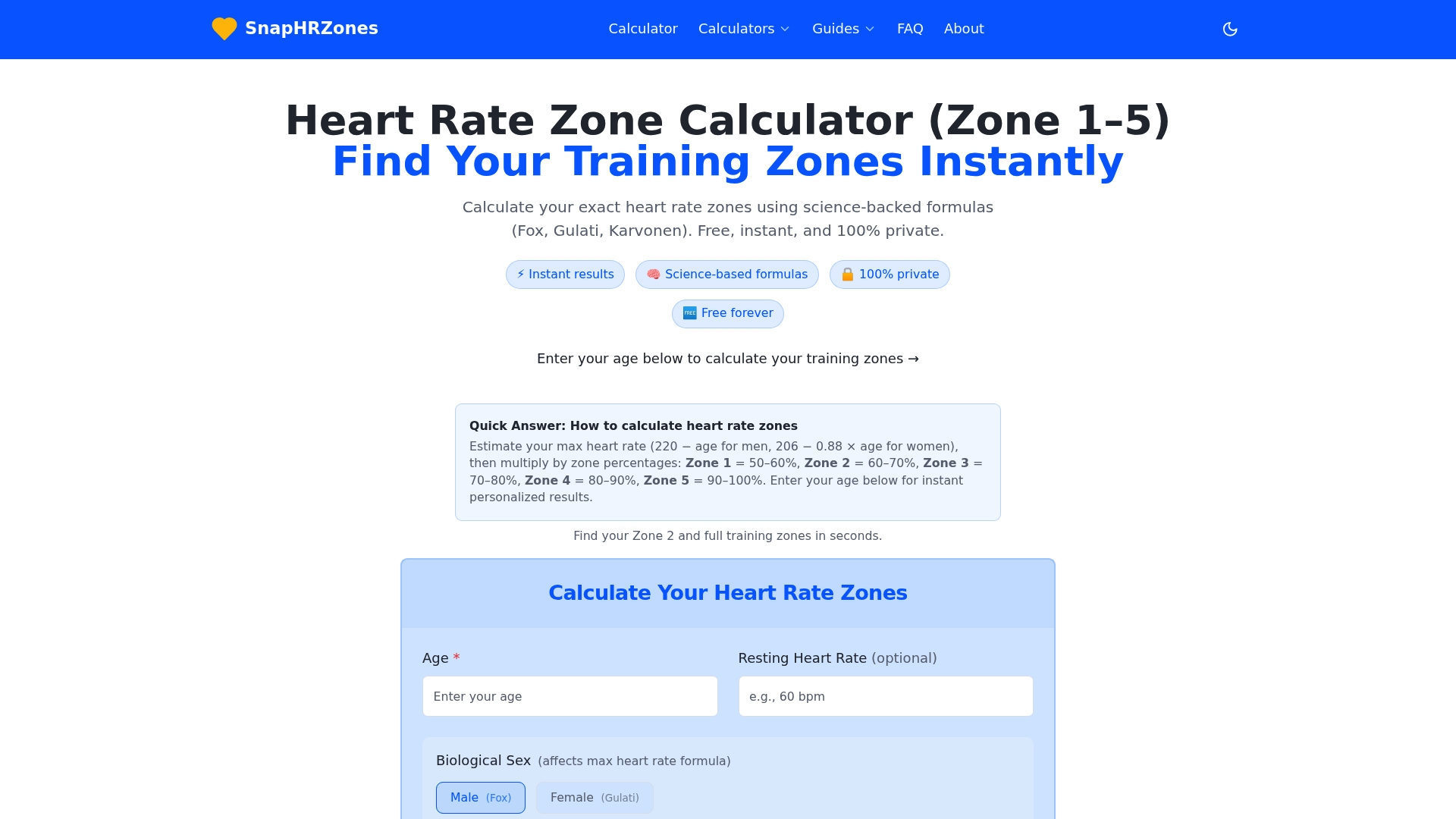
Enter your age and sex, add your resting heart rate if you know it, and use the result to decide which walks stay easy and which add effort. Formula-based zones are estimates, so use them alongside how you feel.
What a realistic month looks like
Use this week-by-week outline to review tolerance and habits, not to predict medical changes. These are practical observations, not trial-derived deadlines:
- Week 1: Find a comfortable starting duration and a repeatable time of day. Watch for foot discomfort or extra fatigue; split or shorten walks if needed.
- Week 2: Review consistency and recovery. You may notice changes in mood or sleep, but no change is also normal. Increase time only if the current amount is well tolerated.
- Week 3: Compare a familiar route at a similar comfortable effort. It may feel easier, but weather, hills and fatigue can obscure any trend; faster pace is not required.
- Week 4: Review your routine, comfort and training balance. Weight, resting heart rate or blood pressure may change or remain unchanged. If tracking them, use consistent conditions and do not interpret a single reading as an adaptation.
The longer-trial averages above cannot validate a four-week prediction. Keep a tolerable habit beyond the month if it suits you; one hour every day is optional, and there is no need to force a number on the scale.
FAQ
Is walking an hour a day too much for a runner?
For most healthy runners, an hour of easy walking adds little stress compared with running the same time. The risk is stacking it on top of high training load without enough recovery. Add it gradually, keep hard days hard and easy days easy, and trim the walk if you feel flat or sore.
How many calories will I burn walking an hour a day for a month?
The CDC estimates a 154-pound person burns about 280 calories an hour at 3.5 mph and about 460 at 4.5 mph. That works out to roughly 8,400 to 13,800 calories over 30 days. Your number will be higher if you weigh more and lower if you weigh less.
Will I lose weight walking an hour a day for 30 days?
Weight loss is possible but not guaranteed within 30 days. The pooled walking-trial average of about 3 pounds was measured across varied study durations, not a standardized one-month program. Food intake, starting activity and fluid changes all influence the result; fitness and wellbeing may improve without weight loss.
Is 30 minutes a day enough instead of an hour?
For general health, yes. The CDC says adults need at least 150 minutes a week of moderate activity, which it says could be brisk walking 30 minutes a day, 5 days a week, plus muscle-strengthening work. An hour a day goes beyond that and may help more with weight control, as long as you build up gradually.
Sources
- Walking: Trim your waistline, improve your health, Mayo Clinic
- Physical Activity and Your Weight and Health, CDC
- The effect of walking on risk factors for cardiovascular disease, 2015 meta-analysis
- The effect of walking on fitness, fatness and resting blood pressure, 2006 meta-analysis (published in print in 2007; online in 2006)
- Benefits of Walking, Cleveland Clinic
- Exercise for weight loss: Calories burned in 1 hour, Mayo Clinic
- Can You Lose Weight by Walking an Hour a Day?, Healthline
- 2008 Physical Activity Guidelines for Americans, HHS (historical edition; current second edition linked above)
- Walking 1 Hour a Day For a Month Results, Today
- Physical activity, cardiorespiratory fitness, and cardiovascular health, clinical practice statement
Recommended
Find your personal heart rate zones
Enter your age to get all five training zones in seconds.
Open the heart rate zone calculator