Running or Walking: Which Is Better for You?
Quick answer: Running is generally more time-efficient; walking is lower impact. The better choice depends on your goals, fitness, joints and available time. Observational heart-health comparisons do not prove identical effects.

Neither activity is better for everyone. Running generally burns more energy per minute, while walking offers a lower-impact way to stay active. Observational research links walking and running to similar cardiovascular risk reductions when estimated energy expenditure is matched; it does not prove that their effects are identical. For runners and triathletes, walking can complement sport-specific training rather than replace it.
This guide compares the two on calories, weight, heart health and injury risk, then explains how estimated heart rate zones and perceived effort can help you compare sessions.
TL;DR
- Running uses more energy per mile and per minute: about 1.70 versus 1.15 kcal per kilogram of body weight per mile in a 2022 clinical statement.
- When energy spent is matched, walking and running were linked to similar reductions in the risk of high blood pressure, high cholesterol, diabetes and coronary heart disease. Walking just takes more time.
- Running is high impact and carries a higher injury risk. Walking is the gentler option and works as active recovery between hard days.
- A sustainable mix, with run-walk progressions for beginners, usually beats an all-or-nothing choice.
Table of Contents
- Calories: running costs more, but less than you might think
- Weight loss: what the research does and does not show
- Heart health: closer than most people expect
- Joints and injuries: the real price of running
- Why runners and triathletes should not treat it as a choice
- Using heart rate to compare the two fairly
- Find your zones in a minute
- How much do you need each week?
- Which should you choose? A quick guide
- FAQ
- Sources
Calories: running costs more, but less than you might think
Per mile, running costs more energy. The American Society for Preventive Cardiology puts the figure at roughly 1.70 kcal per kg per mile for running versus 1.15 for walking, and notes that the cost per distance stays fairly constant across speeds except at very slow or very fast paces.
A quick worked example. For a 70 kg (154 lb) person, those figures work out to about 119 kcal per mile running and about 80 kcal per mile walking. That is a gap of roughly 39 kcal per mile, or about a third less for walking. These are approximate gross energy costs, including energy the body would use at rest, for each mile traveled—not calories per minute or a net calorie deficit. Pace, terrain and individual efficiency affect the result; they cannot predict weight loss.
Running often covers more distance in the same time, so energy use per minute also depends on speed. Cleveland Clinic describes the difference as commonly around 30%, and says it can narrow when you compare a slow jog with a speed walk. That percentage is not a fixed per-minute conversion or a universal running advantage.
What moves the number:
- Body weight. A 2021 comparison of walking and running energy expenditure found that heavier bodies spend more energy in both activities.
- Pace and incline. Faster walking and hill walking close part of the gap.
- Efficiency and fitness. Experienced runners often spend less energy at a given pace than beginners.
- Afterburn. Harder efforts raise post-exercise oxygen consumption, which adds a small amount after the session.
The practical takeaway: if time is short, running delivers more energy expenditure per minute. If time is available, walking can make up much of the difference by distance.
Weight loss: what the research does and does not show
The most cited comparison is an observational study from the National Runners’ and Walkers’ Health Study. Over 6.2 years, both walking and running were associated with lower BMI and less abdominal fat, but the association was stronger for running in men and in heavier women. In the heaviest BMI quartile, the estimated weight-change association per unit of energy expenditure was 90% greater for running than walking. This relative subgroup estimate is not a prediction of 90% more weight loss for an individual.
Two cautions keep that finding in proportion. It is observational, so it shows an association, not proof that running caused the difference. And the people who choose running may differ from those who choose walking in other ways.
Randomized trials add useful context about walking. A Harvard review notes that about three hours a week of brisk walking reduced body weight, BMI, waist circumference and fat mass in a meta-analysis of 22 randomized trials among adults with obesity under age 50.
On exercise volume in general, a 2024 meta-analysis of 116 randomized trials covering 6,880 adults with overweight or obesity found that each additional 30 minutes a week of aerobic exercise was associated with 0.52 kg lower body weight, 0.56 cm lower waist circumference and 0.37 percentage points lower body fat across trials lasting at least eight weeks. These are pooled differences at study follow-up, not losses from each extra half-hour or expected weekly changes. The same analysis suggested at least 150 minutes a week at moderate intensity or higher may be needed for clinically important waist and body-fat changes.
For runners already training seriously, body weight is rarely the only goal, and food matters as much as mileage. This piece on exercise alone and weight loss covers why changes in eating habits usually need to go alongside the training.
Heart health: closer than most people expect
In an observational cohort followed for 6.2 years, equivalent energy expenditure from walking and running was associated with similar reductions in the risk of hypertension, high cholesterol, diabetes and coronary heart disease. Per additional MET-hour a day (a unit that scales effort by time), the estimated relative risk reductions were as follows. They are associations—not absolute percentage-point changes, treatment effects or individual guarantees:
| Condition | Running | Walking |
|---|---|---|
| Hypertension | 4.2% | 7.2% |
| High cholesterol | 4.3% | 7.0% |
| Diabetes | 12.1% | 12.3% |
| Coronary heart disease | 4.5% | 9.3% |
These comparisons do not establish that walking is superior: the walking–running differences were not statistically significant for diabetes or coronary heart disease and were borderline for hypertension and cholesterol. Self-reported activity, self-selection and other differences between participants limit causal interpretation. The catch is time: matching a run’s energy expenditure by walking means walking longer.
A second analysis followed people with hypertension. Doing 1.8 to 3.6 MET-hours a day of either activity was linked to 29% lower all-cause mortality and 34% lower cardiovascular mortality than doing less than 1.07 MET-hours, with no difference between walking and running. Again, these are observational associations.
Geisinger frames the trade-off simply: brisk walking is moderate intensity and running is high intensity. Brisk walking can improve blood pressure, cholesterol and diabetes risk in ways similar to running, although it generally requires more time.
Joints and injuries: the real price of running
Impact is the clearest difference. Harvard Health describes running as high impact, with a higher injury risk than walking. Common overuse problems include shin splints, plantar fasciitis, tendinitis and stress fractures.
A longitudinal study of walkers and runners found lower injury risk for walkers among men: odds ratios of 0.75 for men under 45 and 0.64 for men 45 or older. Among men, running more than 15 minutes a day carried higher injury risk than running under 15 minutes.
The joint picture is more nuanced than “running wrecks knees.” Biomechanics research measured peak knee contact force at about 8.02 body weights in running versus 2.72 in walking. But the load per unit of distance was not significantly different, 0.80 versus 0.75 body weights per meter. These modeled forces came from 14 healthy adults at self-selected speeds, not a long-term arthritis trial. Higher peak forces alone do not establish greater osteoarthritis risk; neither does a similar load per distance prove identical injury risk.
If you have significant joint damage or moderate-to-severe arthritis, Mayo Clinic Press notes that running’s impact can aggravate symptoms and that walking is generally the lower-impact option. If that sounds like you, talk with your doctor before starting or changing a running program.
Why runners and triathletes should not treat it as a choice
If you already run or race triathlons, the useful question is where walking fits. The research supports walking, jogging and running as effective endurance-training modes, and walking offers three practical roles.
Easy aerobic volume with less pounding
Walking lets you add time on your feet without adding much impact. For a triathlete juggling swim, bike and run, that can be a way to add aerobic work while protecting the legs. Uphill walking at a steady effort raises your heart rate without the shock of running. Our guide to Zone 2 walking covers pace, incline and the talk test.

Active recovery
A short, comfortable walk after a hard session can keep you moving with less impact than another run, but it still adds training load. Mayo Clinic Press describes alternating walking and running as a way to provide active recovery and to help someone transition into running. If recovery is a weak spot in your week, this daily recovery routine for athletes offers ideas for structuring it. This is a commercial recovery resource, not evidence that any product or routine accelerates recovery.
Planned walk breaks
Run-walk intervals are not only for beginners. Harvard Health’s beginner guidance supports progressing by alternating walking and jogging, which lets fitness build while limiting the risk of doing too much, too soon or too fast. Returning from a layoff is a good time to use the same approach.
A note on intensity and safety
The American Society for Preventive Cardiology cautions that unaccustomed vigorous exercise, and some high-volume endurance events including marathons and triathlons, carry a higher rate of acute cardiac events, particularly in people who are not conditioned or who have cardiovascular disease. If you are new to vigorous training or have known cardiovascular disease, discuss your plan with a clinician. Stop exercising if chest pain, unusual breathlessness or dizziness occurs; severe, sudden or persistent symptoms require urgent medical attention, not a harder effort to test your limits.
Using heart rate to compare the two fairly
Pace misleads. A walk up a hill and a slow jog on flat ground can land at the same effort, and heat, sleep and fatigue shift your numbers daily. Heart rate is one useful indicator alongside perceived effort and the talk test, not a direct measure of mechanical load or a guarantee of equivalent training stimulus.
Running raises your heart rate closer to its maximum than moderate-intensity brisk walking does, according to Geisinger. The actual comparison depends on speed, incline, fitness and conditions. Walking may be too light to match an easy-run stimulus for a trained runner; that does not make it useless for movement or recovery.
A simple way to use it:
- Estimate your maximum heart rate. Formulas are estimates, and individuals vary widely, so treat the result as a starting range.
- Set your zones. Our heart rate zones for running guide shows what each zone is for. Percentage-based zones are practical estimates, not universal physiological thresholds; different zone systems can assign different ranges. Use the talk test and perceived effort alongside heart rate, especially if medication affects your pulse.
- Match the session to the zone. Easy days and recovery walks sit in the lower zones. Hard intervals go higher; see interval training heart rate targets for work and recovery blocks.
- Adjust for the day. If your heart rate runs high on a slow jog, check these four things before you change your pace.
For runners, the lower-intensity range is often built around 60 to 70% of maximum heart rate, explained in our Zone 2 guide for runners.
Find your zones in a minute
SnapHRZones offers a free Heart Rate Zone Calculator. It uses gender-specific formulas and lets you add your resting heart rate for a more personalized result. Enter your details, then use the ranges to decide whether today is a walk, an easy run or a quality session. You can try the Heart Rate Zone Calculator now, or go straight to your Zone 2 range.
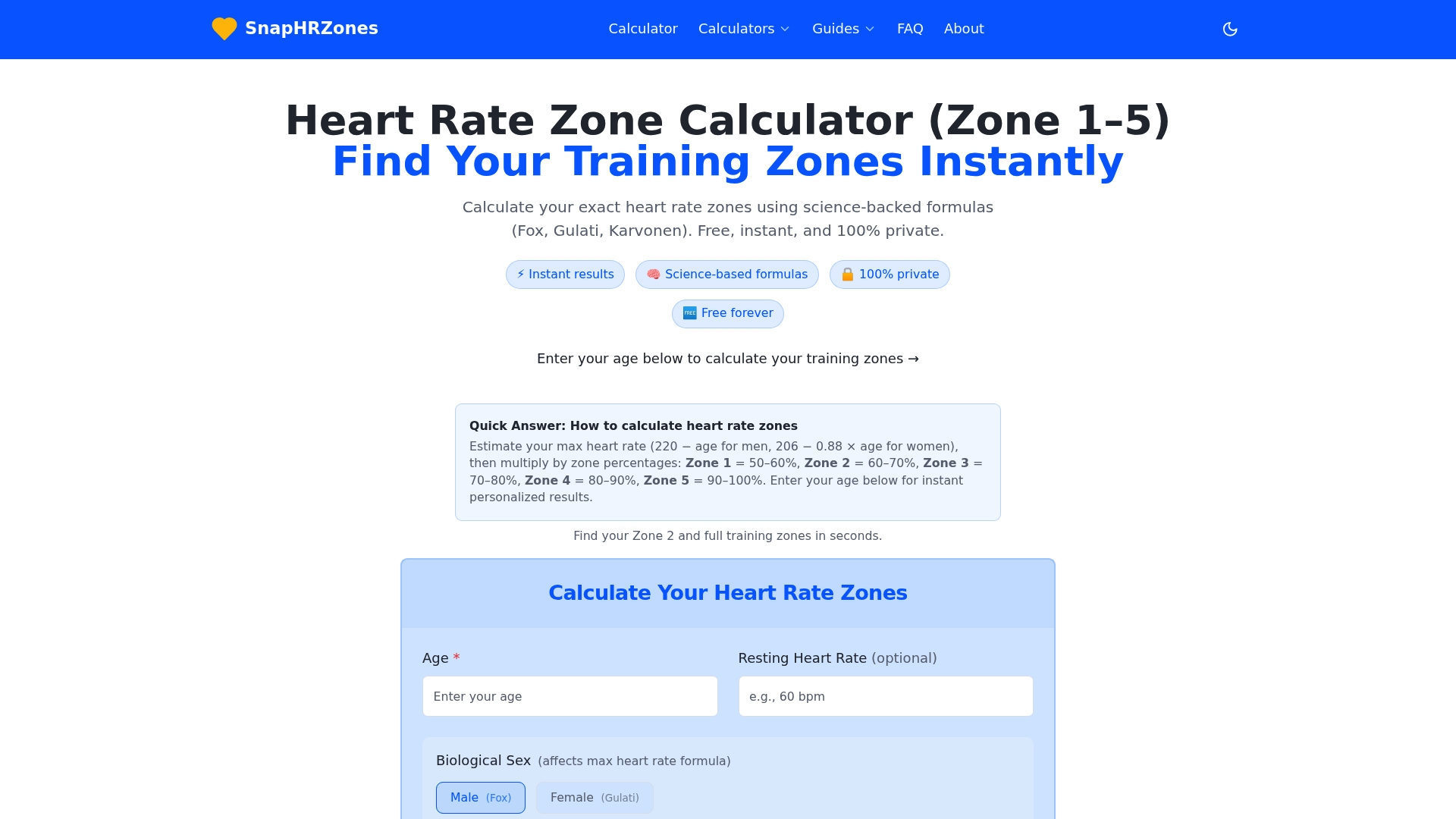
Formulas give estimates, not lab measurements, so use the ranges as a guide and adjust by how the effort feels.
How much do you need each week?
The common guideline for U.S. adults is 150 minutes of moderate-intensity activity or 75 minutes of vigorous activity a week. Geisinger states the equivalent as 150 minutes of brisk walking or 75 minutes of running weekly. The preventive cardiology statement lists walking, tennis and jogging regimens that each meet its minimum of 500 MET-minutes a week for effective exercise.

The weight-focused meta-analysis points in the same direction: benefits kept accumulating up to 300 minutes a week of aerobic exercise, and at least 150 minutes at moderate intensity or higher may be needed for meaningful waist and body-fat changes.
For a runner, that means most training weeks already exceed the minimum. The decision is less about whether you get enough and more about how to distribute the load.
Which should you choose? A quick guide
| Your situation | A reasonable starting point |
|---|---|
| Short on time, healthy joints | Running covers more energy expenditure per minute |
| Plenty of time, want low impact | Brisk or incline walking |
| Returning from injury or a layoff | Comfortable walking first; add run-walk intervals gradually when appropriate or cleared by your clinician |
| Heavy training week | Walks for recovery and easy volume |
| Significant joint damage or arthritis | Walking, after talking with your doctor |
| Triathlete building base | Mix of easy runs, bike and walks, guided by heart rate |
The most reliable advice comes from the same source: choose an activity you enjoy and can sustain. Consistency beats the perfect mode.
FAQ
Is running or walking better for you?
Running is more time-efficient and burns more energy per minute. Walking is gentler and, at matched energy expenditure, was linked to similar reductions in heart disease risk factors in one large cohort. The better choice depends on your time, joints, goals and what you will keep doing.
Can walking replace running for a runner?
Walking can supply easy aerobic volume and recovery, so it can replace some runs, such as an easy day or a recovery day. It does not provide the same high-intensity stimulus, so if you are training for a race, keep the key sessions that match your goal.
Is running better than walking for weight loss?
In one observational study, running was associated with greater weight loss per unit of energy expenditure, especially in heavier participants. Randomized trials also show that brisk walking, done for about three hours a week, can reduce weight and waist size. Total weekly exercise and eating habits matter a great deal.
Does running damage your knees more than walking?
Running has higher peak knee forces and a higher overall injury rate. But one biomechanics study found the load per unit of distance was similar. Higher peak forces are not proof that running causes osteoarthritis. If you have existing joint problems, check with your doctor and build up gradually.
How do I know if I am walking or running hard enough?
Heart rate zones provide an estimated starting range, not a physiological verdict. Pair them with the talk test and perceived effort, and choose an intensity that fits your fitness, symptoms and session purpose.
Sources
- Physical activity, cardiorespiratory fitness, and exercise training: American Society for Preventive Cardiology statement (2022)
- Comparison and predicted equation of energy expenditure in walking and running (2021)
- Walking vs. Running: Which Is Better for You? Cleveland Clinic
- Greater Weight Loss from Running than Walking during 6.2-yr follow-up (2013)
- Walking for Exercise, The Nutrition Source, Harvard T.H. Chan School of Public Health
- Aerobic Exercise and Weight Loss in Adults, JAMA Network Open (2024)
- Walking vs running for hypertension, cholesterol and diabetes risk reduction (2013)
- Walking and running produce similar reductions in cause-specific mortality in hypertensives
- Running vs. Walking, Geisinger (2024)
- Reaping the rewards of running, Harvard Health
- Physical activity-related injuries in walkers and runners (2000)
- Why Don’t Most Runners Get Knee Osteoarthritis? Medicine & Science in Sports & Exercise (2014)
- Running vs. walking: Which is right for you? Mayo Clinic Press (2025)
- Why Exercise Alone Won’t Cause Weight Loss
- Daily Recovery Routine for Athletes
Recommended
Find your personal heart rate zones
Enter your age to get all five training zones in seconds.
Open the heart rate zone calculator