Aerobic vs Anaerobic Exercise: Differences, Benefits and Examples
Quick answer: Aerobic exercise is steady, sustainable work where oxygen-based energy production dominates, such as brisk walking or easy cycling. Anaerobic exercise is short, hard work where faster non-oxygen pathways contribute much more, such as sprints or heavy lifting. All energy systems work together in every effort; intensity and duration shift the balance.

Aerobic and anaerobic exercise are not two separate switches. Your body always produces energy through several systems at once. "Aerobic" exercise is steady work where oxygen-based energy production clearly dominates, so you can keep it up for a long time: brisk walking, easy running, steady cycling. "Anaerobic" exercise is short, hard work where faster, non-oxygen pathways contribute much more: sprints, hard intervals and heavy lifting. Most fitness plans use both.
This guide compares the two as practical types of training. For the cell biology behind energy production, see what is aerobic respiration; for hard-effort training in depth, see our guide to anaerobic exercise.
TL;DR
- All three energy systems (phosphagen, glycolytic and oxidative) work at the same time. Intensity, duration, recovery and your own physiology shift how much each contributes.
- Aerobic-dominant exercise is steady and sustainable; exercise with a larger anaerobic contribution is hard and short.
- Even a short all-out effort has an aerobic contribution, and high-intensity intervals are not purely anaerobic.
- Lactate is not a waste product that causes fatigue on its own; muscles, the heart and other tissues use it as fuel.
- Adults are advised to get 150 to 300 minutes of moderate or 75 to 150 minutes of vigorous aerobic activity a week, plus muscle-strengthening on at least two days.
Table of Contents
- What the difference actually is
- Side-by-side comparison
- Practical examples
- What each type does for you
- Telling them apart while you train
- How much of each?
- Adding harder work without overdoing it
- Safety: who should be careful with hard efforts
- Putting your numbers to work
- FAQ
- Sources
What the difference actually is
The words mean "with oxygen" and "without oxygen," but in exercise they describe which energy pathways dominate, not whether oxygen is present. During aerobic-dominant work your muscles break down carbohydrate and fat using oxygen, a process that is slower to ramp up but can continue for hours. During very intense work your muscles also lean heavily on faster pathways that do not need oxygen directly. That happens because energy is demanded faster than oxygen-based production alone can supply it, not simply because the body "runs out of oxygen."
Carbohydrate feeds both routes: it can be broken down fully with oxygen, or partly through glycolysis for quick energy. Fat is used almost entirely through oxygen-based pathways.
Three energy systems, working together
Exercise physiologists describe three energy systems:
- Phosphagen (ATP-PC): stored high-energy phosphates for the fastest, most explosive efforts.
- Glycolytic: rapid breakdown of carbohydrate, contributing heavily during hard efforts lasting seconds to a few minutes.
- Oxidative (aerobic): oxygen-based production from carbohydrate and fat, dominant in longer, steadier work.
These systems do not take turns. A classic review by Gastin (2001) showed that they interact during all maximal exercise and that the aerobic system contributes earlier and more than older textbook timelines suggested. A 2026 systematic review of maximal exercise reached a similar conclusion: both aerobic and anaerobic contributions are present together, and their relative share shifts with intensity and duration. Exact percentages vary with the athlete, the test and the method used to estimate them, so this guide does not give fixed time boundaries.
Bar length shows the oxidative share only as a rough qualitative impression. It is not a measured percentage and not a universal time boundary.
Side-by-side comparison
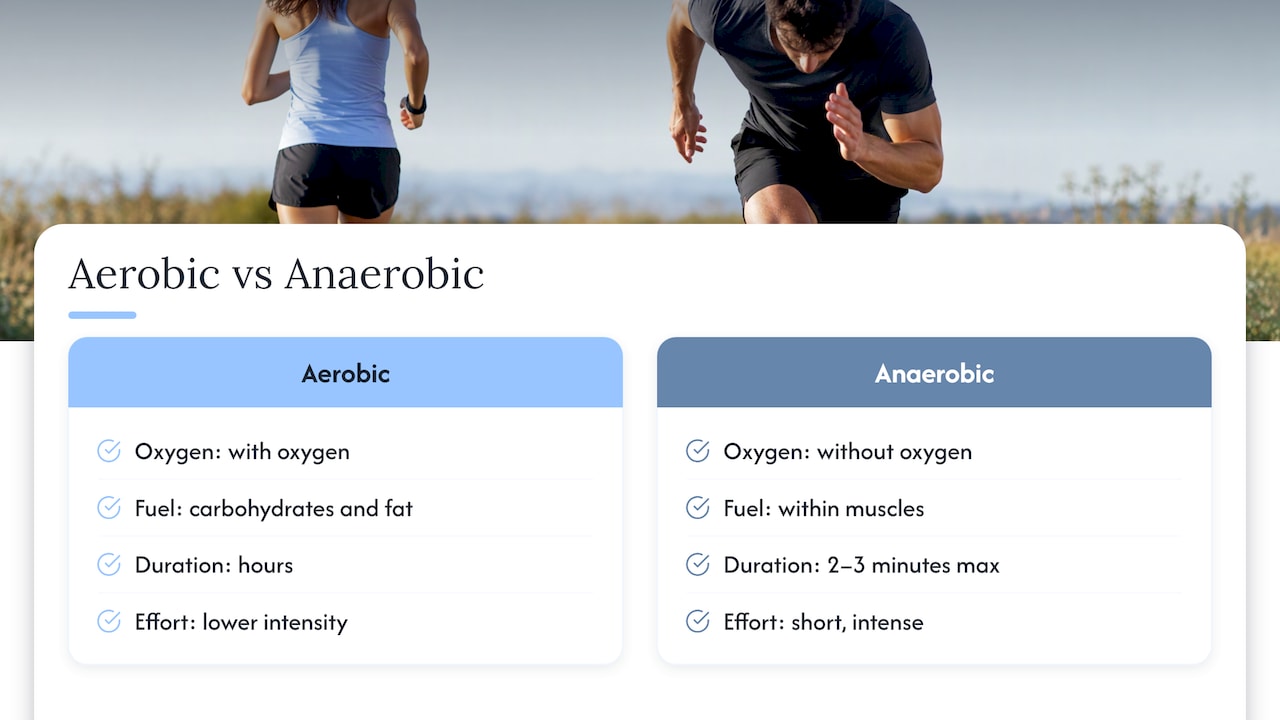
| Feature | Aerobic-dominant exercise | Greater anaerobic contribution |
|---|---|---|
| Energy production | Mainly oxidative, from carbohydrate and fat | Phosphagen and glycolytic pathways contribute much more, alongside aerobic |
| Typical intensity | Light to moderate, sometimes steady-hard | Hard to all-out |
| Practical duration examples | Often 20 minutes to several hours | Often a few seconds to a few minutes per effort, repeated with rest |
| Perceived effort | Comfortable to somewhat hard | Very hard; difficult to sustain |
| Talk test | You can speak in sentences | A few words at most |
| Exercise examples | Brisk walking, easy running, steady cycling, swimming | Sprints, hill repeats, hard intervals, heavy resistance training |
| Training adaptations | Heart and blood vessel fitness, endurance, more mitochondria | Speed, power, high-intensity tolerance, muscle strength |
| Recovery needs | Usually short; easy sessions can be frequent | Longer; hard sessions are usually spread across the week |
Durations are practical examples, not physiological boundaries between systems.
Practical examples
- Brisk walking: aerobic-dominant; easy to sustain and a good entry point for most adults.
- Steady cycling: aerobic-dominant at a pace you can hold while talking.
- Swimming: steady laps are aerobic-dominant; hard 25 or 50 m repeats add a large anaerobic contribution.
- Easy running: aerobic-dominant; the backbone of most running plans.
- Short sprints: large phosphagen and glycolytic contribution, with aerobic metabolism still active and driving recovery between efforts.
- Hill repeats: substantial contributions from both; the share depends on how long and how hard each rep is.
- Resistance training: heavy sets lean on the phosphagen and glycolytic systems; recovery between sets is largely aerobic.
- Mixed-intensity intervals: for example 4 × 4 minutes hard; these are high-intensity, not purely anaerobic, and draw heavily on aerobic capacity.
What each type does for you
Aerobic: the base
Runner’s World describes aerobic running as the endurance base that lets you run longer and helps you save muscle glycogen, the carbohydrate stored in your muscles, for later in a race. Mass General Brigham adds that for long-distance runners, aerobic training helps raise aerobic capacity and the intensity you can sustain. For a deeper look at how this builds over time, see our guide to cardiovascular endurance and our practical notes on how to increase stamina for running and triathlon.
Anaerobic: the efficiency
Anaerobic sessions are about how efficiently and powerfully you run. Triathlete lists top-end tolerance and fast-twitch muscle fiber development among the benefits. Runner’s World coach Gaudette frames the balance this way: aerobic work builds the base so you can go longer, anaerobic work improves the efficiency at which you run, and improving both allows steady progress. Our page on anaerobic exercise goes further into what counts, and our HIIT workouts for runners and triathletes give practical sessions.

Telling them apart while you train
You do not need a lab. Triathlete says swimmers, cyclists and runners can judge aerobic versus anaerobic effort using heart rate, pace or power, or perceived exertion. For running, conversational pace is a good aerobic cue: if you can speak in full sentences, you are most likely in aerobic territory.
Heart rate adds an objective check, which helps because easy runs have a habit of drifting harder. Runner’s World puts Zone 2, the easy aerobic zone, at roughly 60 to 70 percent of maximum heart rate. Maximum heart rate varies between people, and a common estimate of 220 minus age is only a convenient starting point, as one conditioning text notes. Treat any estimate as a range to refine by feel, not a fixed line.
Heart rate zones are estimates, not the boundary between aerobic and anaerobic energy production. Lactate thresholds (measured from blood samples) and ventilatory thresholds (measured from breathing) are lab markers of how metabolism changes as intensity rises; heart rate zones only approximate where those markers sit for an individual.
Why heart rate is less useful for short intervals: heart rate lags behind effort and often needs a minute or more to rise. During a 20-second sprint or a 30-second hill rep, your heart rate may still be climbing when the rep ends, so judge very short efforts by pace, power or perceived effort instead.
Here is a quick way to use it:
- Estimate your maximum heart rate, or use a recent hard effort if you have one.
- Calculate your zones. Our calculator uses gender-specific formulas and accepts an optional resting heart rate for more personalization.
- Do most runs in the lower zones, where you can still talk.
- Reserve the top zones for planned intervals and judge them by heart rate and effort together.
If you want zones matched to your sport, our heart rate zones for running guide lays out each one. For a quick look at the easy zone, try your Zone 2 range. The middle ground between easy and hard also deserves attention: the triathlete 80/20 approach warns that too much moderate “junk” training is a common trap, and we cover when it can be useful in Zone 3 training.
How much of each?
There is no single correct split. Reference points from coaching and research:
- 80/20 training: many endurance athletes spend most of their training at low intensity and a smaller share hard. This is one well-studied approach, not a universal rule.
- Time vs. sessions: an "80/20" split can be counted by training time or by number of sessions, and the two give different weeks. A plan with two hard sessions out of ten can still have well under 20 percent of total time at high intensity.
- Your context: goals, schedule, training history and recovery all shift the balance.
Public health baselines
For general health, WHO and the CDC advise adults to get at least 150 to 300 minutes of moderate-intensity or 75 to 150 minutes of vigorous-intensity aerobic activity per week, or an equivalent combination, plus muscle-strengthening activities on at least two days a week. Strength work is easy to overlook, and our full-body strength workouts for runners and triathletes fit around endurance training.
Adding harder work without overdoing it
Build consistency with easy, aerobic-dominant training before adding much hard work. How long that takes depends on your history; some people add short strides within weeks, while beginners preparing for a first long race often spend longer on easy volume. Coaching suggestions such as "a month" or "two to three months" of base are examples, not physiological requirements.
When you add harder sessions, start with one per week, surround it with easy days, and change one variable at a time, such as adding a repetition or slightly shortening rest. Mass General Brigham suggests doing anaerobic training on its own day and aerobic training after strength work or on a separate day.
An illustrative week for a runner who already trains consistently (adapt it to your sport, schedule and recovery):
| Day | Session |
|---|---|
| Monday | Rest or easy recovery run |
| Tuesday | One interval session, such as 400-meter repeats |
| Wednesday | Easy aerobic run |
| Thursday | Strength work or cross-training |
| Friday | Easy run, optional short strides |
| Saturday | Long, easy aerobic run |
| Sunday | Rest or recovery |
That is an illustration, not a prescription. Swap in your own pace and distances.
When the load increases, give your body room to adapt. A well-structured running injury prevention plan covers how to ramp up gradually and recover between harder sessions. If you notice persistent fatigue, a rising resting heart rate or flat performance, review our list of signs of overtraining in runners.
Safety: who should be careful with hard efforts
For most healthy adults, the health benefits of regular exercise far outweigh the risks. Vigorous efforts place more demand on the heart than easy activity, though, and the risk of an acute cardiac event during exercise is higher in people with undiagnosed or known heart disease, especially when they are not used to hard exercise.
- Mass General Brigham advises checking with a physician before starting conditioning if you have heart issues, which may make high intensity unsafe or call for lower intensity.
- The American Society for Preventive Cardiology's 2022 clinical practice statement notes that vigorous activity is associated with a transiently higher risk of acute cardiac events, mainly in people who are not regularly active.
- A 2019 review of high-intensity interval training advises caution with all-out sprint intervals in people with cardiovascular disease.
If you have known heart disease, high blood pressure, chest pain, unexplained breathlessness, fainting or a family history of sudden cardiac death, talk to a physician before adding intense intervals. Stop exercising and call 911 or your local emergency number if you have chest pain, faint, or feel severely short of breath.
Putting your numbers to work
Knowing the difference between aerobic and anaerobic effort only helps if you can feel it in your own body. Our Heart Rate Zone Calculator is free and takes a few inputs: your age and sex, plus an optional resting heart rate for more personalized zones. It gives you the ranges that separate easy aerobic running from harder efforts, so you can hold back on easy days and know what hard really means on interval days.

If you want a quick reference by age, our Zone 2 pages show sample ranges, such as 28-year-olds and 52-year-olds. These are formula-based estimates, and your own fitness and a conversation test should guide the final call.
FAQ
Is running aerobic or anaerobic?
Both systems contribute to all running. Easy and long runs are strongly aerobic-dominant. Sprints, hill repeats and short hard intervals add a much larger anaerobic contribution, and races fall in between depending on distance and pace.
Can a workout be both aerobic and anaerobic?
Yes, every workout is. The energy systems operate together, and intensity and duration shift which leads. A tempo run, a hilly long run or a race with surges all draw clearly on both.
Which is better, aerobic or anaerobic exercise?
Neither. They do different jobs. Aerobic-dominant training builds endurance and heart health; harder efforts build speed, power and strength. Health guidelines recommend aerobic activity plus muscle-strengthening work.
Does lactic acid cause muscle fatigue?
Not on its own. Hard exercise produces lactate, which many tissues use as fuel. Fatigue during intense work comes from several factors together, including changes in the muscle environment and energy supply.
How many hard workouts should I do per week?
Many plans use one or two, separated by easy days, but the right number depends on your goals, history and recovery. See a physician first if you have heart concerns.
Sources
- Triathlete: What’s the Difference Between Aerobic and Anaerobic?
- Cleveland Clinic: Metabolic Pathways & Metabolic Conditioning
- The Basic Energy Systems, The Physiology of Exercise
- Mass General Brigham: How to Build Endurance Through Conditioning
- Runner’s World: Aerobic vs Anaerobic
- Conditioning and Training Programs for Athletes/Nonathletes
- ASPC clinical practice statement on physical activity and cardiorespiratory fitness
- High-intensity interval training for health benefits
- Gastin PB. Energy system interaction and relative contribution during maximal exercise. Sports Med. 2001 (PubMed)
- Anaerobic and Aerobic Energy System Contribution During Maximal Exercise: a systematic review, 2026 (PubMed)
- Physical activity fact sheet (World Health Organization)
- Adult Activity: An Overview (CDC)
Recommended
Find your personal heart rate zones
Enter your age to get all five training zones in seconds.
Open the heart rate zone calculator